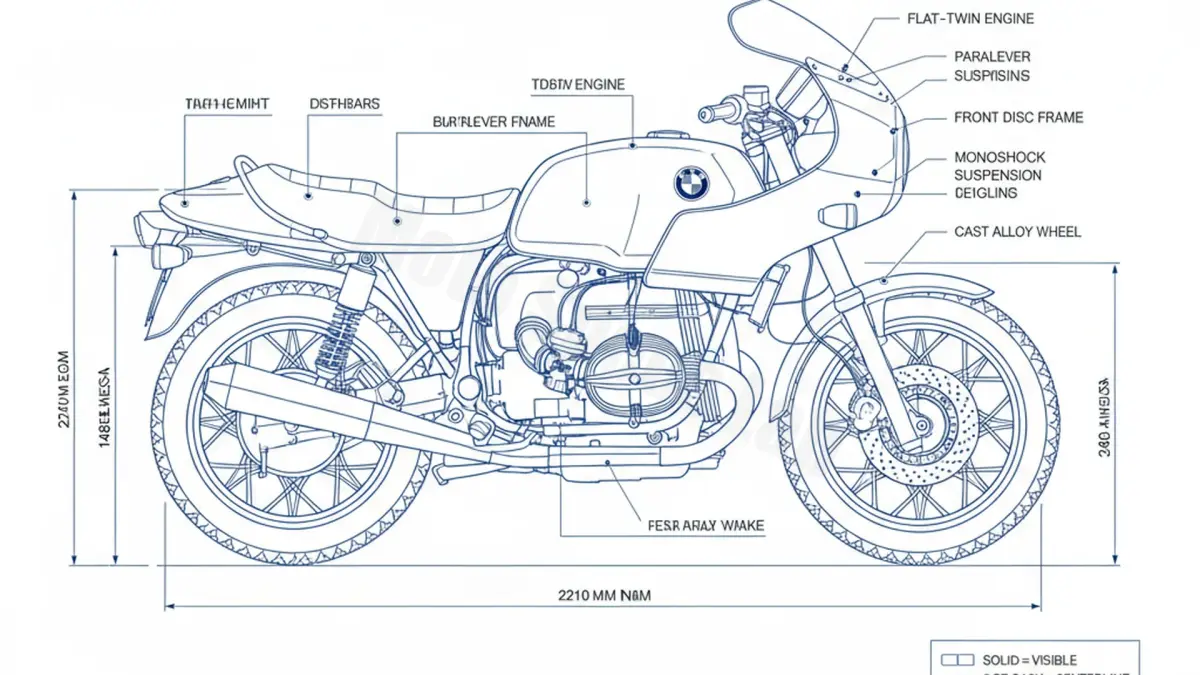
The 1981 BMW R 100 RS represents a pivotal moment in motorcycle engineering: it was the first iteration of the legendary sport-tourer to receive ‘Nikasil’ (Nickel Silicon Carbide) cylinder coatings. This aerospace-derived technology significantly reduced friction and oil consumption while extending the engine’s lifespan, cementing the ‘Airhead’ boxer’s reputation for bulletproof reliability.
| Quick Specs: BMW R 100 RS (1981-1984) | |
|---|---|
| Engine Type | Air-cooled, 4-stroke Boxer Twin |
| Engine Oil | SAE 20W-50 Mineral (API SF/SG) – 2.5 L |
| Tires (Front/Rear) | F: 3.25 H 19 / R: 4.00 H 18 |
| Tire Pressure | F: 2.2 bar (32 psi) / R: 2.5 bar (36 psi) |
| Battery | DIN 52515 (12V 25Ah) |
| Spark Plugs | Bosch W7DC / NGK BP6ES (Gap: 0.6mm) |
Engineering Evolution: The 1981 Refinement
While the R 100 RS was originally launched in 1976 with its iconic Pininfarina-designed wind tunnel fairing, the ’81 model (R100RS/81) introduced critical mechanical updates. Beyond the Nikasil cylinders, this era saw the replacement of the heavy ATE swinging-caliper brakes with more efficient Brembo dual-piston calipers. This change corrected one of the few criticisms of the early models: braking modulation and power.
Performance & Handling
The R 100 RS is not a sportbike in the modern sense, but a high-speed gran turismo. The 980cc boxer engine delivers a flat torque curve that allows for effortless cruising at 100 mph. The frame-mounted fairing provides exceptional weather protection, though it requires a disciplined rider to manage the ‘tucking’ effect at high speeds. The 1981 update also improved the clutch mechanism, making the heavy flywheel transition smoother during downshifts.
Maintenance Protocols
For the R100RS/81, maintenance is straightforward but non-negotiable for longevity. The SAE 20W-50 Mineral oil is vital; modern synthetic oils are often too ‘thin’ for the tolerances of these vintage seals and can lead to leaks. Valve clearances should be checked every 5,000 miles to ensure the pushrod-actuated overhead valves remain within spec.
Ignition and Electrical
The 1981 models utilized an electronic ignition system, which removed the need for point adjustments. However, the DIN 52515 battery must be kept at a full charge to ensure the Bosch starter motor engages reliably. Using Bosch W7DC or NGK BP6ES plugs with a precise 0.6mm gap is critical for maintaining the lean-burn efficiency of the Bing constant-velocity carburetors.
Frequently Asked Questions
What is the oil capacity of the R 100 RS?
The total oil capacity for the engine is 2.5 liters. MotoSpecsLab recommends using a high-quality mineral oil with zinc additives (ZDDP) to protect the flat-tappet camshaft.
What are the factory tire specifications?
The R100RS/81 uses a 3.25 H 19 front tire and a 4.00 H 18 rear tire. Maintaining the correct pressures of 2.2 bar (front) and 2.5 bar (rear) is essential for stable high-speed tracking.