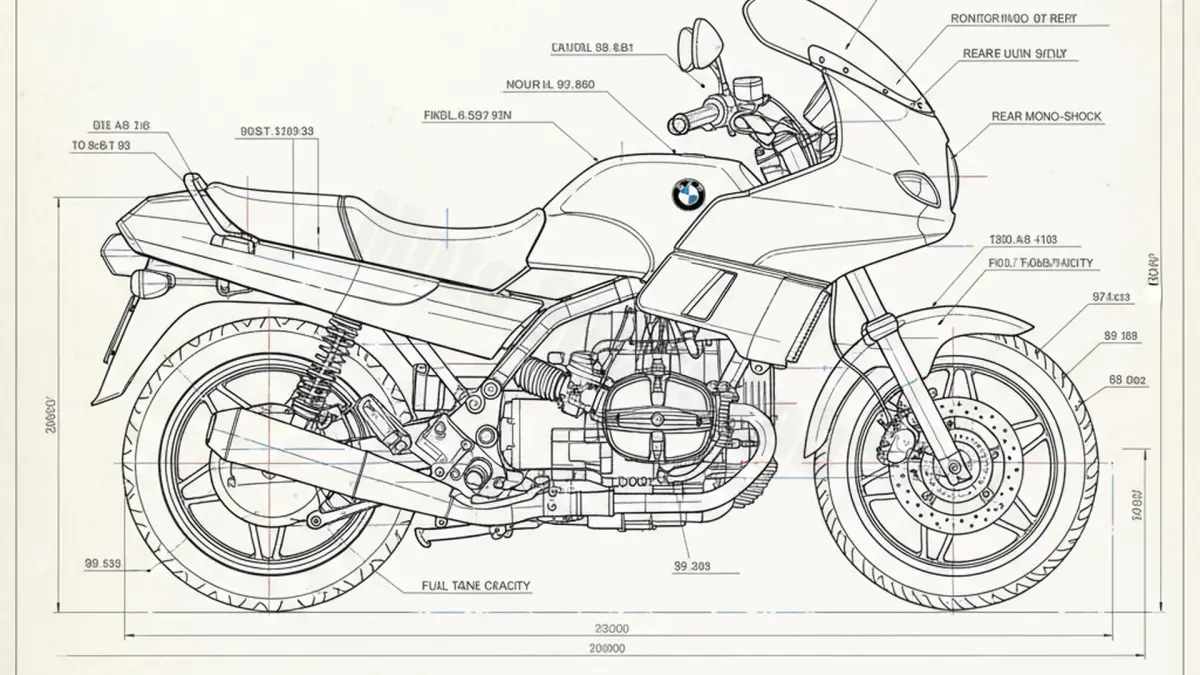
| Attribute | Specification |
|---|---|
| Model Range | BMW K 100 RS/RT (2-Valve) – K100RS/RT |
| Production Years | 1983 – 1989 |
| Engine Oil | SAE 20W-50 API SF/SG (3.75 L) |
| Tire Dimensions | F: 100/90 V 18 / R: 130/90 V 17 |
| Spark Plugs | Bosch X5DC |
| Battery | 12V 25Ah (525 15) / 12V 30Ah (530 30) |
Engineering Highlight: The Birth of the ‘Flying Brick’
The BMW K 100 series represents one of the most significant engineering pivots in motorcycling history. To circumvent the emissions and performance limitations of the aging Boxer twin in the early 1980s, BMW developed the ‘Compact Drive System’. The K 100 was the first production motorcycle to feature a longitudinal inline-four engine laid horizontally on its side at a 90-degree angle. This unique configuration, colloquially known as the ‘Flying Brick’, lowered the center of gravity significantly and allowed for the first mass-market application of electronic fuel injection (Bosch LE-Jetronic) on a motorcycle.
Technical Review: RS vs. RT Variants
The 2-valve (2-Ventiler) K 100 series was offered in several configurations, with the RS (Reisesport) and RT (Reisetourer) being the most prominent. The 987cc liquid-cooled engine delivers linear power, emphasizing torque over peak horsepower, making it an exceptional long-distance platform. The RS featured a sport-touring fairing with a distinctively aggressive stance, while the RT offered a full touring fairing with a taller windscreen and integrated luggage capabilities for trans-continental travel.
The chassis utilized a space-frame design where the engine acted as a stressed member, paired with the Monolever single-sided swingarm. While heavy by modern standards, the stability of the K 100 at high speeds remains legendary among enthusiasts.
Maintenance Guide & Technical Data
Engine Lubrication
For the 2-valve K 100 engine, high-zinc mineral oils are generally preferred to protect the flat-tappet valve train. The specification is SAE 20W-50 API SF/SG. A full oil and filter change requires 3.75 liters. Avoid modern ‘Energy Conserving’ oils which may cause issues with the dry clutch if seals fail.
Tires and Pressures
Maintaining correct tire pressure is critical for the K 100’s handling, as the bike is sensitive to ‘cupping’ on the front tire.
- Front (100/90 V 18): 2.2 bar (32 psi) Solo / 2.5 bar (36 psi) Loaded.
- Rear (130/90 V 17): 2.5 bar (36 psi) Solo / 2.9 bar (42 psi) Loaded.
Electrical System
The K 100 requires a high-capacity battery to turn over the large automotive-style starter motor. Depending on the equipment level (radio, heated grips), use either a 25Ah (525 15) or a 30Ah (530 30) battery. For ignition, the Bosch X5DC spark plugs are the factory-standard and provide the most consistent combustion profile for the LE-Jetronic system.
Frequently Asked Questions
Q: Why does my K 100 smoke on startup?
A: Because the engine lies on its side, oil can seep past the piston rings into the combustion chamber if left on the side stand. Using the center stand usually prevents this.
Q: How often should I spline lube the driveshaft?
A: It is highly recommended to clean and lubricate the drive splines with a high-moly paste every 20,000 to 40,000 km to prevent premature wear.