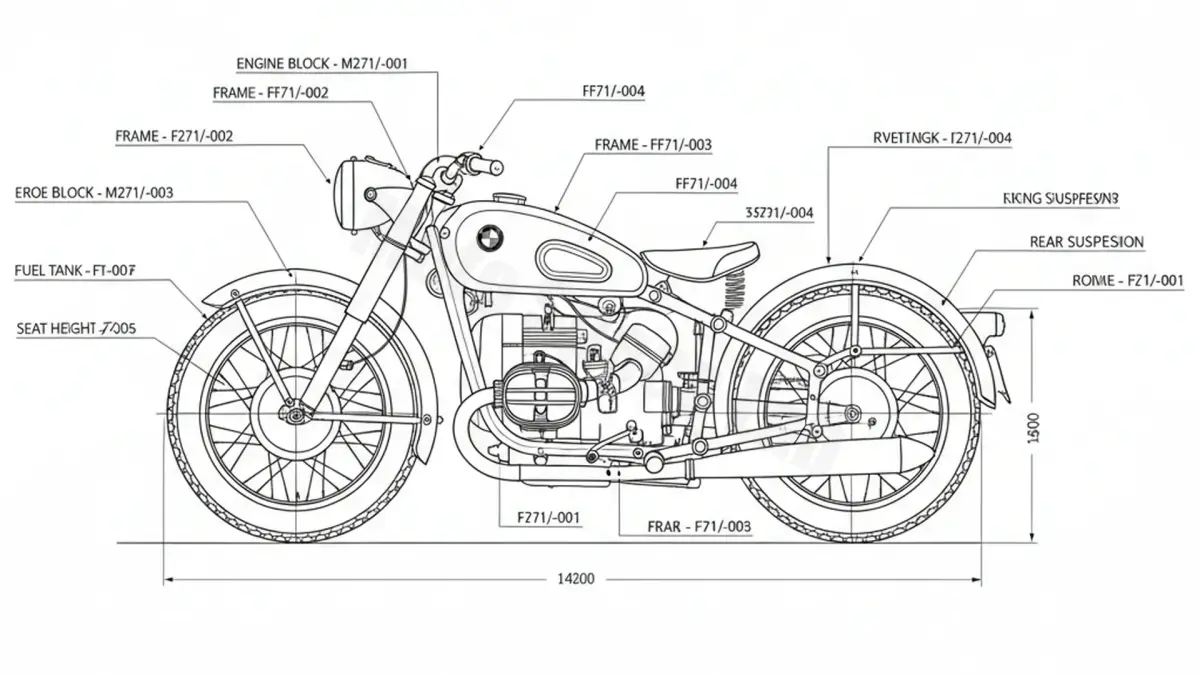
| Quick Specs: BMW R 71 (0271/1) | |
|---|---|
| Production Years | 1938 – 1941 |
| Engine Type | 746cc Side-Valve (SV) Opposed Twin |
| Oil Type | SAE 40 (Summer) / SAE 20 (Winter) |
| Oil Capacity | 2.0 L |
| Tire Size | F/R: 3.50 x 19 |
| Tire Pressure | F: 1.2 bar / R: 1.5 bar |
| Electrical | 6V 8Ah (Bosch B 142) |
| Spark Plug | Bosch W 175 T1 |
The BMW R 71 holds a singular place in motorcycling history: it was the final heavy-duty side-valve (SV) touring model produced by BMW, and its design was so robust that it served as the direct blueprint for the Soviet IMZ-Ural M-72 and the Chinese Chang Jiang CJ750, keeping its engineering DNA in production for over 80 years.
Engineering Overview
Introduced in 1938 alongside the R 51, R 61, and R 66, the R 71 was designed for high-torque touring and sidecar duty. While its overhead-valve (OHV) siblings focused on performance, the R 71 utilized a 746cc side-valve engine producing 22 hp. This engine was prized for its reliability and ease of maintenance in the field.
Technically, the R 71 was a bridge between eras. It featured the revolutionary plunger rear suspension and telescopic front forks, providing a level of comfort that far surpassed the rigid-frame R 12 it replaced. The frame itself was constructed from oval-section tubing, a hallmark of BMW’s commitment to torsional rigidity.
Maintenance Guidelines
1. Lubrication System
The R 71 relies on a high-pressure oiling system. Modern synthetic oils are generally discouraged for these vintage engines due to their detergent properties, which can dislodge decades of sediment and clog narrow oil passages. We recommend a high-quality non-detergent SAE 40 for summer operations and SAE 20 for colder climates. Total capacity is 2.0 liters; ensure the level is checked every 500km.
2. Electrical and Ignition
The 6V electrical system is centered around the Bosch B 142 (8Ah) battery. Given the age of these machines, grounding points (massenanschluss) should be inspected for corrosion. The Bosch W 175 T1 spark plug is the period-correct heat range; modern equivalents must be carefully gapped to ensure consistent combustion in the side-valve chambers.
3. Tires and Handling
The R 71 uses identical 3.50 x 19 tires for both front and rear. To maintain the intended handling characteristics, particularly the stability of the plunger rear end, pressures should be kept at 1.2 bar (17.4 psi) for the front and 1.5 bar (21.7 psi) for the rear. If a sidecar is attached, the rear pressure should be increased to 1.9 bar.
Expert Verdict
From the perspective of MotoSpecsLab, the BMW R 71 represents the pinnacle of pre-war side-valve engineering. It lacks the raw speed of the R 5, but its tractor-like torque and sophisticated (for the time) suspension make it one of the most rideable pre-war classics today. Collectors should prioritize machines with original Graetzin G 24 carburetors, as these are critical for the engine’s smooth idling characteristics.
Frequently Asked Questions
Q: Can I use modern 10W-40 oil?
A: It is not recommended. The R 71 lacks a modern filtration system; a straight-grade non-detergent oil is safer for the internal bearings.
Q: How does the R 71 differ from the Ural M-72?
A: While the designs are nearly identical, the BMW R 71 features higher-quality metallurgy in the crankcase and more refined casting techniques compared to early Soviet iterations.