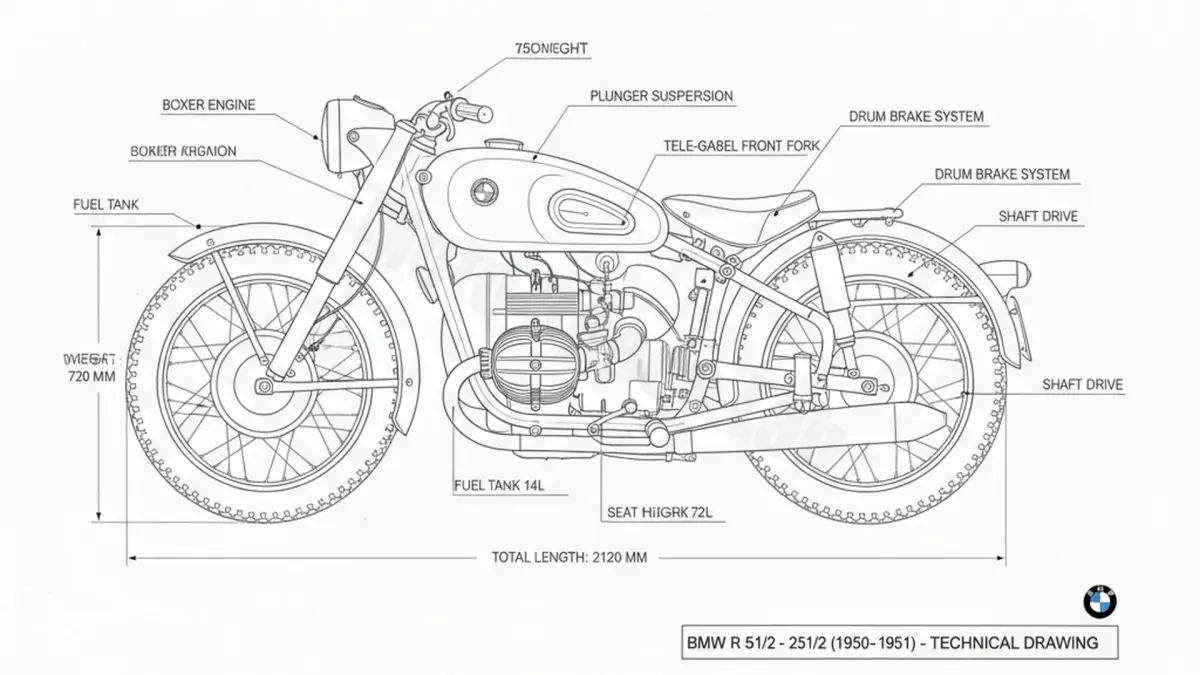
The BMW R 51/2 holds a unique position in motorcycling history as the first post-World War II horizontally-opposed twin-cylinder motorcycle produced by BMW. Emerging in 1950 after Allied restrictions on large-displacement engine production were lifted, the R 51/2 was a bridge between pre-war engineering and the refined touring machines of the 1950s. Notably, it was the only post-war model to utilize a gear-driven camshaft system, a complex and precise engineering choice that was replaced by chain drives in its successor, the R 51/3.
| Production Years | 1950 – 1951 |
|---|---|
| Engine Type | 494cc OHV Boxer Twin |
| Engine Oil | Mineral-based 20W-50 (2.0 L) |
| Tires (F/R) | 3.50 x 19 / 3.50 x 19 |
| Tire Pressure | Front: 1.2 bar (17.4 psi) / Rear: 1.5 bar (21.7 psi) |
| Electrical System | 6V 7Ah Battery |
| Spark Plug | Bosch W 240 T 1 (NGK B7HS) |
Technical Review: Engineering the Post-War Icon
The R 51/2 utilized a 494cc overhead valve (OHV) engine capable of producing approximately 24 horsepower. While it shared its frame and plunger rear suspension architecture with the pre-war R 51, the engine was a clean-sheet design (Type 251/2). The gear-driven camshafts provided exceptional timing accuracy but required meticulous setup. This model represents the pinnacle of BMW’s “transition” era, combining the classic aesthetics of the 1930s with improved metallurgy and manufacturing tolerances of the early 1950s.
The telescopic front forks and plunger rear suspension offered a level of comfort that was superior to many of its contemporaries, though by modern standards, the travel is limited and the damping is primitive. The 4-speed gearbox, operated via a foot lever (with a manual auxiliary lever on the side), is robust but requires a deliberate, slow shifting technique to avoid grinding.
Maintenance Guide & Technical Care
Lubrication System
The Boxer engine relies on a 2.0-liter oil capacity. It is critical to use mineral-based 20W-50 oil. Modern synthetic oils contain detergents and friction modifiers that can be too aggressive for the vintage cork and felt seals found in the R 51/2. Furthermore, synthetics may cause the centrifugal oil cleaners (slingers) to function less effectively, potentially leading to sludge buildup in the crankshaft journals.
Electrical & Ignition
Operating on a 6V system with a 7Ah battery, the R 51/2 requires a well-maintained charging system to ensure reliable starting. The Noris generator is generally reliable but sensitive to brush wear. For the spark plugs, the original Bosch W 240 T 1 specification is best cross-referenced to the NGK B7HS. Ensure the gap is set to 0.6mm (0.024″) for optimal combustion.
Chassis & Tires
The 19-inch wheels require 3.50-section tires. Due to the era’s rim design and the bike’s weight distribution, tire pressures are significantly lower than modern motorcycles. Maintaining 1.2 bar (17.4 psi) at the front and 1.5 bar (21.7 psi) at the rear is essential for both handling and protecting the vintage rims from impact damage.
Frequently Asked Questions
Can I upgrade the R 51/2 to a 12V system?
Yes, several aftermarket electronic ignition and 12V conversion kits exist. While this improves lighting and starting reliability, many collectors prefer the original 6V Noris setup for historical accuracy.
How often should the ‘oil slingers’ be cleaned?
Unlike modern bikes with spin-on filters, the R 51/2 uses centrifugal slingers. These typically require cleaning every 30,000 to 50,000 kilometers, which involves a significant engine teardown. Regular oil changes help extend this interval.
Is the R 51/2 suitable for modern highway speeds?
While the bike can reach speeds of 135 km/h (84 mph), its comfortable cruising speed is around 90-100 km/h. Sustained high-speed operation is not recommended due to the age of the components and the limitations of the plunger suspension.