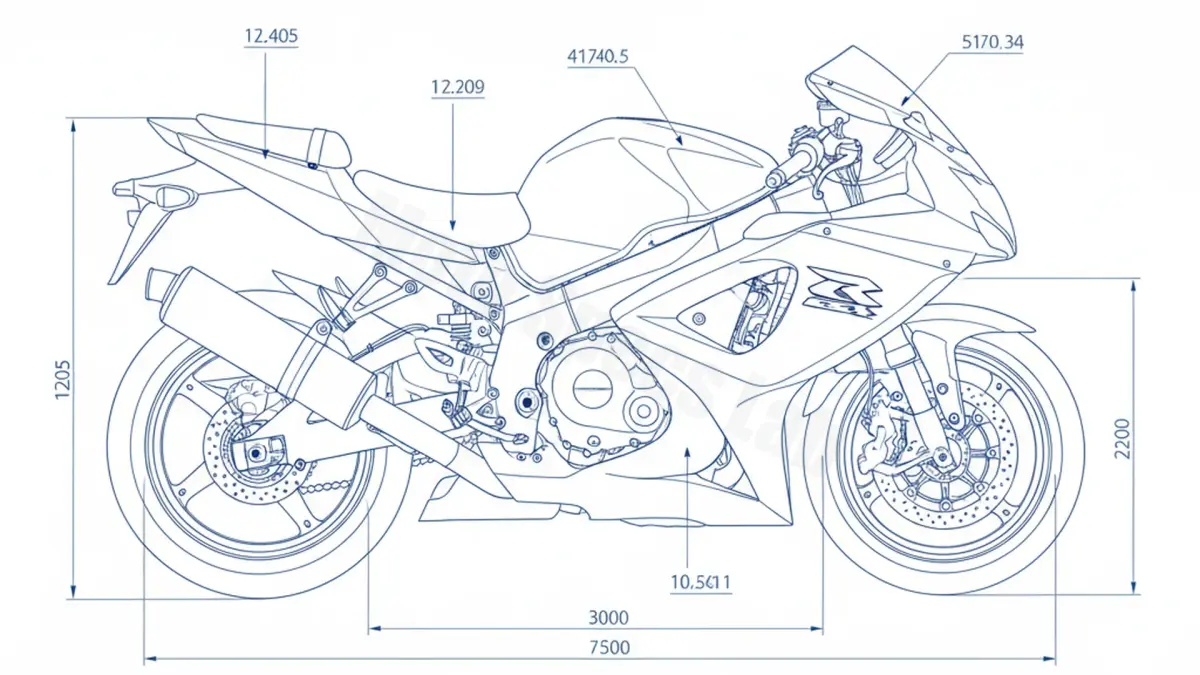
| Attribute | Specification |
|---|---|
| Production Years | 2004-2005 (K4/K5) |
| Engine Type | 749cc Inline-4, DOHC, 16-valve |
| Oil Type | SAE 10W-40 (JASO MA) |
| Oil Capacity | 2.5 Liters |
| Tire Size (F/R) | 120/70 ZR 17 / 180/55 ZR 17 |
| Spark Plugs | NGK CR9E / Denso U27ESR-N |
| Battery | YT12A-BS |
A pivotal engineering highlight of the Suzuki GSX-R 750 K4/K5 (WVB3) is its introduction of lightweight titanium valves and a 32-bit ECU, a significant technological leap that allowed the 750cc platform to remain relevant while competitors abandoned the displacement class. This specific generation is often cited by enthusiasts as the ‘sweet spot’ of the GSX-R lineage, offering the chassis agility of a 600cc machine with the mid-range torque of a liter-bike.
Technical Engineering Deep Dive
The WVB3 chassis represents a refined evolution in aluminum twin-spar design. By 2004, Suzuki engineers focused on mass centralization and weight reduction, resulting in a frame that was narrower and more rigid than the preceding K1-K3 models. The 749cc powerplant utilized double overhead cams and a high-compression ratio to deliver linear power delivery, managed by the Suzuki Dual Throttle Valve (SDTV) system which optimizes intake velocity.
Maintenance Guide & Fluid Specifications
Maintaining the K4/K5 requires precision to preserve its high-revving nature. The engine requires 2.5 Liters of SAE 10W-40 oil. It is critical to use oil meeting JASO MA standards to ensure the wet clutch operates without slipping. For ignition, the NGK CR9E or Denso U27ESR-N plugs are the factory-specified heat range.
Chassis and Safety Specs
- Tire Pressures: For optimal handling and tire longevity, maintain 2.5 bar (36 psi) in the front and 2.9 bar (42 psi) in the rear under standard load conditions.
- Electrical: The system relies on a YT12A-BS battery. Owners should monitor the regulator/rectifier, a known weak point in this era of Suzuki electronics, ensuring proper heat dissipation.
Expert Verdict
The GSX-R 750 K4/K5 remains a benchmark for analog sportbike performance. It lacks the complex rider aids of modern machinery, demanding—and rewarding—pure rider skill. From a maintenance perspective, it is a remarkably accessible machine for the home mechanic, provided the cooling system and valve clearances are inspected at the recommended intervals.
Frequently Asked Questions
Q: How often should I change the oil?
A: MotoSpecsLab recommends every 6,000 km (approx. 4,000 miles) or annually, whichever comes first, using a high-quality synthetic blend.
Q: Can I use a 190-section rear tire?
A: While possible, the 180/55 ZR 17 is the designed specification for the rim width. A 190 may slow down the turn-in response and alter the geometry.