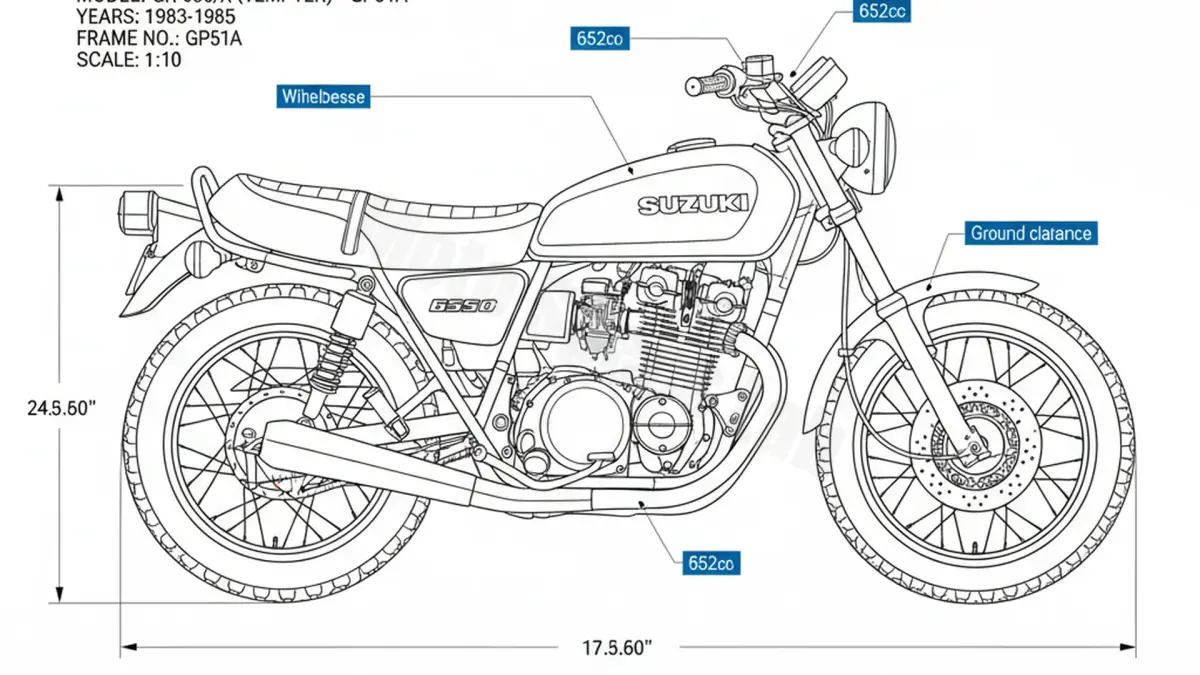
| Component | Specification |
|---|---|
| Production Years | 1983 – 1989 |
| Engine Oil | SAE 10W-40 (API SE/SF) (2.7 L) |
| Tires (Front/Rear) | F: 100/90-19 57H / R: 130/90-16 67H |
| Tire Pressure | F: 1.7 bar (25 psi) / R: 2.0 bar (28 psi) |
| Battery | YB12A-A |
| Spark Plug | NGK BPR6ES (0.7 – 0.8 mm gap) |
Engineering Highlight: The Variable Inertia Flywheel
The Suzuki GR 650 Tempter (GP51A) is a masterclass in mid-80s Japanese engineering, most notably for its unique two-stage centrifugal flywheel. Unlike conventional parallel twins that suffer from a compromise between low-end torque and high-end responsiveness, the GR 650 utilized a centrifugal weight system. At low RPMs, an auxiliary weight engaged to increase flywheel mass, smoothing out power delivery and enhancing low-end grunt. As RPMs climbed, the weight disengaged, allowing the engine to rev more freely—a sophisticated solution to the ‘standard’ motorcycle dilemma of the era.
Technical Overview
The GP51A is powered by a 651cc DOHC parallel twin, air-cooled engine. It was designed to bridge the gap between a traditional standard and a cruiser, often referred to in Japan as the ‘Tempter’. Its lightweight chassis (approx. 180kg dry) combined with the narrow engine profile made it exceptionally nimble compared to the heavier 4-cylinder competitors of the time. The 180-degree crankshaft provided a distinct exhaust note, while the Full Floater rear suspension offered a progressive ride quality that was ahead of its time.
Maintenance Guide
Lubrication System
To maintain the longevity of the DOHC valvetrain, regular oil changes are critical. The system requires 2.7 liters of SAE 10W-40. Given the air-cooled nature of the GP51A, we recommend using an oil that meets at least API SE or SF standards to handle the thermal loads. Ensure the oil filter is replaced every two oil changes to prevent sludge buildup in the narrow oil galleries.
Ignition & Electrical
The GP51A utilizes a YB12A-A battery. Frequent checks of the electrolyte levels (if using a conventional lead-acid unit) are necessary. For optimal combustion, the NGK BPR6ES spark plugs must be gapped precisely between 0.7 and 0.8 mm. A wider gap can lead to high-speed misfires, while a narrower gap may cause poor idling.
Chassis & Tires
Stability on the Tempter is highly sensitive to tire pressure. The factory recommended pressures are 1.7 bar (25 psi) for the front and 2.0 bar (28 psi) for the rear. Given the 19-inch front and 16-inch rear configuration, maintaining these pressures is vital for predictable cornering transition, particularly given the bike’s ‘cruiser-standard’ geometry.
Frequently Asked Questions (FAQ)
Q: What is the total oil capacity for a dry fill?
A: While a standard change is approximately 2.7L, a completely dry engine (after rebuild) may require slightly more; always refer to the sight glass after a brief warm-up period.
Q: Can I use modern synthetic oil in the GR 650?
A: Yes, provided it is JASO-MA rated to ensure the wet clutch does not slip. However, the original API SE/SF mineral or semi-synthetic specs are perfectly adequate for the engine’s design.
Q: Why does my GR 650 feel sluggish at low speeds?
A: This is often due to the centrifugal flywheel mechanism sticking or carburetor synchronization issues. Ensure the mechanical advance and flywheel weights are moving freely.