| Specification | Data |
|---|---|
| Production Years | 1978 – 1982 |
| Engine Oil | SAE 10W-40 (API SE or SF) |
| Oil Capacity | 2.6 L (with filter change) |
| Tire Size (Front) | 3.25 H 19 |
| Tire Size (Rear) | 3.75 H 18 |
| Tire Pressure (F/R) | 1.72 bar (25 psi) / 1.93 bar (28 psi) |
| Battery | YB10L-A2 |
| Spark Plug | NGK B8ES (Gap: 0.6 – 0.7 mm) |
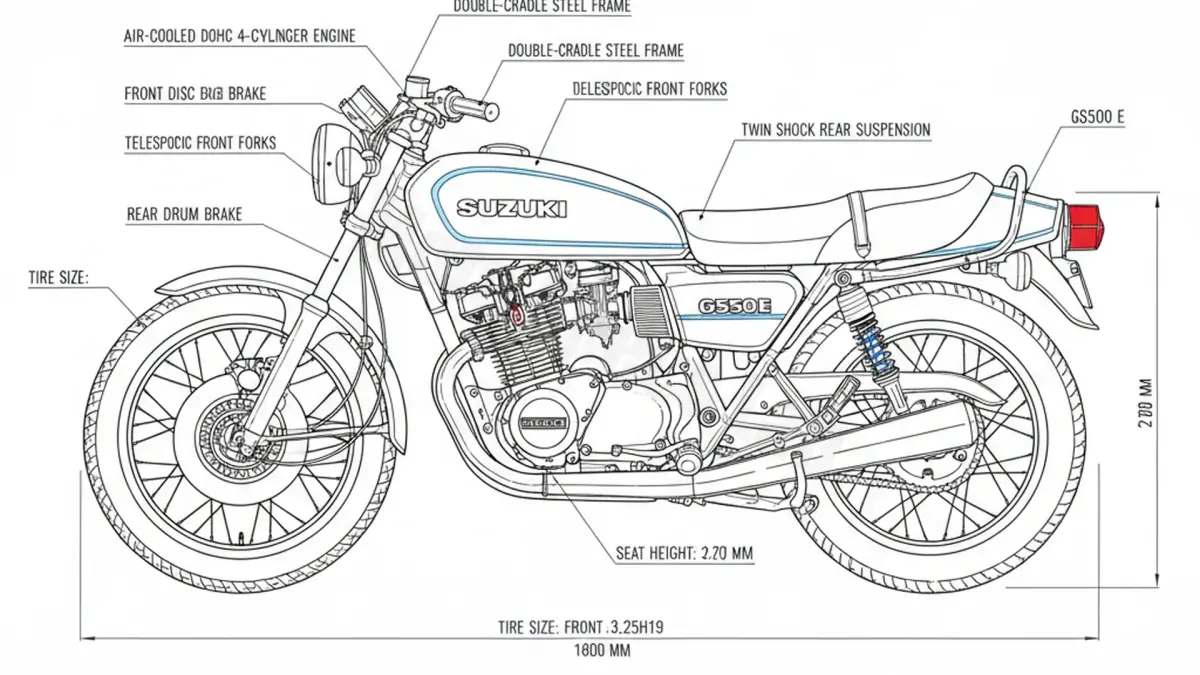
While many middleweight competitors of the late 1970s relied on single overhead cam (SOHC) configurations, the Suzuki GS 550 E distinguished itself by incorporating a sophisticated Double OverHead Cam (DOHC) valvetrain. This engineering choice not only provided superior high-RPM stability but also established the GS series as the benchmark for reliability in the Universal Japanese Motorcycle (UJM) era.
Engineering Excellence: The DOHC Middleweight
The GS 550 E was engineered during a pivotal moment in Suzuki’s history. Transitioning from two-stroke dominance to four-stroke precision, Suzuki utilized a bulletproof bottom end with a roller-bearing crankshaft. The 549cc inline-four engine delivers a smooth, linear power band that remains remarkably relevant for modern vintage enthusiasts. Its DOHC setup allows for more precise valve timing compared to its contemporaries, resulting in a machine that is as comfortable at highway speeds as it is agile in urban environments.
Maintenance Essentials
To maintain the high-authority performance of the GS550E, adherence to technical fluid specifications is critical. The engine utilizes a wet-sump lubrication system requiring 2.6 liters of SAE 10W-40 oil when the filter is replaced. For vintage engines of this era, MotoSpecsLab recommends using oils with adequate zinc content (ZDDP) to protect the cam lobes, ensuring they meet at least the API SE or SF standards.
Ignition and Electrical System
The ignition system relies on NGK B8ES spark plugs. For optimal combustion efficiency and throttle response, the electrode gap must be precisely set between 0.6 and 0.7 mm. Electrical stability is provided by the YB10L-A2 battery, which must be kept at a full charge to prevent strain on the vintage charging system—a known sensitive point in early GS models.
Chassis and Handling
The GS 550 E features a traditional steel cradle frame paired with telescopic forks and twin rear shocks. Handling characteristics are heavily dependent on maintaining correct tire pressures. For the standard 19-inch front and 18-inch rear wheel setup, Suzuki specifies 25 psi (1.72 bar) for the front and 28 psi (1.93 bar) for the rear. Modern rubber compounds in these vintage sizes can significantly enhance the cornering confidence of this 1980s icon.
The MotoSpecsLab Verdict
The Suzuki GS 550 E remains a masterclass in balanced motorcycle design. It offers a rare combination of mechanical transparency and sophisticated DOHC performance. For the collector or the daily vintage rider, the GS550E represents one of the most accessible and rewarding entries into the golden age of Japanese motorcycling.