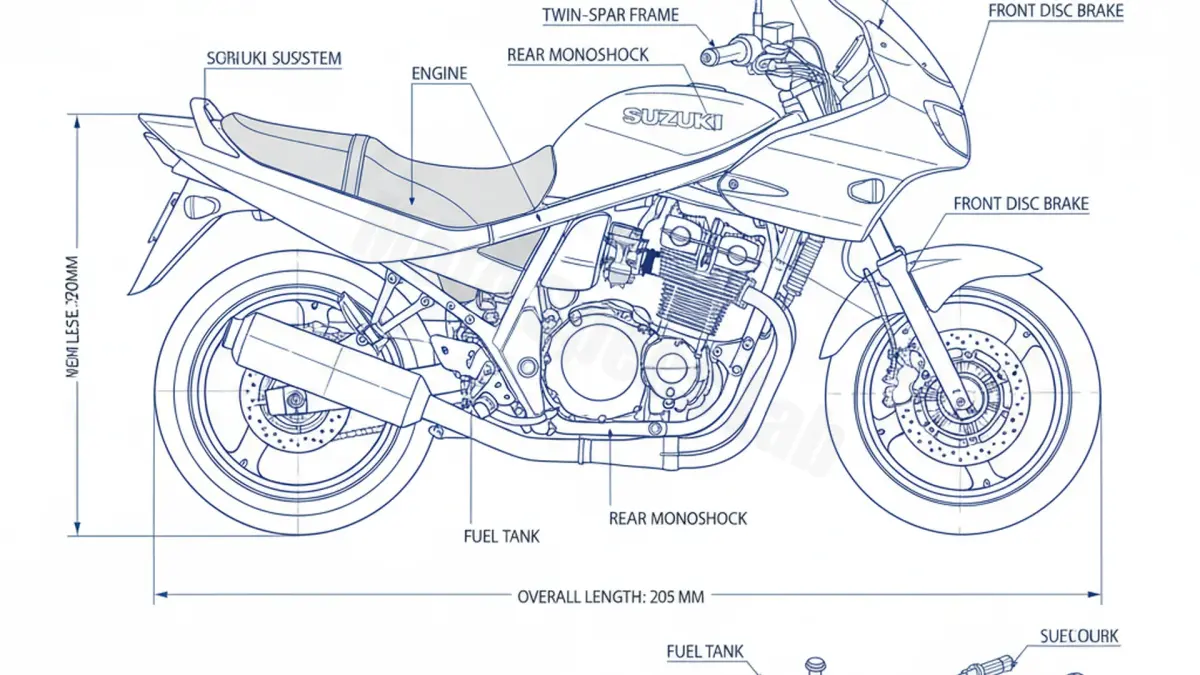
Historical Engineering Highlight: The Suzuki GSF 400 Bandit (GK75B) was a revolutionary departure from traditional Japanese design of the early 90s. While its competitors focused on utilitarian aesthetics, the Bandit featured a beautiful steel trellis frame inspired by Italian exotica, housing a high-revving 16-valve inline-four engine directly derived from the GSX-R400 race replica. It remains one of the few sub-500cc naked bikes capable of screaming to a 14,000 RPM redline while maintaining the poise of a modern classic.
| Quick Specs: Suzuki GSF 400 Bandit (GK75B) | |
|---|---|
| Production Years | 1991 – 1995 |
| Engine Type | 398cc Liquid-cooled Inline-4, DOHC |
| Oil Requirement | SAE 10W-40 (2.7 L) |
| Tire Sizes | F: 110/70-17 | R: 150/70-17 |
| Battery Type | YTX9-BS |
| Spark Plugs | NGK CR8EK / CR9EK |
Technical Engineering Analysis
The heart of the GK75B is its liquid-cooled, dual overhead cam engine. Unlike larger displacement bikes of the era, the Bandit 400 relies on high-velocity intake ports and Slingshot carburetors to generate its power. This configuration provides a distinct power band that rewards aggressive riding. The chassis, a steel tube trellis, offers a unique balance of rigidity and flex, making it a favorite for riders who prioritize handling feedback over raw straight-line speed.
Maintenance & Fluid Specifications
To maintain the high-revving nature of the GK75B, strict adherence to fluid intervals is mandatory. The 2.7-liter oil capacity should be filled with SAE 10W-40 oil. For modern preservation, we recommend a JASO MA2 specification to ensure the wet clutch remains slip-free under high-load shifts.
The cooling system is equally critical. Given the engine’s 14,000 RPM ceiling, thermal management is paramount. Ensure the radiator fins are clear of debris and the coolant is a 50/50 ethylene glycol mix. For ignition, the NGK CR8EK is the standard choice, though the CR9EK (colder plug) is recommended for sustained high-speed highway use to prevent pre-ignition.
Tires and Contact Patch
The Bandit 400 utilizes a 17-inch wheel setup that allows for modern rubber compounds. The 110/70-17 front and 150/70-17 rear provide a nimble footprint. Maintaining correct pressures is vital for the bike’s flickable nature: 2.25 bar (33 psi) in the front is standard, while the rear should be adjusted between 2.50 bar (36 psi) for solo sprints and 2.80 bar (41 psi) for pillion transport.
MotoSpecsLab Verdict
The Suzuki GSF 400 Bandit (GK75B) is a “jewelry box” motorcycle—small, intricate, and valuable to those who understand its mechanical pedigree. It requires more frequent maintenance than a modern commuter, particularly regarding carburetor synchronization and valve clearances, but the reward is one of the most engaging sensory experiences in the 400cc class.
Frequently Asked Questions
Q: How often should I change the oil?
A: For the GK75B, we recommend changes every 5,000 km (3,000 miles) or annually, whichever comes first, due to the high-revving nature of the engine.
Q: What battery does the Bandit 400 use?
A: The standard fitment is the YTX9-BS. Ensure the charging system is outputting between 13.5V and 15.0V at 5,000 RPM.
Q: Can I use 160-section rear tires?
A: While some riders fit a 160/60-17, it can pinch the tire profile on the standard rim, potentially slowing down the steering response. The OEM 150/70-17 remains the optimal choice for handling geometry.