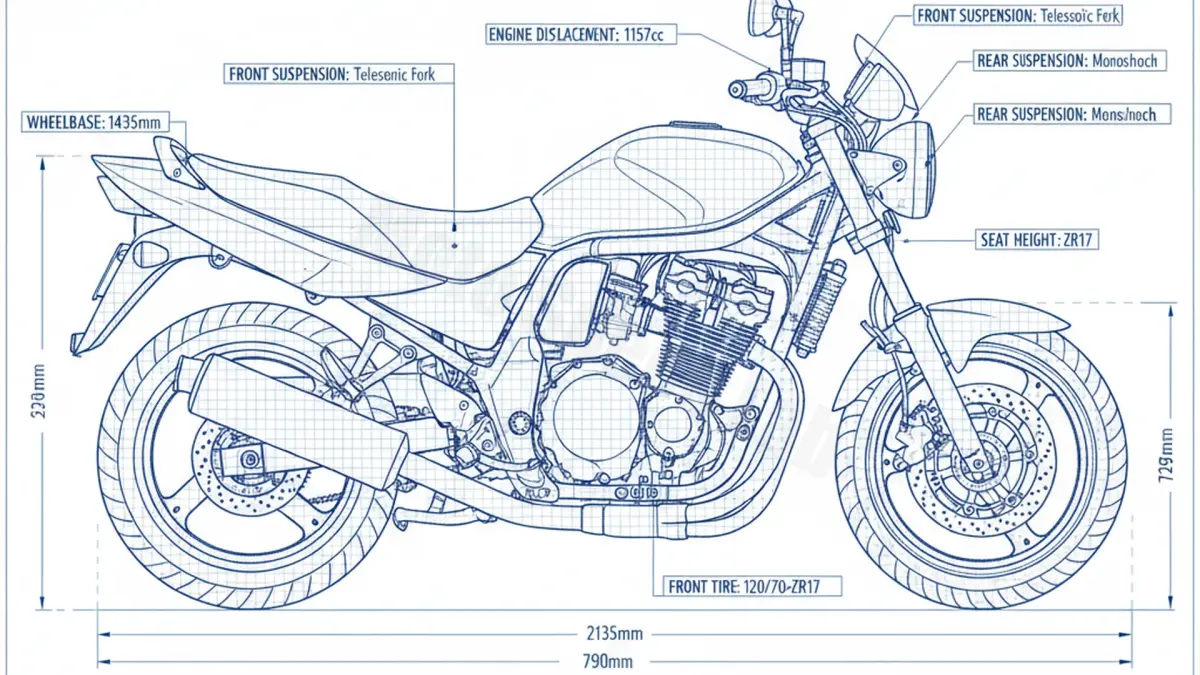
| Specification | Value |
|---|---|
| Production Years | 2001 – 2005 |
| Engine Type | 1157cc, SACS Oil-Cooled, Inline-4 |
| Oil Requirement | SAE 10W-40 (API SF/SG) – 3.5L (Filter Change) |
| Spark Plug | NGK JR9B |
| Battery | YTX12-BS |
| Tire Size | F: 120/70 ZR 17 | R: 180/55 ZR 17 |
| Tire Pressure | F: 2.5 bar (36 psi) | R: 2.9 bar (42 psi) |
While most manufacturers were transitioning to liquid cooling by the turn of the millennium, the Suzuki GSF 1200 WVA9 (Generation 2) cemented its legacy by retaining the SACS (Suzuki Advanced Cooling System). This engineering choice wasn’t just about tradition; the WVA9 utilized a high-volume oil pump and specialized cooling jets to manage thermal loads, a direct evolution of the legendary GSX-R1100 architecture. This makes the WVA9 one of the most robust and ‘tunable’ platforms in modern motorcycling history.
Engineering Analysis: The WVA9 Evolution
Launched in 2001, the WVA9 series brought significant refinements over the original GSF1200. Suzuki engineers focused on frame rigidity and updated ergonomics. The frame was redesigned to lower the seat height while increasing the wheelbase slightly for improved high-speed stability. The Mikuni BSR36 carburetors replaced the older BST units, providing a smoother throttle response and better fuel atomization, crucial for meeting tightening emission standards of the era.
Maintenance Guide & Technical Specs
For the professional technician or the dedicated enthusiast, the WVA9 requires specific attention to its lubrication system. Because the oil serves as the primary cooling medium, the quality and viscosity of the lubricant are paramount.
- Lubrication: Use a high-quality SAE 10W-40 meeting API SF or SG standards. A standard oil change requires 3.3L, while a filter replacement brings the total to 3.5L. If the engine is completely dry (overhaul), 4.5L is required.
- Ignition: The NGK JR9B spark plugs are specifically gapped for this high-torque engine. Regular inspection every 6,000 miles is recommended to ensure optimal combustion.
- Chassis & Tires: The WVA9 moved to a 180-section rear tire, providing a larger contact patch than its predecessor. Maintaining the factory-spec 2.5 bar (Front) and 2.9 bar (Rear) is critical for preventing ‘cupping’ on the front tire and ensuring stable cornering.
Editor’s Verdict
The Suzuki GSF 1200/S Bandit WVA9 remains a masterclass in ‘honest’ engineering. It lacks the electronic rider aids of contemporary machines, offering instead a pure, mechanical connection to the road. Its SACS engine is virtually bulletproof if the oil change intervals are strictly followed, making it a premier choice for long-distance touring and spirited street riding alike.
Frequently Asked Questions
What is the correct battery for the WVA9?
The Suzuki Bandit 1200 (2001-2005) uses the YTX12-BS maintenance-free lead-acid battery. Ensure the terminals are coated with dielectric grease to prevent corrosion.
Can I use synthetic oil in the GSF 1200?
Yes, provided it meets the API SF or SG rating. However, many owners prefer high-quality semi-synthetic oils to maintain optimal clutch feel, as the Bandit uses a wet-clutch system that can be sensitive to certain friction modifiers found in modern ‘Energy Conserving’ oils.