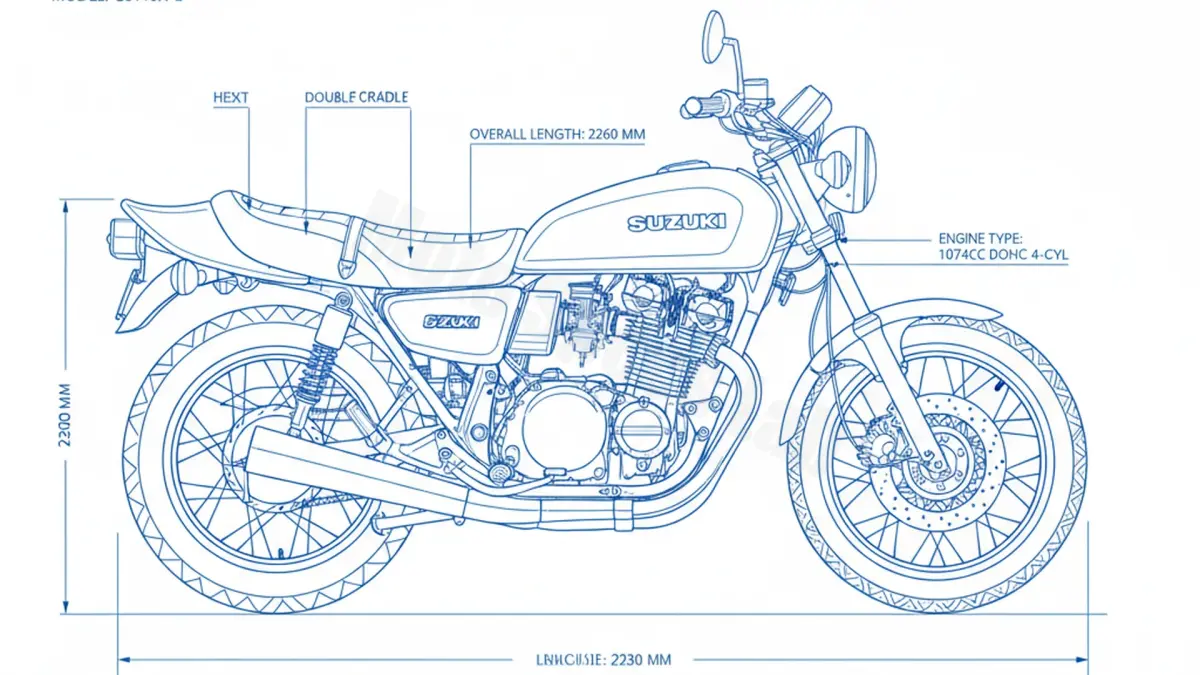
| Attribute | Specification |
|---|---|
| Production Years | 1980–1981 |
| Engine Type | Air-cooled, 4-stroke, DOHC, 16-valve (TSCC) |
| Engine Oil | SAE 10W-40 (API SE/SF) – 3.4 Liters |
| Front Tire | 3.25 H 19 (2.0 bar / 28 psi) |
| Rear Tire | 130/90 – 16 (2.3 bar / 32 psi) |
| Spark Plug | NGK B8ES (Gap: 0.6–0.7mm) |
| Battery | YB14L-A2 |
At MotoSpecsLab, we define the Suzuki GSX 1100 L (GS110X-L) as a pivotal moment in motorcycle engineering. While its ‘L’ designation marketed it as a ‘Low-seat’ cruiser, its soul was defined by the debut of the Twin Swirl Combustion Chamber (TSCC). This was the first time a mass-produced 1100cc cruiser utilized a four-valve-per-cylinder head designed to induce a double-vortex air-fuel mixture, drastically improving combustion efficiency and throttle response over the older two-valve GS series.
The TSCC Advantage and Engine Architecture
The GS110X-L engine was not merely a bored-out GS1000. It featured a sophisticated DOHC top end where the valves were actuated via forked rocker arms with screw-and-locknut adjusters—a mechanic’s favorite for ease of maintenance. The TSCC design allowed for a narrower valve angle, resulting in a more compact combustion chamber and a higher compression ratio without the risk of detonation. This engineering choice provided the GSX 1100 L with a flat torque curve that made it the king of the ‘stoplight-to-stoplight’ sprints in the early 1980s.
Maintenance Guidelines for the GS110X-L
Maintaining a vintage GSX 1100 L requires adherence to specific factory tolerances to preserve the integrity of the air-cooled block. For lubrication, use 3.4 liters of SAE 10W-40. Given the age of these engines, we recommend high-zinc mineral oils or semi-synthetics that meet API SE or SF standards to protect the flat-tappet surfaces.
Ignition and Electrical
The ignition system relies on NGK B8ES spark plugs. For optimal flame front propagation within the TSCC head, the gap must be precisely set between 0.6mm and 0.7mm. The electrical system is supported by a YB14L-A2 battery; ensure the charging system (stator and regulator/rectifier) is tested regularly, as these were known weak points in early 80s Japanese superbikes.
Chassis and Contact Patch
The ‘L’ model features a unique staggered wheel setup: a 19-inch front for stability and a 16-inch rear for that classic cruiser silhouette. Correct tire pressure is critical for handling: 2.0 bar (28 psi) in the front and 2.3 bar (32 psi) in the rear. Over-inflating the 130/90-16 rear tire can lead to a ‘skittish’ feel during high-speed cornering due to the bike’s significant dry weight.
MotoSpecsLab Verdict
The Suzuki GSX 1100 L is a rare breed—a cruiser with the heart of a world-class superbike. By combining the aggressive TSCC engine with a relaxed ergonomic profile, Suzuki created a machine that remains highly collectible today. For the modern owner, success lies in meticulous valve clearances and maintaining the integrity of the 16-valve head through high-quality lubrication and precise ignition timing.