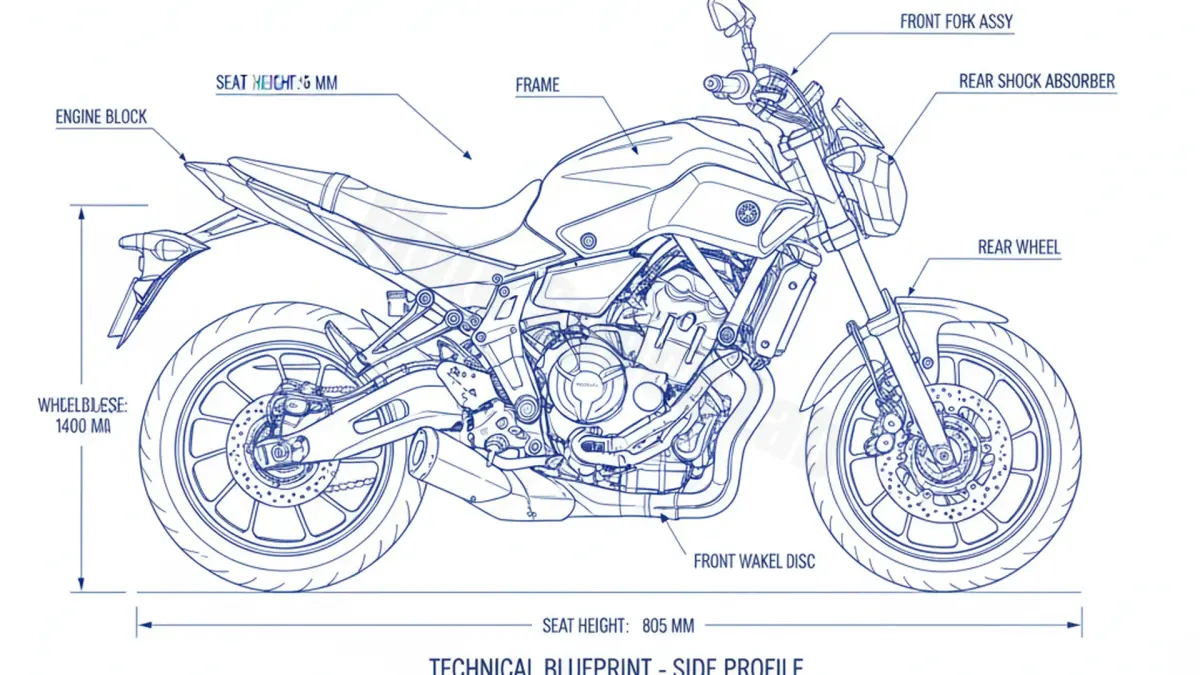
| Component | Specification |
|---|---|
| Production Years | 2014 – Present |
| Engine Type | 689cc CP2 Parallel-Twin |
| Engine Oil | Yamalube 10W-40 / 15W-50 (2.6 L) |
| Tires (Front/Rear) | 120/70 ZR 17 / 180/55 ZR 17 |
| Spark Plug | NGK LMAR8A-9 (Gap: 0.8–0.9 mm) |
| Battery | YTZ10S |
Engineering Highlight: The Crossplane Philosophy
The Yamaha MT-07’s enduring success is rooted in its CP2 engine architecture. Unlike traditional parallel twins with 180 or 360-degree crank pins, the MT-07 utilizes a 270-degree crank. This engineering choice, derived from Yamaha’s MotoGP ‘Crossplane’ philosophy, synchronizes the inertial and combustion torque to provide the rider with a linear throttle response and a distinct, V-twin-like exhaust note. This ‘Crossplane Concept’ is what gives the MT-07 its legendary ‘Master of Torque’ character.
Technical Maintenance Specifications
To maintain the mechanical integrity of the CP2 powerplant, strict adherence to fluid and ignition specifications is mandatory. The MT-07/25 platform is designed for longevity, provided the following parameters are met:
1. Lubrication System
The total oil capacity is 2.6 Liters. MotoSpecsLab recommends Yamalube 10W-40 or 15W-50 depending on your ambient operating temperature. The oil must meet API SG standards or higher and carry the JASO MA2 certification to ensure the wet clutch operates without slippage.
2. Ignition & Electrical
The MT-07 utilizes the NGK LMAR8A-9 spark plug. Precise ignition timing is dependent on the electrode gap, which must be maintained between 0.8–0.9 mm. For electrical stability, particularly with the sensitive ECU and ABS modules, the YTZ10S battery is the factory-standard requirement.
3. Chassis & Contact Patch
Handling precision is highly sensitive to tire pressure. The MT-07 uses a 120/70 ZR 17 front and a 180/55 ZR 17 rear. For optimal carcass deformation and heat cycles, maintain pressures at:
- Front: 2.25 bar (33 psi)
- Rear: 2.50 bar (36 psi)
Editor’s Verdict
The Yamaha MT-07 (MT-07/25) remains the benchmark for the middleweight naked category. Its blend of mechanical simplicity and sophisticated engine harmonics makes it both a reliable commuter and a capable track tool. From a technical perspective, its ease of maintenance is a significant advantage for owners who prefer to perform their own servicing.