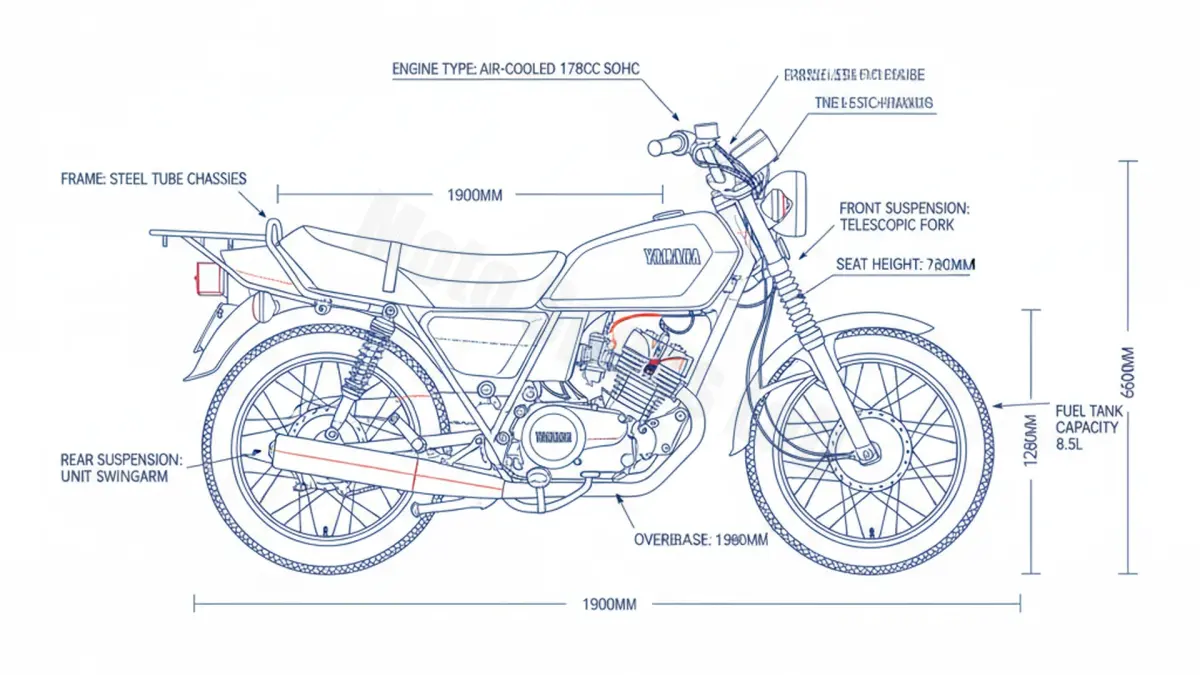
| Specification | Data |
|---|---|
| Production Years | 1982 – 1985 |
| Engine Type | 4-Stroke, OHC Single Cylinder |
| Engine Oil | SAE 10W-30 / 10W-40 (1.0L Periodic / 1.2L Total) |
| Tire Size | Front: 3.50-10 4PR | Rear: 3.50-10 4PR |
| Spark Plug | NGK C7HSA (Gap: 0.6 – 0.7 mm) |
| Battery | YB10L-A2 |
Engineering Highlight: The Yamaha XC 180 Cygnus (32H) holds a prestigious place in motorcycle history as the world’s first mass-produced large-displacement four-stroke scooter. Introduced in the early 1980s, it was Yamaha’s direct response to the demand for a sophisticated, highway-capable commuter that offered the reliability of a four-stroke engine in an era dominated by smoky two-stroke alternatives.
Technical Overview
The 32H variant of the Cygnus 180 is powered by a 171cc OHC (Overhead Cam) engine. Unlike modern fuel-injected scooters, the XC 180 utilizes a precise carburetion system that requires specific tuning to maintain its smooth power delivery. The chassis featured an advanced (for its time) anti-dive front suspension system, designed to counteract the weight transfer during heavy braking—a common issue with small-wheel scooters.
Maintenance Guide
Lubrication System
For optimal engine longevity, MotoSpecsLab recommends using a high-quality mineral or semi-synthetic oil meeting API SE or SF standards. The periodic oil change requires exactly 1.0 Liter. If the engine has been disassembled for repair, the total dry capacity is 1.2 Liters. We suggest a viscosity of 10W-40 for most climates, though 10W-30 is suitable for colder regions.
Ignition & Electrical
The ignition system relies on an NGK C7HSA spark plug. To ensure efficient combustion and prevent stalling, the electrode gap must be maintained between 0.6 and 0.7 mm. The electrical system is supported by a YB10L-A2 battery; given the age of these units, ensuring clean terminal connections is vital to prevent charging circuit failure.
Tires and Handling
The XC 180 uses symmetrical 3.50-10 4PR tires on both the front and rear. Handling characteristics are highly sensitive to tire pressure. For solo riding, maintain 1.5 bar (22 psi) in the front and 2.0 bar (29 psi) in the rear. When carrying a passenger, the rear pressure should be increased to 2.5 bar (36 psi) to maintain stability and prevent sidewall overheating.
Conclusion
The Yamaha XC 180 Cygnus 32H remains a marvel of 1980s engineering. While it requires more diligent maintenance than contemporary scooters, its robust four-stroke design and historical significance make it a prized possession for collectors and vintage enthusiasts. Regular oil changes and precise spark plug maintenance are the keys to keeping this pioneer of the maxi-scooter world on the road.