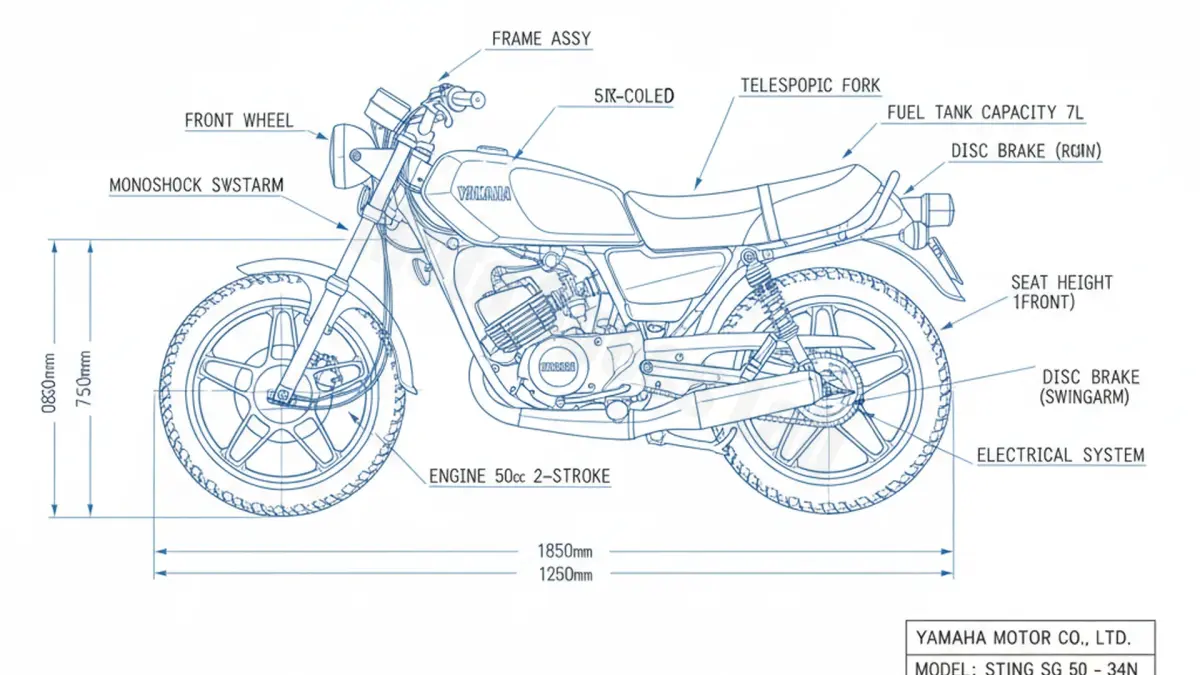
| Component | Specification |
|---|---|
| Production Years | 1984 – 1985 |
| Engine Oil | SAE 10W-30 Type SE (0.3 L) |
| Tire Size (Front/Rear) | 2.50-10 4PR |
| Tire Pressure (Front) | 1.25 bar (18 psi) |
| Tire Pressure (Rear) | 2.0 bar (29 psi) |
| Battery Type | 6N4-2A-4 (6 Volt) |
| Spark Plug | NGK BP4HS |
The Shaft-Drive Enigma: A Historical Perspective
The Yamaha STING SG 50 (34N) remains one of the most curious footnotes in mid-80s moped history. While most 50cc machines of the era relied on messy chain drives or CVT belts, Yamaha engineered the Sting with a fully enclosed shaft-drive system. This was a direct inheritance from the Yamaha Townmate (T50) technology, scaled down for a more youthful, ‘mini-cruiser’ aesthetic. This engineering choice virtually eliminated the most common maintenance headache for small-displacement riders: chain tensioning and lubrication.
Technical Performance & Engineering
Produced briefly between 1984 and 1985, the 34N variant was designed for urban utility with a touch of flair. The engine is a reliable two-stroke single cylinder, though its power delivery is intentionally modest to comply with period moped regulations. The shaft drive provides a smooth, if slightly rigid, power transfer to the 10-inch rear wheel, making it an exceptionally clean vehicle for commuting.
Maintenance Guide: Keeping the Sting Sharp
Lubrication System
The SG 50 requires a specific, albeit small, amount of oil. For the transmission/final drive housing, use 0.3 Liters of SAE 10W-30 Type SE. Given the age of these units, MotoSpecsLab recommends checking for seal leaks around the shaft housing, as the low oil volume leaves little margin for error.
Chassis & Tires
The Sting utilizes identical 2.50-10 4PR tires for both front and rear. However, the pressure settings are distinct to compensate for weight distribution. The front should be maintained at 1.25 bar (18 psi), while the rear requires 2.0 bar (29 psi) to handle the load of the rider and the shaft-drive assembly.
Electrical & Ignition
The 34N operates on a 6-volt system, utilizing a 6N4-2A-4 battery. For optimal combustion, the NGK BP4HS spark plug is the factory standard. Ensure the gap is checked regularly, as 6V systems are notoriously sensitive to fouled plugs or weak sparks.
MotoSpecsLab Editorial Verdict
The Yamaha STING SG 50 is a masterclass in ‘over-engineering’ for a niche market. Its shaft-drive system makes it a collector’s item today, offering a level of mechanical sophistication rarely seen in the 50cc class. For owners, meticulous adherence to the 0.3L oil capacity and 6V battery maintenance is the key to preserving this unique piece of Yamaha’s engineering heritage.