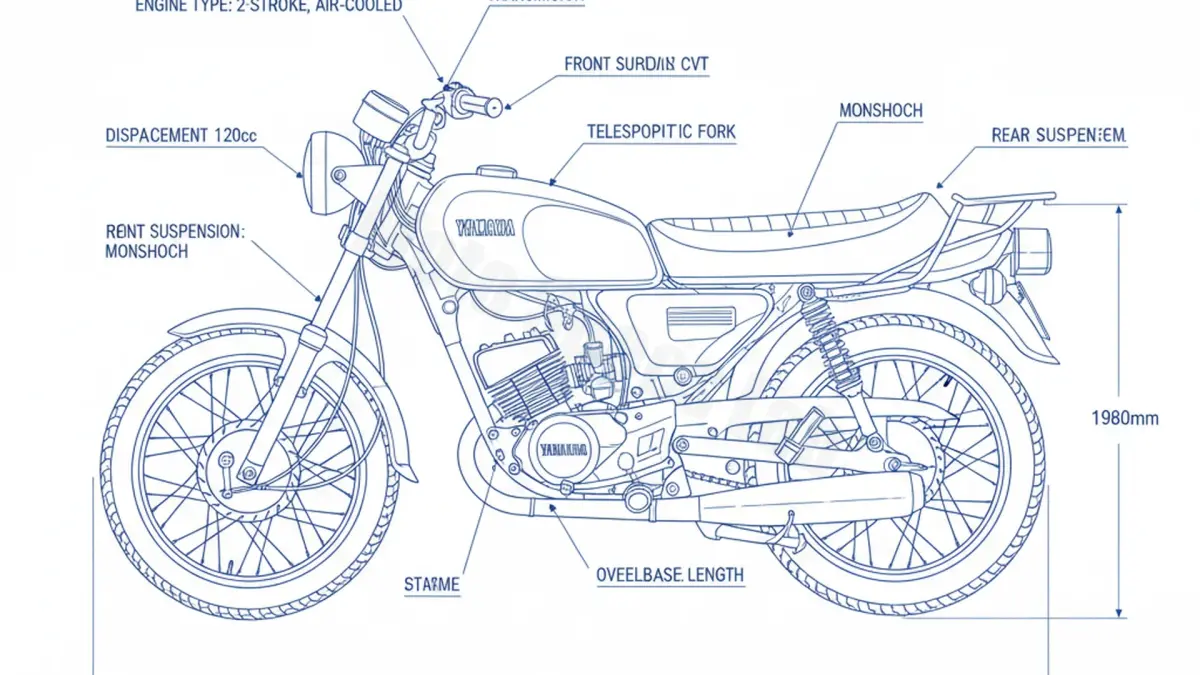
The Yamaha BL 125 Beluga, known in various markets as the Riva 125, holds a unique place in engineering history as one of the first mass-produced scooters to successfully integrate a sophisticated, fully-enclosed automotive-style instrument cluster and an advanced four-stroke cooling system. Unlike its two-stroke contemporaries of the early 1980s, the 50W series prioritized thermal efficiency and low-noise operation, making it the ‘luxury sedan’ of the scooter world during its production run from 1985 to 1995.
| Quick Specs: Yamaha BL 125 Beluga (50W) | |
|---|---|
| Production Years | 1985 – 1995 |
| Engine Type | Single Cylinder, 4-Stroke, SOHC |
| Oil Specification | SAE 10W-30 or 10W-40 (API SE/SF/SG) |
| Oil Capacity | 0.9L (Periodic) / 1.1L (Dry) |
| Spark Plug | NGK C7HSA (Gap: 0.6–0.7 mm) |
| Battery | 12V 7Ah (YB7L-B) |
| Tire Size | F/R: 3.50-10 51J |
Technical Engineering Overview
The heart of the Beluga 50W is its air-cooled, 124cc single-cylinder engine. While many scooters of the era relied on simple reed-valve two-stroke designs, Yamaha’s choice of a SOHC four-stroke powerplant provided a smoother torque curve and significantly improved fuel economy. The chassis design utilized a step-through steel frame, which, combined with the 10-inch wheels, provided exceptional maneuverability in urban environments.
Maintenance & Service Guidelines
Lubrication System
For optimal engine longevity, MotoSpecsLab recommends high-quality mineral or semi-synthetic oils meeting API SE, SF, or SG standards. Because the Beluga lacks a modern oil filter (utilizing a mesh strainer instead), regular oil changes are critical. Periodic Change: 0.9 Liters. Dry Engine: 1.1 Liters.
Ignition & Electrical
The 50W uses a CDI ignition system. The NGK C7HSA spark plug is the standard requirement. Ensure the electrode gap is precisely 0.6–0.7 mm to prevent misfires and ensure reliable cold starts. The electrical system is powered by a YB7L-B lead-acid battery; given the age of these units, checking the charging system output (approx. 14V at 5,000 RPM) is advised.
Tires and Safety
The Beluga runs on identical front and rear 3.50-10 51J tires. Maintaining correct pressure is vital for handling stability:
- Front: 1.5 bar (22 psi)
- Rear (Solo): 2.0 bar (29 psi)
- Rear (Dual): 2.3 bar (33 psi)
Editorial Review: The MotoSpecsLab Verdict
The Yamaha BL 125 Beluga – 50W is a masterclass in transitional scooter design. It successfully bridged the gap between the utilitarian post-war scooters and the high-tech maxi-scooters of the 21st century. While its 10-inch wheels can feel twitchy at top speeds, its mechanical reliability and iconic ‘boxy’ 80s aesthetic make it a highly desirable classic for collectors and urban commuters alike. Maintenance is straightforward, provided the owner adheres to the specific oil and spark plug tolerances defined by Yamaha’s original engineering team.
Frequently Asked Questions
A: Given the lack of a traditional paper filter, we recommend oil changes every 1,500 to 2,000 miles (2,500-3,000 km).
Q: Can I use synthetic oil?
A: Yes, but ensure it meets the API SE/SF/SG specifications and maintain the 10W-40 viscosity for better heat protection in older air-cooled engines.