| Component | Specification |
|---|---|
| Engine Oil Type | SAE 10W-40 or 10W-50 (API SG, JASO MA) |
| Oil Capacity | 0.71 Liters |
| Spark Plug | NGK LMAR8G |
| Tires (Front/Rear) | 90/90-21 M/C 54M / 130/90-18 M/C 69M |
| Tire Pressure | 1.0 bar (15 psi) Front & Rear |
| Battery | YTZ7S (12V) |
Engineering Highlight: The Mass Centralization Paradigm
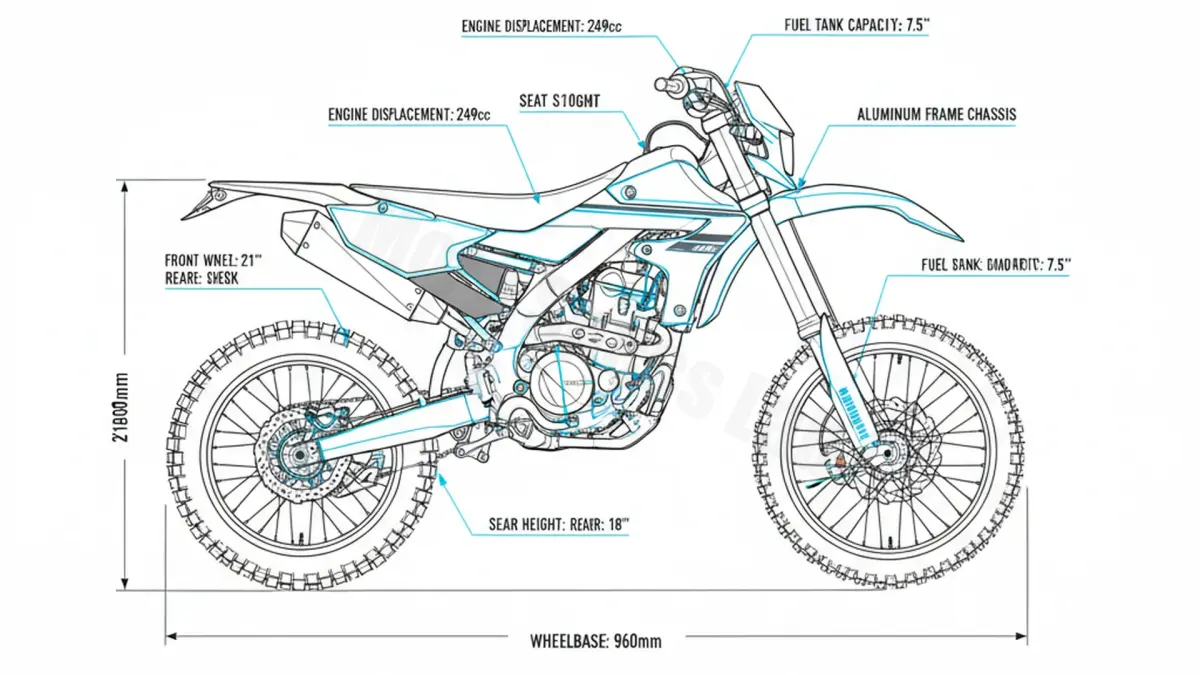
The 2016 Yamaha WR 250 F (CG36W) stands as a landmark in enduro engineering. It was the first generation to fully inherit the “reverse-slanted” cylinder head design from the YZ250F motocrosser. By rotating the cylinder head 180 degrees—placing the intake at the front and the exhaust at the rear—Yamaha achieved a near-perfect mass centralization. This layout allows for a straight-shot intake tract, significantly improving volumetric efficiency and throttle response, while keeping the heavy exhaust components closer to the bike’s center of gravity.
Technical Review: Performance and Handling
The CG36W/2GB8 iteration is more than just a trail bike; it is a competition-ready machine. Equipped with the legendary KYB® SSS (Speed Sensitive System) air-oil separate forks, the WR 250 F offers industry-leading damping consistency. The fuel injection system is highly tunable via the Yamaha Power Tuner, allowing riders to map the 249cc DOHC engine for technical woods riding or high-speed desert sections.
One of the critical nuances of the 2016 model is its wide-ratio 6-speed transmission, which provides a significant advantage over the 5-speed YZ variant when navigating diverse terrain. The inclusion of an electric starter, powered by the compact YTZ7S battery, ensures reliability in stall-heavy technical sections.
Maintenance Guide: Professional Standards
Lubrication System
The WR 250 F utilizes a high-performance lubrication system that requires precision. For a standard oil change, 0.71 liters of SAE 10W-40 or 10W-50 is required. It is imperative to use oil that meets JASO MA standards to prevent clutch slippage, given the shared sump design.
Ignition & Chassis
The NGK LMAR8G spark plug is specifically chosen for its heat dissipation properties under high-load enduro conditions. Gap settings should be checked every 15-20 hours of hard use. For the chassis, tire pressures are recommended at a baseline of 1.0 bar (15 psi), though riders may drop to 0.8 bar (12 psi) in muddy conditions to increase the contact patch of the 130/90-18 rear tire.
Editor’s Verdict
The 2016 WR 250 F remains a benchmark for the quarter-liter enduro class. Its combination of motocross-derived power delivery and enduro-specific refinements makes it a formidable tool for both amateur enthusiasts and professional racers. Proper adherence to the 0.71L oil capacity and specific NGK plug requirements is essential for maintaining the longevity of this high-strung, high-performance powerplant.