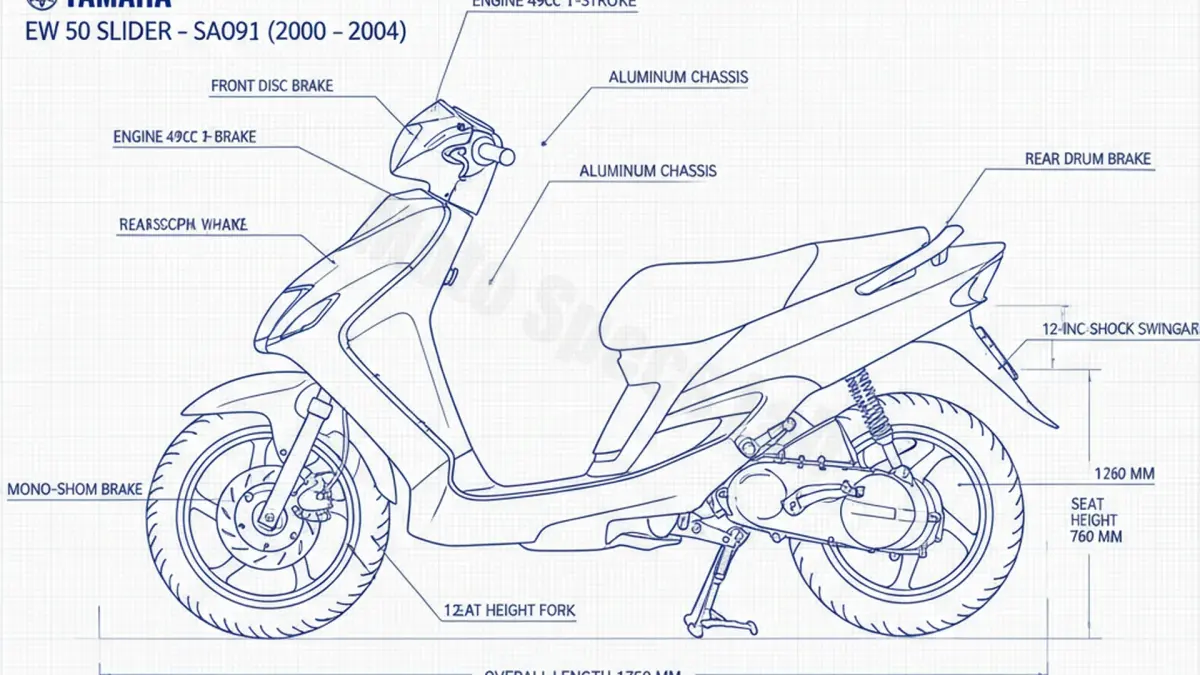
While most scooters of the early 2000s were designed for fuel economy and soft commuting, the Yamaha EW 50 Slider (SA091) achieved cult status as the first mass-produced scooter engineered specifically with ‘urban freestyle’ in mind. Its most unique engineering highlight is the integrated plastic ‘sliders’ on the bodywork—sacrificial protectors designed to prevent expensive fairing damage during low-speed drops or stunt maneuvers.
| Quick Specs: Yamaha EW 50 Slider (2000–2004) | |
|---|---|
| Engine Type | Air-cooled, 2-Stroke Single (Minarelli Vertical) |
| Oil Specification | JASO FC or FD (2-Stroke Synthetic/Semi-Synthetic) |
| Tire Size (F/R) | 120/80-12 55J / 130/80-12 60J |
| Spark Plug | NGK BR8HS (0.6 – 0.7 mm gap) |
| Battery | YTX4L-BS (12V) |
Technical Review: Performance and Architecture
At the heart of the SA091 is the legendary Minarelli vertical air-cooled engine. Unlike its horizontal counterparts found in the Aerox, the Slider’s vertical configuration allows for a shorter wheelbase and a more centralized center of gravity, making it exceptionally flickable in tight urban environments. The 12-inch wheels, wrapped in high-profile tires, provide a unique balance of agility and shock absorption over cobblestones and curbs.
From an editorial perspective, the Slider remains a masterclass in minimalist design. Its lightweight chassis (approx. 72kg dry) paired with a responsive CVT transmission ensures that the 50cc displacement feels significantly more punchy than its competitors. However, the air-cooled nature means performance can slightly fade during prolonged high-load urban sessions in peak summer heat.
Maintenance & Service Specifications
To maintain the reliability of the SA091, following the specific technical parameters below is critical for both engine longevity and safety.
1. Lubrication System
The Slider utilizes an autolube system. It is imperative to use high-quality JASO FC or FD grade 2-stroke oil. The oil tank capacity is 1.4 liters. Using inferior oils will lead to rapid carbon buildup in the exhaust port and piston crown.
2. Ignition & Electrical
For optimal combustion, the NGK BR8HS spark plug must be maintained with a precise gap of 0.6 – 0.7 mm. The electrical system is powered by a YTX4L-BS battery, which is compact and requires regular voltage checks, especially if the scooter is used sporadically.
3. Wheel and Tire Assembly
Tire pressure is paramount for the Slider’s handling characteristics. Due to the rear-biased weight distribution, maintain 1.8 bar (26 psi) in the front (120/80-12) and 2.0 bar (29 psi) in the rear (130/80-12). Under-inflation will lead to sluggish steering and increased wear on the sidewalls.
Frequently Asked Questions
What is the fuel tank capacity?
The Yamaha Slider typically features a 6.5-liter fuel tank, which provides a reasonable range given its 2-stroke fuel consumption profile.
Can I use JASO FB oil?
While JASO FB is acceptable in emergencies, MotoSpecsLab recommends JASO FC or FD to minimize smoke emissions and protect the engine during high-RPM operation.
How often should I change the spark plug?
We recommend inspecting the NGK BR8HS every 3,000 km and replacing it every 6,000 km to ensure reliable cold starts and consistent power delivery.