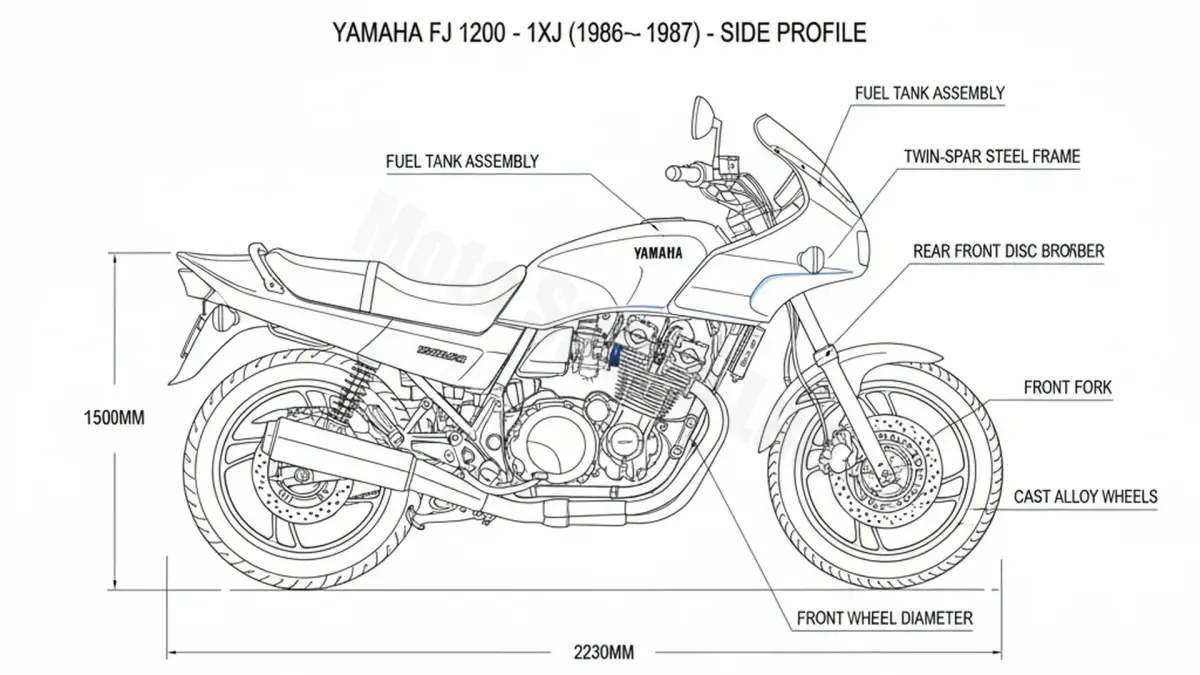
| Attribute | Specification |
|---|---|
| Production Years | 1986–1987 |
| Engine Oil | SAE 10W-40 or 20W-40 (API SE/SF) (3.2 L) |
| Tires (Front/Rear) | 120/80-16 60V / 150/80-16 71V |
| Tire Pressure | F: 2.25 bar (33 psi) / R: 2.50 bar (36 psi) |
| Battery | YB14L-A2 |
| Spark Plug | NGK DPR8EA-9 (0.8–0.9 mm gap) |
The Yamaha FJ 1200 (1XJ) holds a unique place in motorcycling history as the machine that perfected the ‘Lateral Frame’ concept. While its predecessor, the FJ1100, introduced the world to Yamaha’s high-speed touring ambitions, the 1XJ refined the formula with a massive 1188cc air-cooled engine that remains one of the most reliable and torque-rich inline-fours ever produced. Its engineering highlight is the rigid steel perimeter frame that wraps tightly around the cylinder head, a design that provided unprecedented high-speed stability for the mid-80s.
Engineering Analysis: The 1XJ Evolution
The 1XJ variant, produced between 1986 and 1987, was more than just a displacement bump. It introduced improved aerodynamics and a more robust braking system featuring opposed-piston calipers that addressed the fading issues found in earlier models. The air-cooled, 16-valve DOHC engine is a masterpiece of thermal management, utilizing a large oil cooler to maintain performance during sustained high-speed runs.
Chassis and Handling
Despite its dry weight, the 1XJ manages its mass through a sophisticated Monocross rear suspension system. The 16-inch wheel combination—a hallmark of late 80s performance bikes—allows for quick turn-in, though it requires specific tire profiles to maintain the intended geometry. Owners should stick strictly to the 120/80-16 front and 150/80-16 rear sizing to preserve the bike’s legendary neutral handling characteristics.
Maintenance Guide
Lubrication System
The FJ 1200 is famously ‘bulletproof’ but relies heavily on high-quality oil for cooling. We recommend a high-zinc 10W-40 or 20W-40 oil meeting API SE/SF standards. The total capacity is 3.2 liters. Given the air-cooled nature, oil changes should be performed every 5,000 km (3,000 miles) to prevent thermal breakdown.
Ignition and Electrical
For optimal combustion, the NGK DPR8EA-9 spark plugs must be gapped precisely to 0.8–0.9 mm. A weak battery is the primary cause of starter clutch wear in these models; ensure the YB14L-A2 battery is maintained at full charge, especially during winter storage.
Technical FAQ
What is the recommended tire pressure for the FJ 1200 1XJ?
For standard solo riding, maintain 2.25 bar (33 psi) in the front and 2.50 bar (36 psi) in the rear. For heavy touring or pillion use, the rear can be increased to 2.8 bar (40 psi).
Can I use modern synthetic oil?
Yes, provided it is compatible with wet clutches (JASO MA/MA2). However, many long-term owners prefer semi-synthetic mineral-based oils to ensure proper seal swelling and clutch operation in this vintage engine.
Why the 16-inch wheels?
In the mid-80s, 16-inch wheels were the racing standard, believed to provide a larger contact patch at lean and faster steering response. While tire choices are more limited today, modern compounds in these sizes offer better grip than the original 1980s rubber.