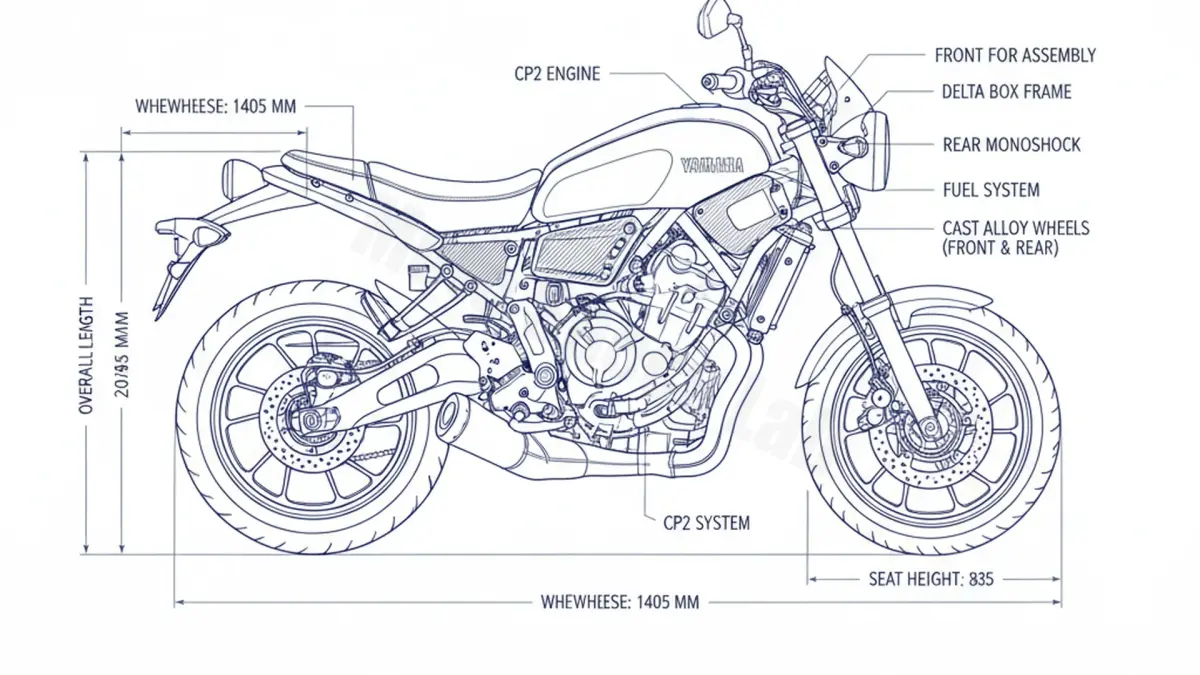
| Component | Specification |
|---|---|
| Engine Oil | SAE 10W-40, API SG+, JASO MA (2.30L Periodic / 2.60L Filter Change) |
| Front Tire | 120/70 ZR 17 M/C (58W) @ 2.25 bar (33 psi) |
| Rear Tire | 180/55 ZR 17 M/C (73W) @ 2.50 bar (36 psi) |
| Spark Plug | NGK LMAR8E-9 |
| Battery | YTZ10S |
While many enthusiasts view the Yamaha XSR 700 as a mere aesthetic evolution of the MT-07, it actually represents the inaugural realization of Yamaha’s “Faster Sons” philosophy. This design ethos was pioneered by legendary Japanese custom builder Shinya Kimura, whose “Faster Son” concept bike directly influenced the RM11/RM12’s modular frame and timeless silhouette, ensuring that modern engineering never compromised heritage aesthetics.
Technical Review: The CP2 Powerhouse
At the heart of the XSR 700 RM11/RM12 series (2016–2020) lies the 689cc Crossplane 2 (CP2) parallel-twin engine. This Euro 4 compliant unit is celebrated for its 270-degree crankshaft, which mimics the firing order and torque characteristics of a V-twin. The result is a highly linear power delivery that provides exceptional traction and a distinctive exhaust note.
The RM11/RM12 chassis utilizes a high-tensile steel backbone frame. Its short wheelbase and lightweight construction (approx. 186kg wet) make it one of the most agile middleweight standards in its class. During the Euro 4 era, Yamaha refined the fuel mapping to ensure smoother low-end throttle response while maintaining the engine’s punchy mid-range performance.
Maintenance Guide & Engineering Essentials
Lubrication System
For optimal longevity of the CP2 engine, MotoSpecsLab recommends high-quality synthetic 10W-40 oil meeting JASO MA standards. The oil capacity is strictly defined: 2.30 liters for a standard drain, and 2.60 liters when the cartridge filter is replaced. Maintaining these levels is critical for the integrated wet clutch system.
Ignition and Electrical
The RM11/RM12 utilizes specialized NGK LMAR8E-9 spark plugs. These long-reach plugs are essential for the high-compression combustion chamber design. Power is managed by a YTZ10S battery, which provides the high cold-cranking amps (CCA) necessary for the fuel injection system’s startup sequence.
Chassis and Contact Patch
Handling precision on the XSR 700 is highly sensitive to tire pressure. To maintain the intended geometry and prevent cupping, the 120/70-17 front must be kept at 2.25 bar (33 psi), while the 180/55-17 rear requires 2.50 bar (36 psi). These pressures are optimized for a balance between heat dissipation and carcass stability during spirited riding.
Editorial Verdict
The Yamaha XSR 700 (Euro 4) remains a benchmark for reliability and mechanical simplicity. Its modular subframe allows for easy customization, while the underlying RM11/RM12 platform offers a level of mechanical durability that has become the gold standard for modern parallel twins. It is a rare machine that satisfies both the technical purist and the aesthetic enthusiast.