| Specification | Data |
|---|---|
| Production Years | 2007 – 2010 |
| Engine Type | Inline-4, Liquid-cooled (R6 Derived) |
| Engine Oil | SAE 10W-40 JASO MA (2.8 L) |
| Spark Plugs | NGK CR9EK |
| Tire Dimensions | F: 120/70 ZR 17 / R: 180/55 ZR 17 |
| Battery | GT12B-4 |
Engineering Highlight: The Hexagonal Swingarm
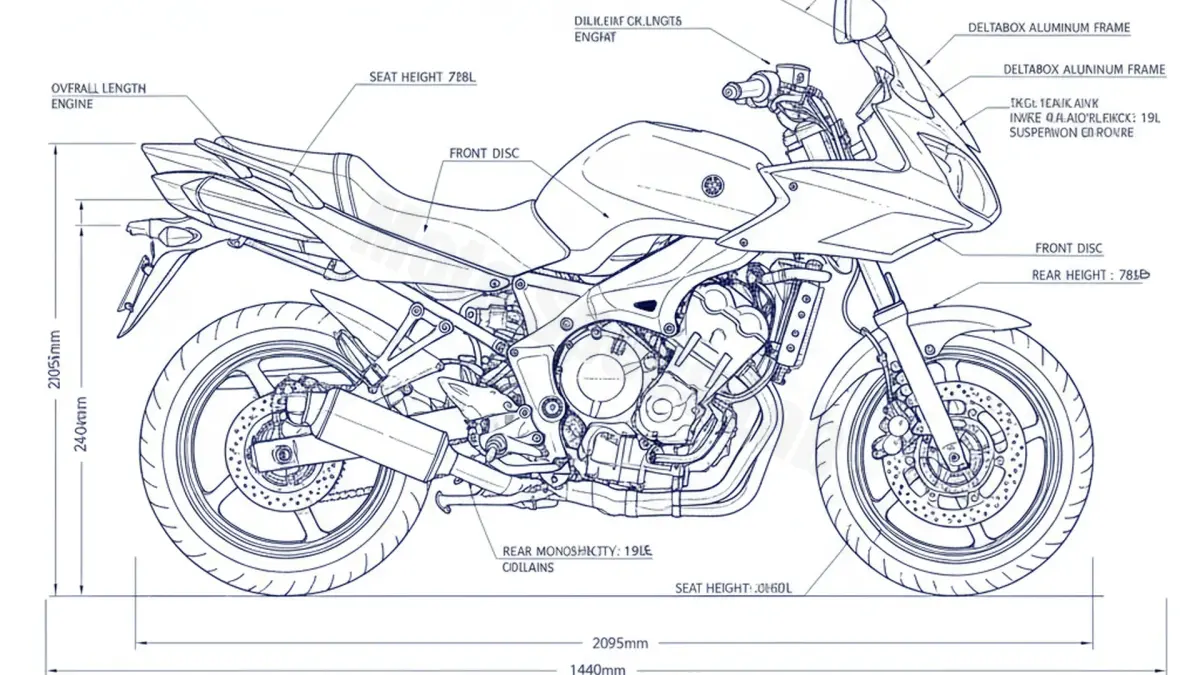
While the original FZ6 was often criticized for its budget-conscious steel square-section swingarm, the RJ148 (S2) variant marked a significant engineering shift. Yamaha introduced a high-rigidity, die-cast aluminum hexagonal swingarm. This wasn’t merely aesthetic; it drastically reduced unsprung weight and increased torsional rigidity, finally allowing the chassis to keep pace with the high-revving YZF-R6 derived powerplant.
Technical Review: Performance and Architecture
The RJ148 represents the pinnacle of the FZ6 lineage. By 2007, Yamaha refined the fuel injection mapping to smooth out the ‘on-off’ throttle transition found in earlier models. The engine, a detuned version of the 2003 R6, delivers its power linearly but retains a ferocious top-end rush above 8,000 RPM. The S2 also benefited from new monoblock four-piston front brake calipers, significantly enhancing stopping power and lever feedback over the previous sliding-piston design.
Maintenance Guide & Technical Data
Fluid Dynamics and Lubrication
For optimal shear stability in the high-revving inline-four, MotoSpecsLab recommends a high-quality synthetic SAE 10W-40 JASO MA oil. The total capacity for an oil and filter change is 2.8 Liters. Ensuring the JASO MA specification is met is critical to prevent clutch slippage, as the RJ148 utilizes a wet multi-plate clutch system.
Ignition and Electrical
The RJ148 uses NGK CR9EK twin-ground electrode spark plugs. These are designed to provide a more consistent spark and better heat dissipation under high loads. The electrical system is anchored by a GT12B-4 battery; given the FZ6’s sensitive immobilizer system, maintaining a steady voltage is paramount to avoiding ‘Error 51’ start-up issues.
Chassis and Contact Patch
Handling precision is highly dependent on tire pressure. The factory recommended settings for the 120/70 and 180/55 ZR 17 combination are 2.25 bar (33 psi) for the front and 2.50 bar (36 psi) for the rear. For spirited riding or touring with luggage, the rear may be increased to 2.8 bar to maintain profile stability.
FAQ
What makes the RJ148 different from the RJ07?
The RJ148 (S2) features the aluminum swingarm, upgraded 4-piston brakes, a redesigned fairing/instrument cluster from the FZ1, and remapped fuel injection for better mid-range response.
How often should the valves be checked?
Yamaha specifies a valve clearance inspection every 40,000 km (24,000 miles). However, the R6-based shim-and-bucket system is remarkably robust and rarely requires adjustment at the first interval.