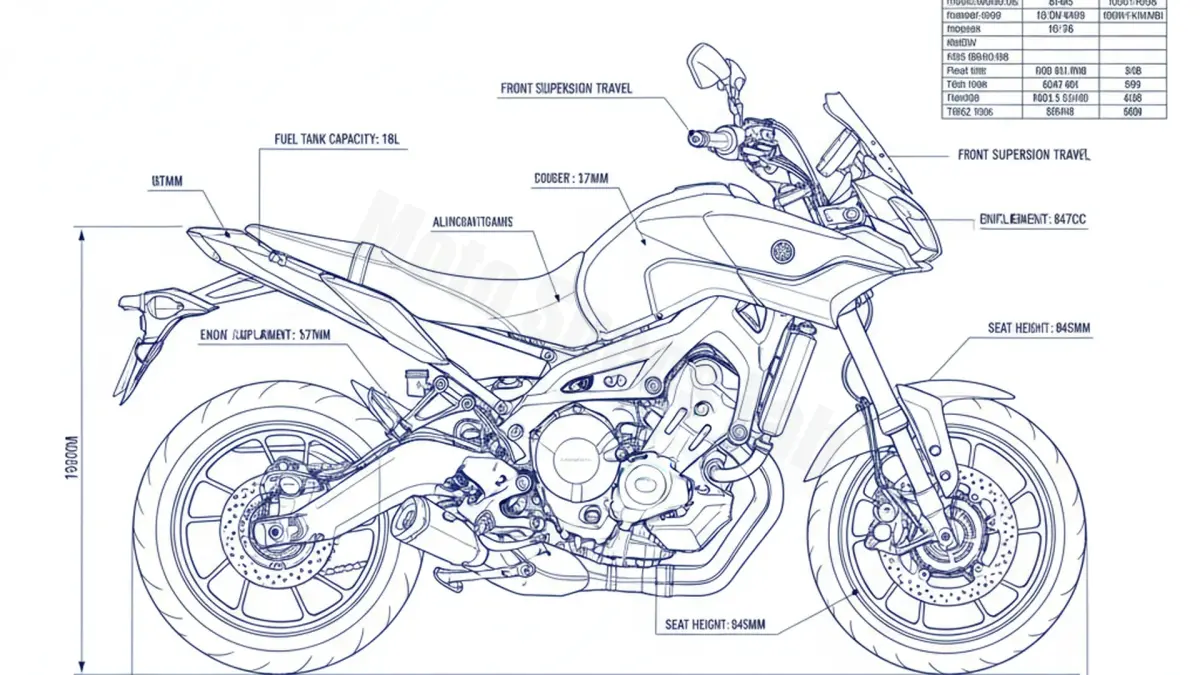
| Quick Specs: Yamaha MT-09 TRACER (RN29F) | |
|---|---|
| Production Years | 2015 – 2017 |
| Engine Type | 847cc Liquid-cooled, DOHC, 12-valve Inline 3-cylinder (CP3) |
| Engine Oil | SAE 10W-40, API SG+, JASO MA (2.7 L) |
| Tire Sizes | F: 120/70 ZR 17 / R: 180/55 ZR 17 |
| Tire Pressure | F: 2.5 bar (36 psi) / R: 2.9 bar (42 psi) |
| Battery | YTZ10S |
| Spark Plug | NGK CPR9EA-9 (Gap: 0.8–0.9 mm) |
The Yamaha MT-09 TRACER (RN29F), introduced in 2015, represents a pivotal moment in Yamaha’s engineering history. While it utilized the aggressive CP3 engine architecture of the MT-09, the RN29F was the first to implement the “Crossplane Concept” in a dedicated sport-touring chassis. A little-known engineering highlight of the RN29F is its specific ECU mapping, which was designed to smooth out the notoriously “snatchy” throttle response found in the early naked MT-09 models, while providing a longer swingarm for enhanced high-speed stability under luggage loads.
Engineering Analysis: The CP3 Powerhouse
At the heart of the RN29F is the 847cc triple. This engine is celebrated for its 120-degree crank pin offset, which eliminates inertial torque fluctuations, providing the rider with a direct connection between the throttle and the rear tire. For the Tracer variant, Yamaha engineers integrated D-Mode (Drive Mode) selectable maps specifically calibrated for touring, alongside a standard Traction Control System (TCS) that was revolutionary for its price point in 2015.
Maintenance Essentials
To maintain the high-performance standards of the RN29F, adherence to the technical service schedule is paramount. The CP3 engine is robust but sensitive to oil quality due to its high-revving nature.
1. Lubrication System
The RN29F requires 2.7 liters of engine oil when the filter is replaced. We recommend a high-quality synthetic SAE 10W-40 meeting JASO MA standards to ensure the wet clutch operates without slippage. Change intervals should not exceed 10,000 km (6,000 miles) or 12 months.
2. Ignition & Electrical
The NGK CPR9EA-9 spark plugs are critical for the triple-cylinder’s combustion efficiency. Ensure the gap is precisely 0.8–0.9 mm. The electrical system is powered by a YTZ10S AGM battery; given the Tracer’s propensity for accessory use (heated grips, GPS), maintaining a healthy charging system is vital.
3. Chassis & Tires
The RN29F utilizes a die-cast aluminum CF (Controlled Filling) frame. For optimal handling, tire pressures must be strictly maintained at 2.5 bar (Front) and 2.9 bar (Rear). The 180/55-17 rear tire size offers a wide range of options, but dual-compound sport-touring tires are recommended to balance the CP3’s torque with longevity.
Editor’s Verdict
The RN29F remains one of the most versatile motorcycles of the last decade. It successfully bridged the gap between raw naked performance and long-distance capability. While the suspension on early models can feel soft under aggressive riding, it provides a compliant platform for 90% of real-world touring scenarios. From a technical standpoint, its reliability record is exemplary, provided the cam chain tensioner (a known early-production quirk) is monitored.