| Attribute | Specification |
|---|---|
| Production Years | 1982-2003 |
| Engine Oil | SAE 10W-40 JASO MA (1.1 L) |
| Tires (Front/Rear) | F: 3.00-17 45P / R: 3.50-16 58P |
| Tire Pressure (F/R) | F: 1.75 bar / R: 2.0-2.25 bar |
| Spark Plug | NGK BP7ES |
| Battery | YB7L-B |
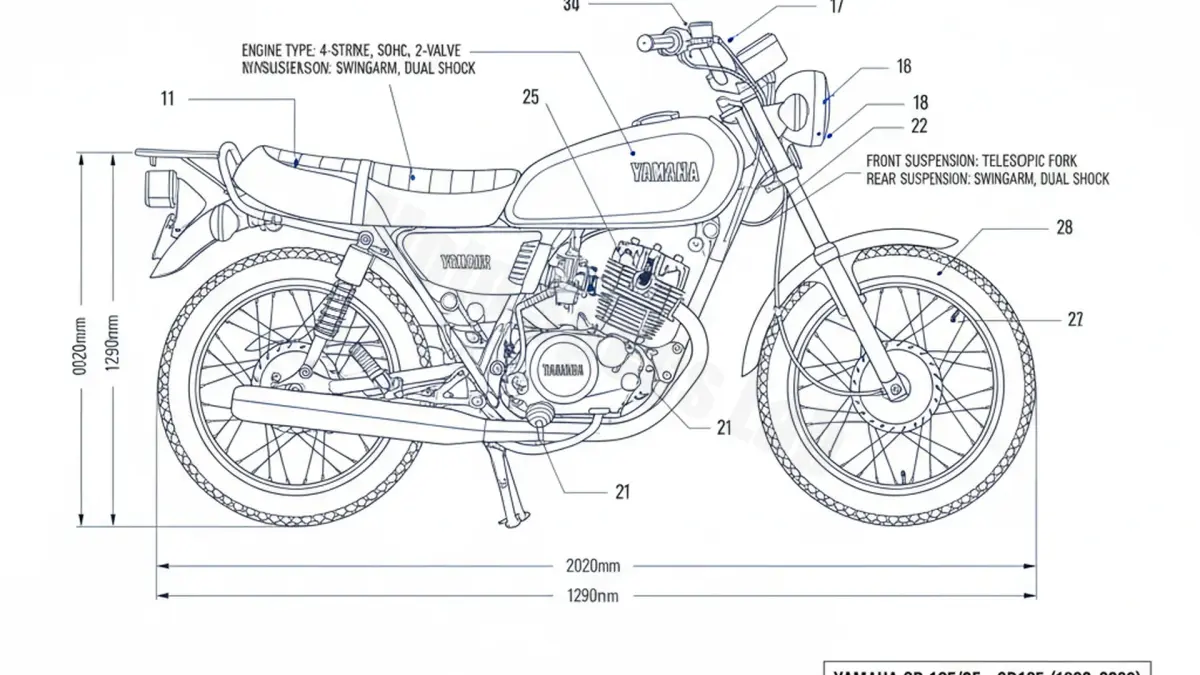
While many motorcycles chase transient trends, the Yamaha SR 125/SE stands as a testament to the longevity of the ‘Universal Japanese Motorcycle’ (UJM) philosophy. A unique engineering highlight of this machine is its remarkable 21-year production run with virtually no changes to its core architecture. This consistency was not due to a lack of innovation, but rather the perfection of its air-cooled, SOHC single-cylinder design, which became a benchmark for reliability in the 125cc class.
Technical Review: The Bulletproof Commuter
The SR 125’s heart is a 124cc four-stroke engine that prioritizes torque delivery over high-RPM power. This makes it an exceptional urban navigator. The ‘SE’ (Special Edition) variants often featured chrome accents and a slightly more cruiser-oriented aesthetic, but the mechanical soul remained focused on simplicity and ease of maintenance.
From a chassis perspective, the SR 125 utilizes a lightweight tubular steel frame. The combination of a 17-inch front wheel and a 16-inch rear wheel provides a low seat height and stable handling, making it an ideal choice for shorter riders and beginners alike.
Maintenance Guide & Technical Requirements
1. Lubrication System
The engine requires 1.1 liters of SAE 10W-40 oil. It is critical to use oil with a JASO MA rating to ensure the wet clutch does not slip. Given the air-cooled nature of the engine, regular oil changes every 3,000 km are recommended to prevent thermal degradation.
2. Ignition & Electrical
The SR 125 utilizes an NGK BP7ES spark plug. Gapping should be checked periodically to ensure efficient combustion. The electrical system is supported by a YB7L-B lead-acid battery. Owners should monitor fluid levels in the battery cells, as the charging system on older models can sometimes lead to evaporation over time.
3. Tires and Safety
Proper inflation is vital for the SR 125’s nimble handling. The front tire (3.00-17) should be maintained at 1.75 bar (25 psi). The rear tire (3.50-16) requires 2.0 bar (29 psi) for solo riding, but must be increased to 2.25 bar (33 psi) when carrying a pillion passenger to maintain sidewall integrity.
Editorial Verdict
At MotoSpecsLab, we categorize the Yamaha SR 125 as a ‘Modern Classic.’ Its mechanical transparency allows owners to perform their own servicing with basic tools, a rarity in the modern era of ECU-controlled motorcycles. If you value reliability and timeless design over raw speed, the SR 125 remains one of the most sensible investments in the used market.