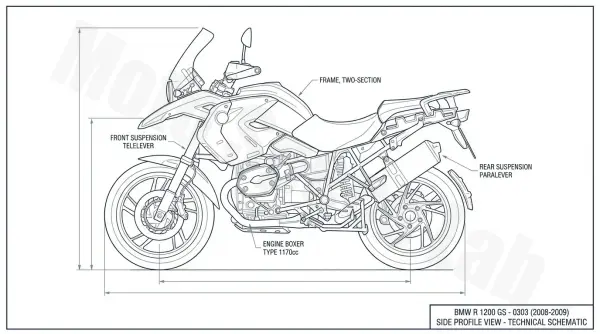
BMW R 1200 GS Maintenance Guide: 2004 – 2007 (The Hexhead Era)
Comprehensive DIY Service Instructions for the R 1200 GS (Model Code 0307)
Introduction to the BMW R 1200 GS (2004-2007)
The launch of the BMW R 1200 GS (0307) in 2004 marked a revolutionary shift for the GS lineage. Replacing the legendary R 1150 GS, the “Hexhead” R 1200 GS was 30kg lighter and significantly more powerful. For owners of the 2004, 2005, 2006, and 2007 models, performing your own maintenance is not just a way to save money—it is a way to ensure the longevity of one of the most capable adventure motorcycles ever built.
This guide covers the essential maintenance tasks required to keep your 1200 GS running smoothly, from the iconic boxer engine’s valve adjustments to the critical final drive fluid changes. Whether you are preparing for a cross-continental trek or a weekend ride, this optimized guide provides the technical specifications and step-by-step instructions you need.
Maintenance Schedule Intervals
BMW recommends a service interval every 6,000 miles (10,000 km). However, for bikes that see heavy off-road use or long periods of storage, more frequent checks are advised.
- Every 6,000 Miles: Engine oil and filter change, valve clearance check, and synchronized throttle bodies.
- Every 12,000 Miles: Change air filter, spark plugs, and final drive oil. Inspect the alternator belt.
- Every 2 Years: Flush brake fluid and change gearbox oil.
- Every 4 Years: Replace the alternator belt regardless of mileage.
Essential Tools and Supplies
Before you begin, gather the following tools and parts specific to the 2004-2007 R 1200 GS:
- Oil: 20W-50 Mineral or Semi-Synthetic (approx. 3.95 liters).
- Oil Filter: BMW Part #11427673541.
- Air Filter: BMW Part #13717672552.
- Spark Plugs: NGK DCPR8EKC (2 per cylinder).
- Final Drive Oil: 75W-90 Synthetic Gear Oil (GL-5).
- Tools: Torx T20 to T50, 19mm Allen key (for front axle), Feeler gauges (0.15mm and 0.30mm), and a Torque wrench.
1. Engine Oil and Filter Change
Changing the oil on a Hexhead boxer is straightforward but essential for cooling, as these engines are air/oil-cooled.
Step-by-Step Oil Change:
- Warm the Engine: Ride the bike for 10 minutes to reach operating temperature. This ensures the oil flows freely and contaminants are suspended.
- Drain the Oil: Place the bike on the center stand. Remove the 8mm Allen drain plug located on the bottom of the engine. Warning: The oil will be hot.
- Remove Filter: Use a BMW-specific oil filter wrench to remove the recessed filter.
- Install New Filter: Lubricate the rubber gasket of the new filter with fresh oil. Hand-tighten, then turn an additional 1/2 turn (11 Nm).
- Refill: Replace the drain plug with a new crush washer (32 Nm). Pour in 3.8 liters of 20W-50 oil through the filler cap on the left cylinder head.
- Check Level: Run the engine, let it sit for 5 minutes, and check the sight glass. The level should be at the red circle’s center.
2. Valve Clearance Adjustment
The R 1200 GS “Hexhead” uses a traditional screw-and-locknut adjuster. Incorrect valve clearances can lead to poor idling, decreased fuel economy, and “ticking” noises.
Specifications:
- Intake: 0.15 mm
- Exhaust: 0.30 mm
Procedure:
- Cold Engine Only: This must be performed when the engine is completely cold (overnight).
- Find TDC: Remove the spark plugs and the plastic timing cover. Rotate the engine (using the rear wheel in 6th gear or the alternator nut) until the “OT” mark is visible in the timing hole and the cam lobes for the cylinder you are working on are pointing away from the valves.
- Measure: Insert the feeler gauge between the rocker arm and the valve stem. It should have a slight “drag.”
- Adjust: If out of spec, loosen the 10mm locknut and turn the adjuster screw. Re-tighten the locknut (8 Nm) and re-measure.
- Repeat: Perform the same for the other cylinder.
3. Final Drive Maintenance
On 2004-2007 models, the final drive was originally marketed as “sealed for life.” However, BMW later revised this. It is now recommended to change the final drive oil every 12,000 miles to prevent bearing failure.
Note: On early 2004-2005 models, the drain plug is located at the 9 o’clock position, requiring the final drive to be dropped (pivoted down) to drain. 2006-2007 models usually have a drain plug at the 6 o’clock position.
Final Drive Oil Change:
- Drain: Remove the drain plug. If yours is at 9 o’clock, remove the speed sensor and the paralever torque arm bolt to tilt the housing down.
- Refill: Use exactly 180ml of 75W-90 GL-5 gear oil. Do not overfill, as this can blow out the seals.
- Lube Splines: While the final drive is dropped, apply a high-quality moly grease (like Optimoly TA) to the driveshaft splines.
4. Air Filter and Spark Plugs
The air filter is located under the right-hand side fuel tank cover. Remove the clips, slide the old filter out, and ensure the airbox is free of debris before sliding the new one in.
The 2004-2007 GS is a “Twin Spark” model. Each cylinder has a primary plug (under the center plastic cover) and a secondary plug (on the bottom of the cylinder). Use a thin-walled spark plug socket to avoid cracking the ceramic.
5. Alternator Belt Inspection
The alternator belt (Poly-V belt) drives the charging system. Access it by removing the front plastic engine cover. Check for cracking or fraying. On 2004-2007 models, the belt usually requires replacement every 24,000 miles. Tensioning is achieved by pivoting the alternator; however, many modern replacement belts are “elast” (stretch) belts that do not require manual tensioning.
6. Brake System & Servo-ABS
Early R 1200 GS models (up to late 2006) were equipped with Integral ABS II (Servo Brakes). These systems are incredibly powerful but complex to bleed. If your bike makes a high-pitched “whine” when you pull the brake lever, you have servo brakes.
- Maintenance: Flushing the servo-ABS system requires a specific sequence (wheel circuits vs. control circuits). If you are not comfortable with this, it is recommended to have a specialist perform the biennial flush.
- Pad Wear: Check brake pads every 6,000 miles. Sintered pads are recommended for the front for maximum stopping power.
Torque Specifications Table
| Component | Torque (Nm) |
|---|---|
| Engine Oil Drain Plug | 32 Nm |
| Oil Filter | 11 Nm |
| Spark Plugs | 12 Nm |
| Valve Cover Bolts | 10 Nm |
| Final Drive Drain Plug | 20 Nm |
| Front Brake Caliper Bolts | 30 Nm |
| Rear Wheel Lug Bolts | 60 Nm (Tighten in a cross pattern) |
Common Issues to Watch For
While the 2004-2007 R 1200 GS is robust, keep an eye on these specific areas:
- Fuel Flange Cracks: Check for fuel smells near the pump. There was a BMW recall for this issue.
- Battery Health: The CAN-bus system is sensitive to voltage. If the battery is weak, you may see “ABS” faults on the dashboard.
- Shaft Drive Boots: Inspect the rubber boots for tears. If water enters the swingarm, it will rust the U-joints.
Conclusion
The BMW R 1200 GS (2004-2007) remains one of the most versatile motorcycles on the road. By following this maintenance guide, you ensure that your “Hexhead” continues to deliver the performance and reliability it was designed for. Regular oil changes, valve adjustments, and final drive care are the keys to reaching the 100,000-mile club.
Disclaimer: This guide is for informational purposes. Always consult your official BMW service manual for specific procedures and safety warnings.