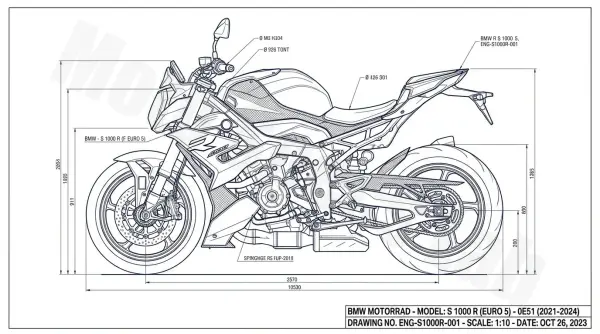
BMW S 1000 R (Euro 5) Maintenance Guide: 2021 – 2024 (Model 0E51)
The BMW S 1000 R (Model Code: 0E51), introduced for the 2021 model year, represents a significant evolution of the “Single-R” platform. Transitioning to the Euro 5 emissions standard, this generation shares much of its DNA with the S 1000 RR superbike but is tuned for street-focused torque and agility. To keep this high-performance machine running at its peak, following a strict maintenance regimen is essential.
This guide provides a deep dive into the service requirements, technical specifications, and DIY maintenance procedures for the 2021, 2022, 2023, and 2024 BMW S 1000 R models.
1. Technical Overview & Quick Specs
Before diving into the tools, it is vital to understand the core specifications of the 0E51 model. This generation features the 999cc inline-four engine without the ShiftCam technology found in the RR, optimized instead for a linear power delivery.
- Engine: 999cc, Water/Oil-cooled 4-cylinder 4-stroke inline engine
- Horsepower: 165 hp (121 kW) at 11,000 rpm
- Torque: 114 Nm at 9,250 rpm
- Oil Capacity: 3.8 Liters (4.0 US qt) with filter change
- Oil Type: SAE 5W-40, API SL / JASO MA2 (BMW Advantec Ultimate recommended)
- Coolant: Nitrite-free coolant (approx. 2.1 Liters)
- Spark Plugs: NGK LMAR9AI-10
- Chain Slack: 40–45 mm (on side stand)
2. Official BMW Service Intervals
BMW Motorrad utilizes a flexible service schedule that is tracked via the bike’s TFT display. However, the standard intervals for the Euro 5 S 1000 R are as follows:
| Service Interval | Key Actions |
|---|---|
| Running-in Service (1,000 km / 600 miles) | Oil and filter change, rev-limiter removal, check for leaks, diagnostic scan. |
| Standard Service (10,000 km / 6,000 miles) | Oil and filter change, chain lubrication/adjustment, check brake pads/fluid, reset service date. |
| Major Service (20,000 km / 12,000 miles) | Everything in Standard Service plus: Air filter replacement, spark plug replacement, valve clearance check. |
| Fork Service (30,000 km / 18,000 miles) | Change telescopic fork oil. |
| Annual Service | If mileage is not reached, oil change and brake fluid check must be performed every 12 months. |
3. Engine Oil and Filter Change
The oil change is the most critical maintenance task for the S 1000 R. Given the high-revving nature of the 0E51 engine, clean oil ensures the longevity of the plain bearings and the complex valvetrain.
Tools Needed:
- 17mm Socket (Drain plug)
- Oil filter wrench (BMW-specific or 74mm 14-flute)
- Torque wrench
- New crush washer (M16)
The Process:
- Warm the Engine: Run the bike for 5 minutes to allow the oil to flow more easily.
- Drain the Oil: Remove the drain plug located at the bottom of the sump. Be careful as the oil will be hot.
- Remove Filter: Position the oil pan under the filter (front of the engine). Unscrew the old filter.
- Install New Filter: Lubricate the rubber gasket of the new filter with fresh oil. Hand-tighten, then torque to 11 Nm.
- Replace Drain Plug: Use a new crush washer. Torque the drain plug to 28 Nm.
- Refill: Add 3.8 liters of 5W-40 synthetic oil. Start the engine, let it idle for 1 minute, shut it off, and check the sight glass after 5 minutes.
4. Drivetrain: Chain and Sprockets
The 2021+ S 1000 R often comes equipped with the M Endurance Chain. While BMW claims this chain is “maintenance-free” due to its industrial diamond coating (DLC), real-world usage suggests it still requires periodic cleaning and tensioning.
Chain Tension Adjustment:
Chain slack should be measured midway between the sprockets on the bottom run while the bike is on its side stand. The ideal slack is 40–45 mm.
- Loosen the rear axle nut (34mm).
- Adjust the tensioning bolts equally on both sides.
- Ensure the alignment marks on the swingarm match perfectly.
- Torque the rear axle nut to 100 Nm.
5. Braking System Maintenance
The 0E51 generation uses BMW-branded Hayes or Nissin calipers (depending on the production batch and recalls). These brakes offer immense stopping power but require attention to fluid levels and pad wear.
Brake Fluid:
BMW specifies DOT 4 Low Viscosity (LV) brake fluid. The fluid should be replaced every two years regardless of mileage. If the fluid appears dark, it has absorbed moisture and should be flushed immediately to prevent ABS pump failure.
Brake Pads:
Inspect the grooves in the brake pads. If the groove is no longer visible, the pads have reached their wear limit (approx. 1.0 mm of friction material). Use only high-quality sintered pads to maintain the bite required for this 165hp machine.
6. Cooling System & Euro 5 Considerations
The Euro 5 engine runs hotter than previous generations to ensure complete combustion of gases. This puts extra stress on the cooling system.
- Coolant Level: Check the expansion tank located on the right side of the bike. The level should be between the MIN and MAX marks when the engine is cold.
- Radiator Fins: The S 1000 R’s radiator is prone to stone damage. Check for bent fins or leaks. Installing a radiator guard is highly recommended for this model.
7. Air Filter and Spark Plugs
Accessing the airbox on the 2021-2024 model requires removing the center tank cover and the side panels. This is a labor-intensive process compared to older models.
- Air Filter: Inspect every 10,000 km. Replace every 20,000 km. If riding in dusty environments, replace sooner.
- Spark Plugs: The 0E51 uses long-thread NGK LMAR9AI-10 plugs. These are sensitive to torque; ensure they are torqued to 12 Nm to avoid damaging the cylinder head threads.
8. Battery and Electronics
The S 1000 R is a rolling computer. The 6.5-inch TFT display and the various riding modes (Rain, Road, Dynamic, Dynamic Pro) rely on a healthy battery voltage.
If the bike is stored for more than two weeks, use a BMW-compatible CAN-bus charger. Standard chargers may not “wake up” the accessory socket, leading to a dead battery. If replacing the battery, ensure it is an AGM or Lithium-ion (if equipped with the M Package) with the correct CCA (Cold Cranking Amps) rating.
9. Critical Torque Specifications (0E51 Model)
| Component | Torque Value |
|---|---|
| Engine Oil Drain Plug | 28 Nm |
| Oil Filter | 11 Nm |
| Rear Axle Nut | 100 Nm |
| Front Axle Bolt | 50 Nm |
| Front Axle Pinch Bolts | 19 Nm |
| Front Brake Caliper Bolts | 38 Nm |
| Spark Plugs | 12 Nm |
10. Troubleshooting Common Issues
While the 2021–2024 S 1000 R is generally reliable, some owners have reported specific Euro 5-related quirks:
- SOS Warning: The “Intelligent Emergency Call” system may occasionally throw a failure code if the internal battery of the SOS module is low.
- Quickshifter (Shift Assistant Pro) Stiffness: Often solved by ensuring the chain tension is exactly within the 40-45mm spec. A loose chain significantly degrades shift quality.
- Cold Start Rattles: The cam chain tensioner uses oil pressure. A brief rattle for 1-2 seconds on a cold start is considered normal by BMW, but persistent noise should be investigated.
Conclusion
The BMW S 1000 R (0E51) is a precision instrument. Maintaining the Euro 5 standards while delivering supercar-level performance requires diligent care. By adhering to the 10,000 km service intervals, using the correct 5W-40 synthetic oil, and keeping a close eye on the electronics and drivetrain, you ensure that your S 1000 R remains a reliable and exhilarating partner on the road.
Disclaimer: This guide is for informational purposes. Always refer to your official BMW Rider’s Manual for specific instructions. If you are not confident in your mechanical abilities, please visit an authorized BMW Motorrad service center.