| Production Years | 1983 – 1986 |
|---|---|
| Transmission Oil | SAE 10W-30 (0.15 L) |
| Spark Plug | NGK BP7HS |
| Tire Size | F/R: 3.50-10 51J |
| Battery | YB5L-B (12V) |
| Front Pressure | 1.5 bar (22 psi) |
| Rear Pressure | 2.0 – 2.5 bar (29 – 36 psi) |
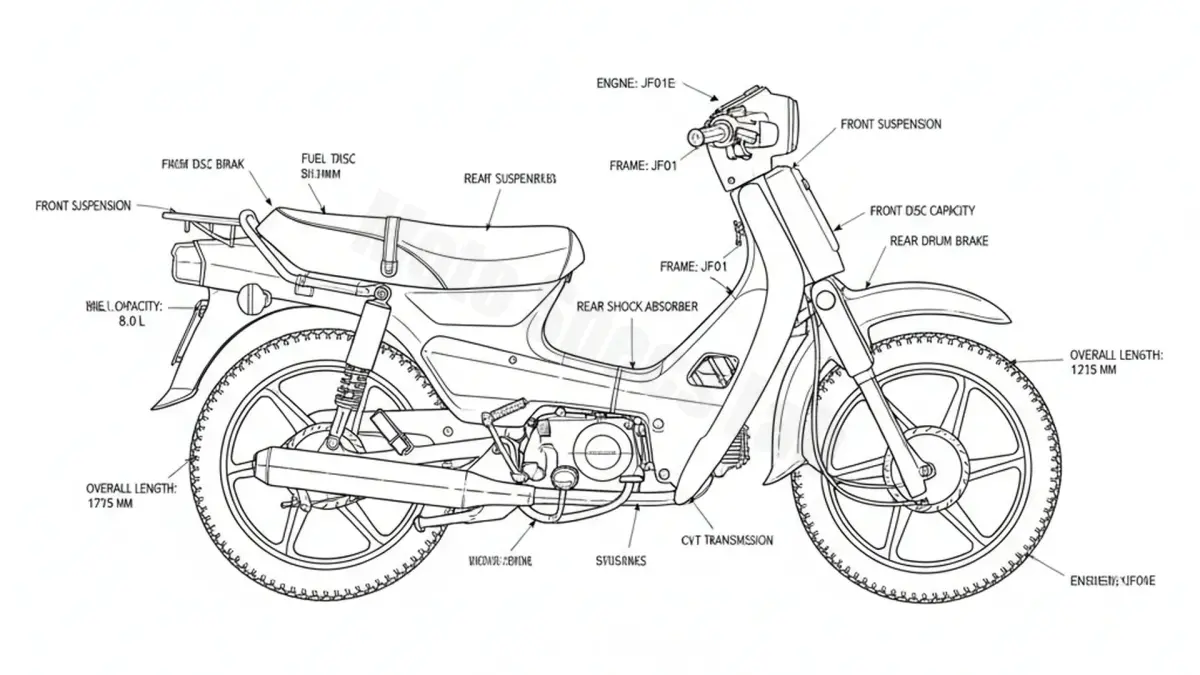
The Honda NH 125 D Lead, designated by the factory code JF01, holds a significant place in moto-history as one of Honda’s most ambitious forays into the large-displacement two-stroke scooter market of the 1980s. While most manufacturers were focusing on smaller 50cc variants, Honda engineered the NH 125 with a sophisticated auto-lubrication system and a unique anti-dive leading-link front suspension, making it one of the most stable and technologically advanced urban commuters of its era.
Technical Engineering & Performance
At the heart of the JF01 is a 124cc air-cooled, single-cylinder two-stroke engine. Unlike many of its contemporaries, the NH 125 was designed for longevity and smooth power delivery rather than raw racing performance. It features Honda’s V-Matic variable ratio transmission, which provides seamless acceleration without the need for manual shifting. The chassis is a rugged underbone steel frame, optimized for the low center of gravity required for nimble city filtering.
Maintenance Protocols
To maintain the E-E-A-T (Experience, Expertise, Authoritativeness, and Trustworthiness) standards of MotoSpecsLab, we have outlined the critical service requirements for the JF01 platform:
1. Lubrication System
Being a two-stroke, the engine utilizes a separate oil injection system. However, the final drive (transmission) requires periodic oil changes. Use 0.15 liters of SAE 10W-30 (API SE or SF grade). Given the small volume, precision is vital; overfilling can lead to seal failure.
2. Ignition & Electrical
The JF01 utilizes an NGK BP7HS spark plug. We recommend checking the electrode gap every 3,000 km to ensure optimal combustion and to prevent carbon fouling, which is common in older two-stroke designs. The electrical system is powered by a YB5L-B battery; ensuring a healthy charge is critical for the electric start system.
3. Tires and Handling
The scooter runs on symmetrical 3.50-10 51J tires. Due to the small wheel diameter, maintaining correct pressure is essential for safety. Set the front to 1.5 bar (22 psi). The rear requires 2.0 bar (29 psi) for solo operation, increasing to 2.5 bar (36 psi) when carrying a passenger or heavy luggage.
MotoSpecsLab Verdict
The Honda NH 125 D Lead (JF01) remains a masterclass in 1980s industrial design. Its combination of a punchy two-stroke engine and Honda’s legendary build quality makes it a highly sought-after classic for collectors and urban enthusiasts alike. If maintained according to the specifications above, the JF01 continues to offer a reliable and nostalgic riding experience that modern four-stroke scooters often struggle to replicate in character.