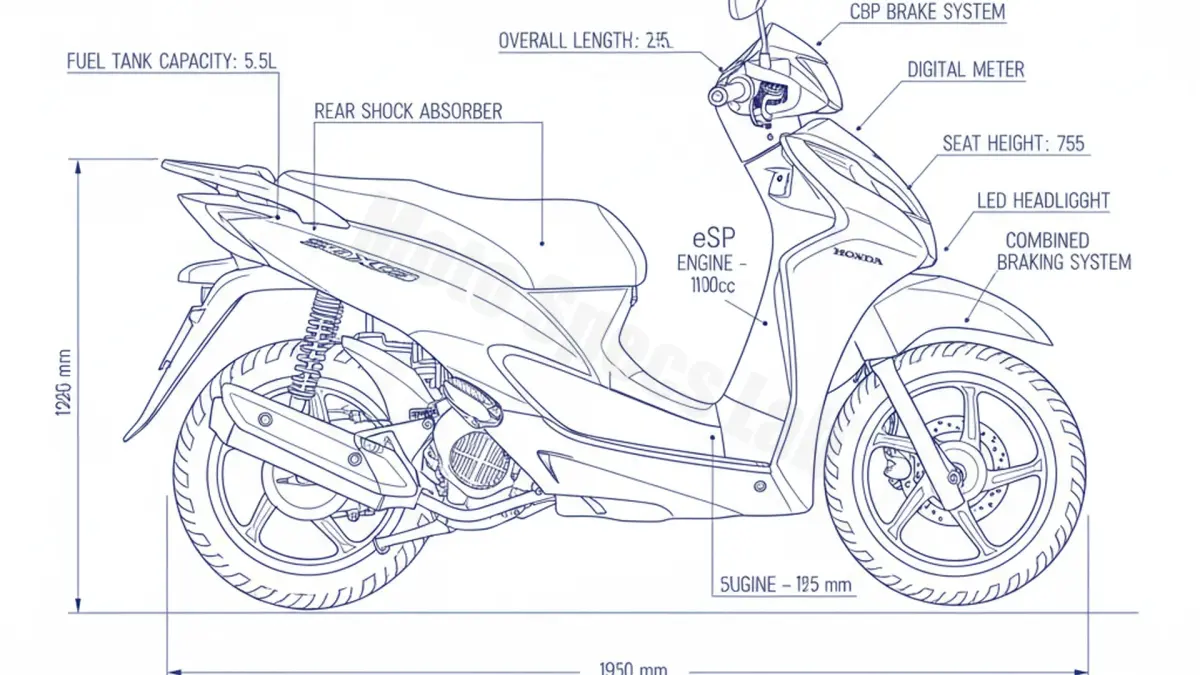
| Parameter | Specification |
|---|---|
| Production Years | 2011 – 2016 |
| Engine Type | Air-cooled 4-stroke OHC single |
| Engine Oil | SAE 10W-30 JASO MB (0.7 L capacity) |
| Front Tire | 80/90-14 M/C 40P |
| Rear Tire | 90/90-14 M/C 46P |
| Tire Pressure (F/R) | F: 2.00 bar | R: 2.25 – 2.80 bar |
| Battery | YTZ6V |
| Spark Plug | NGK CPR7EA-9 |
The Honda Vision 110 (JF53) holds a unique position in Honda’s engineering history as the first ‘Global Scooter’ designed to be manufactured across several continents with a unified parts ecosystem. Unlike previous regional models, the JF53 was engineered specifically to balance the low-friction requirements of Asian markets with the high-speed stability demands of European urban centers, introducing the Combined Braking System (CBS) as a standard safety feature for the entry-level segment.
Engineering Overview
The JF53 chassis is built around a high-rigidity underbone frame that provides the foundation for its agile handling. The heart of the machine is its air-cooled, fuel-injected engine. While simple in architecture, it utilizes low-friction technologies such as a needle roller bearing for the rocker arm shaft and an offset cylinder to minimize piston-wall friction. This focus on efficiency allows the 0.7-liter oil capacity to remain effective even under the thermal stresses of city stop-and-go traffic.
Maintenance & Fluid Dynamics
Proper maintenance of the JF53 is predicated on using the correct lubricants. Honda specifies JASO MB oil for this model. Unlike JASO MA oils (designed for wet clutches), JASO MB is a low-friction lubricant optimized for the dry-clutch CVT transmission found in the Vision 110. Using JASO MA may lead to decreased fuel economy and increased internal drag.
Ignition and Electrical
The electrical system relies on the compact YTZ6V battery to power the PGM-FI system. For optimal combustion, the NGK CPR7EA-9 spark plug should be gapped correctly and inspected every 4,000 miles. A fouled plug in this small-displacement engine significantly impacts cold-start reliability and throttle response.
Chassis and Safety: The CBS System
The ‘CBS’ in the model name refers to Honda’s Combined Braking System. When the left brake lever (rear) is applied, it also activates the front hydraulic disc brake via a delay valve. This ensures balanced deceleration, which is critical given the narrow 14-inch tire profile. Maintaining correct tire pressures—2.00 bar front and up to 2.80 bar rear when loaded—is vital to prevent ‘tramlining’ and to ensure the CBS distributes braking forces as intended.
Frequently Asked Questions
What is the oil change interval?
Honda recommends changing the engine oil every 2,500 to 4,000 miles, depending on the severity of use. Given the small 0.7L sump, regular checks are mandatory.
Can I use 10W-40 oil?
While 10W-40 can be used in warmer climates, 10W-30 is the factory recommendation for maintaining the intended fuel efficiency and flow rates to the cylinder head.
Why is my rear tire pressure so high?
The 2.80 bar (41 psi) rating is specifically for riding with a pillion passenger to prevent tire deformation and overheating on the 90/90-14 rear carcass.