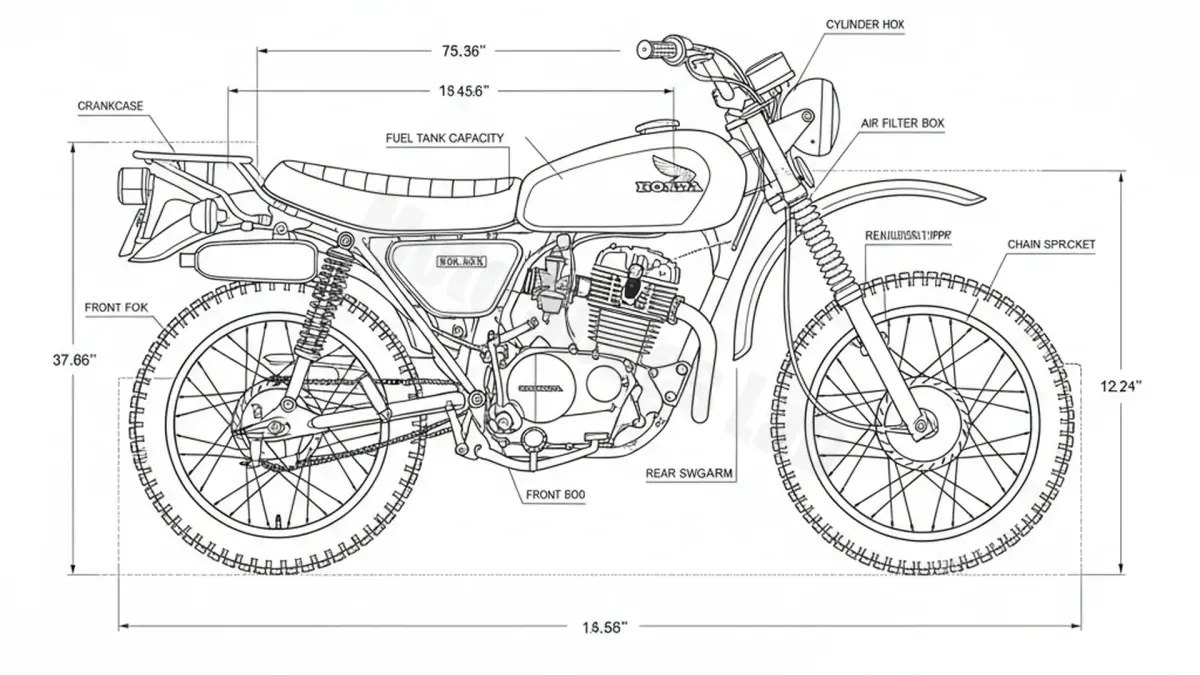
| Specification | Data |
|---|---|
| Production Years | 1977 – 1982 |
| Engine Type | 49cc Single-Cylinder, 4-Stroke, OHC |
| Oil Type / Capacity | SAE 10W-40 (API SE/SF) / 0.7 Liters |
| Tire Size (Front/Rear) | 2.50-16 / 3.00-14 |
| Tire Pressure (Front/Rear) | 1.25 bar (18 psi) / 1.50 bar (21 psi) |
| Battery Type | 6N4-2A (6V) |
| Spark Plug | NGK C7HS (Gap: 0.6 – 0.7 mm) |
The Honda XL 50 holds a unique place in motorcycling history as the machine that democratized the “XL” dual-sport lineage. While its larger siblings were conquering the Baja 1000, the XL 50 utilized a sophisticated overhead camshaft (OHC) horizontal engine—an engineering feat for a 50cc bike of that era, which was largely dominated by simpler, smokier two-strokes.
Engineering & Performance
At the heart of the XL 50 is Honda’s legendary four-stroke, air-cooled single. Unlike the mopeds of the late 1970s, the XL 50 offered a true motorcycle experience with a manual 4-speed gearbox. The OHC design allowed for a cleaner power delivery and higher RPM ceiling compared to pushrod designs, making it an exceptionally reliable platform for young riders and urban commuters alike.
Maintenance Guide
Lubrication System
The XL 50 relies on a wet sump system. For optimal engine longevity, MotoSpecsLab recommends using SAE 10W-40 oil meeting API SE or SF standards. The total capacity is a modest 0.7 liters. Given the lack of a traditional oil filter (utilizing a centrifugal cleaner and screen), frequent oil changes every 1,000 km are vital to prevent sludge buildup.
Ignition & Electrical
The 6-volt electrical system is powered by a 6N4-2A battery. Ignition timing is critical on these small-displacement engines. Ensure the NGK C7HS spark plug is gapped precisely between 0.6 mm and 0.7 mm to ensure consistent combustion and easy cold starts.
Chassis & Tires
The XL 50’s agility comes from its staggered wheel setup: a 16-inch front and a 14-inch rear. For balanced handling on mixed surfaces, maintain pressures at 1.25 bar (18 psi) for the front and 1.50 bar (21 psi) for the rear. Over-inflating the rear tire can lead to reduced traction in off-road scenarios, while under-inflation risks rim damage on the small 14-inch hoop.
MotoSpecsLab Verdict
The Honda XL 50 (XL50) remains a masterclass in “small-scale” engineering. It proved that a 50cc machine could be more than a toy; it could be a rugged, technically competent motorcycle. For collectors and enthusiasts, maintaining the 6V system and clean oil passages are the keys to keeping this vintage enduro on the trails for another four decades.
Frequently Asked Questions
Q: Can I use modern synthetic oil in an XL 50?
A: While possible, it is safer to use high-quality mineral or semi-synthetic 10W-40 oils designed for wet clutches to prevent slippage.
Q: What is the primary cause of poor idling on the XL50?
A: Usually, it is a clogged pilot jet in the Keihin carburetor or an incorrectly gapped NGK C7HS spark plug.