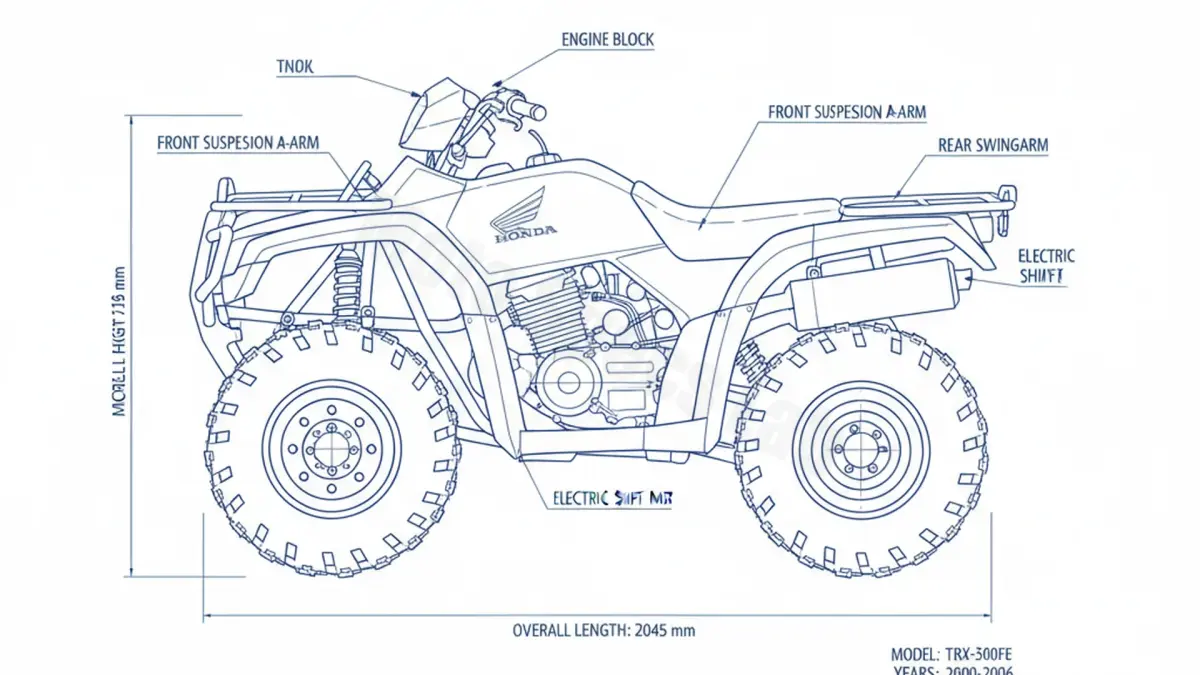
Engineering Highlight: The Honda TRX 350 FE (Rancher ES) was a pivotal model in Honda’s utility lineup, famously introducing the second generation of the Electric Shift Program (ESP). This system allowed riders to shift gears via handlebar-mounted buttons, utilizing an ECU-controlled shift motor that balanced the mechanical durability of a manual transmission with the ergonomics of a clutchless interface—a design that remains a benchmark for utility ATV reliability today.
| Attribute | Specification |
|---|---|
| Production Years | 2000-2006 |
| Engine Oil | SAE 10W-40 JASO MA (1.9 L) |
| Front Tires | 24 x 8-12 |
| Rear Tires | 24 x 9-11 |
| Tire Pressure | 0.2 bar (2.8 psi) F/R |
| Battery | YTX14-BS |
| Spark Plug | NGK DPR7EA-9 / DENSO X22EPR-U9 |
Technical Analysis: The Rancher 350 Legacy
The TRX 350 FE features a longitudinal, air-cooled 329cc OHV engine. By orienting the crankshaft longitudinally, Honda eliminated several 90-degree power turns in the drivetrain, significantly reducing mechanical friction and improving power delivery to the 4WD system. The “FE” designation specifically identifies this model as having 4WD and the Electric Shift Program.
Maintenance Essentials
Lubrication System: The 1.9-liter oil capacity is critical. Because the engine is air-cooled and shares its oil with the transmission, using a JASO MA rated oil is non-negotiable to prevent clutch slippage within the ESP system. We recommend high-performance 10W-40 synthetic blends for heavy utility work.
Electrical & Ignition: The YTX14-BS battery provides the necessary cold cranking amps (CCA) to operate the electric shift motor. If shifting becomes sluggish or the display shows error codes (blinking bars), the battery voltage is the first component to inspect. The NGK DPR7EA-9 spark plug should be gapped at 0.8-0.9mm to ensure optimal combustion efficiency.
Editorial Review: MotoSpecsLab Verdict
The Honda TRX 350 FE is often cited as the “bulletproof” era of ATVs. Its simplicity is its greatest strength. While it lacks the independent rear suspension (IRS) found on modern units, its swingarm setup offers superior towing stability. The ESP system, while occasionally requiring sensor cleaning (Angle Sensor), remains one of the most intuitive utility transmissions ever built.
- Pros: Exceptional engine longevity, compact chassis for tight trails, reliable 4WD engagement.
- Cons: Limited suspension travel compared to modern IRS models, ESP system sensitive to low battery voltage.
Frequently Asked Questions
What oil capacity is required for a filter change?
The Honda TRX 350 FE requires approximately 1.9 liters (2.0 US qt) of oil when changing the oil and filter.
Why is my ESP shifting intermittently?
Intermittent shifting is usually caused by a weak YTX14-BS battery or a dirty shift motor. Ensure your battery is holding at least 12.6V under load.
What is the factory tire pressure?
Both front and rear tires should be set to a low-pressure specification of 0.2 bar (2.8 psi) to maintain the intended footprint and traction.