| Component | Specification |
|---|---|
| Engine Oil | SAE 10W-30 (API SG+, JASO T 903: MA) (2.7 L) |
| Tires (Front/Rear) | F: 120/70 ZR 17 / R: 160/60 ZR 17 |
| Tire Pressure | F: 2.5 bar (36 psi) / R: 2.9 bar (42 psi) |
| Battery | YTZ10S |
| Spark Plug | NGK CPR8EA-9 (Gap: 0.80–0.90 mm) |
Engineering Highlight: The PC63 generation of the Honda CB 500 F represents a significant milestone in A2-compliant engineering. Unlike its predecessors, the PC63 introduced a revised valve timing strategy and a redesigned intake tract that optimized mid-range torque between 3,000 and 7,000 RPM, successfully balancing EURO 5 emissions compliance without sacrificing the linear power delivery that defines the parallel-twin platform.
Technical Review: The PC63 Evolution
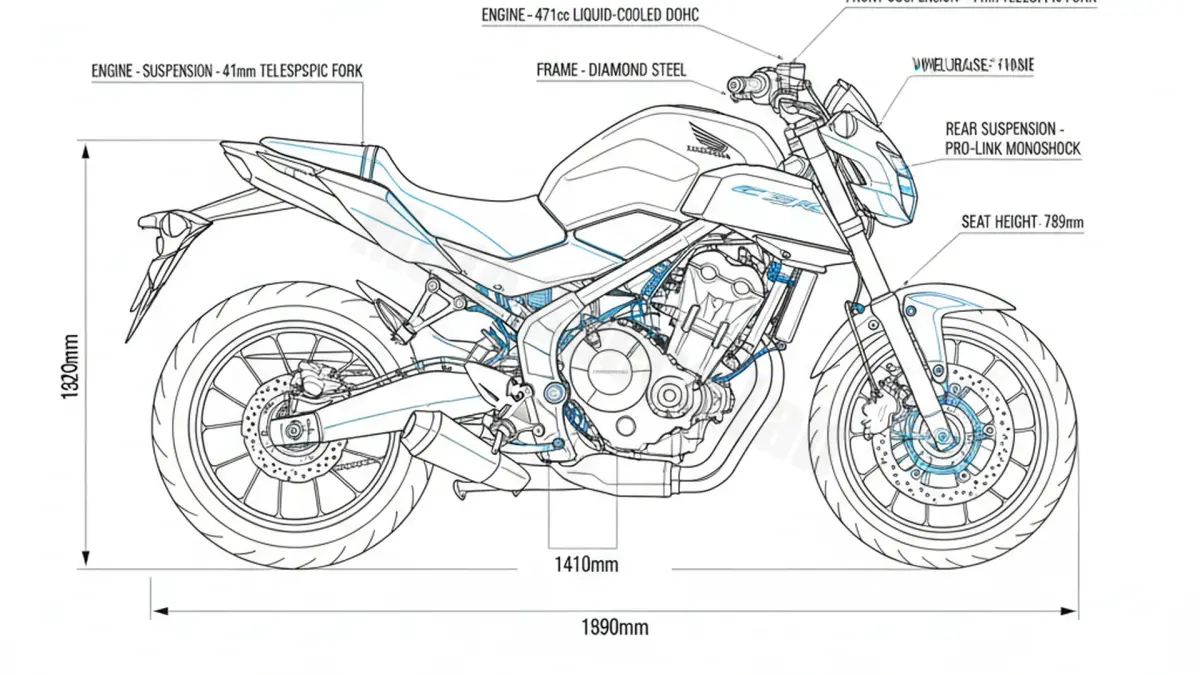
Launched in 2019 and refined through 2023, the PC63 chassis is built around a diamond-shaped steel tube mainframe. The 471cc liquid-cooled parallel-twin engine acts as a stressed member, enhancing torsional rigidity. For the 2022 update, Honda further elevated the platform by replacing the standard telescopic forks with 41mm Showa SFF-BP (Separate Function Fork Big Piston) USD forks and adding dual front disc brakes, drastically improving the unsprung weight ratio and front-end feedback.
The assist/slipper clutch is a standout feature in this displacement class, significantly reducing lever effort and preventing rear-wheel hop during aggressive downshifting. This makes the PC63 not just an entry-level machine, but a precision tool for experienced riders seeking efficiency and reliability.
Professional Maintenance Guide
Lubrication System
For optimal engine longevity, MotoSpecsLab recommends SAE 10W-30 oil meeting the JASO MA standard. The total oil capacity for a filter change is 2.7 liters. Given the high-revving nature of the 471cc twin, maintaining oil quality is critical for protecting the cam lobes and transmission gears.
Chassis & Tires
The PC63 utilizes a 120/70-17 front and a 160/60-17 rear tire setup. To maintain the bike’s neutral handling characteristics, pressures must be strictly adhered to: 2.5 bar (36 psi) in the front and 2.9 bar (42 psi) in the rear. Under-inflation leads to sluggish steering and increased heat buildup, which can compromise the carcass integrity during long-distance touring.
Ignition & Electrical
The electrical system relies on the compact YTZ10S battery. For the ignition system, the NGK CPR8EA-9 spark plugs are specified. It is vital to verify the electrode gap of 0.80–0.90 mm before installation to ensure complete combustion and prevent fouling, especially in colder climates where EURO 5 mapping can be lean during warm-up phases.
Frequently Asked Questions (FAQ)
Q: How often should the valve clearance be checked on the PC63?
A: Honda recommends a valve clearance inspection every 24,000 km (16,000 miles).
Q: Can I use 10W-40 oil instead of 10W-30?
A: While 10W-40 is acceptable in hotter climates, 10W-30 is the factory-recommended viscosity for optimal fuel efficiency and cold-start lubrication as per the PC63’s engineering tolerances.