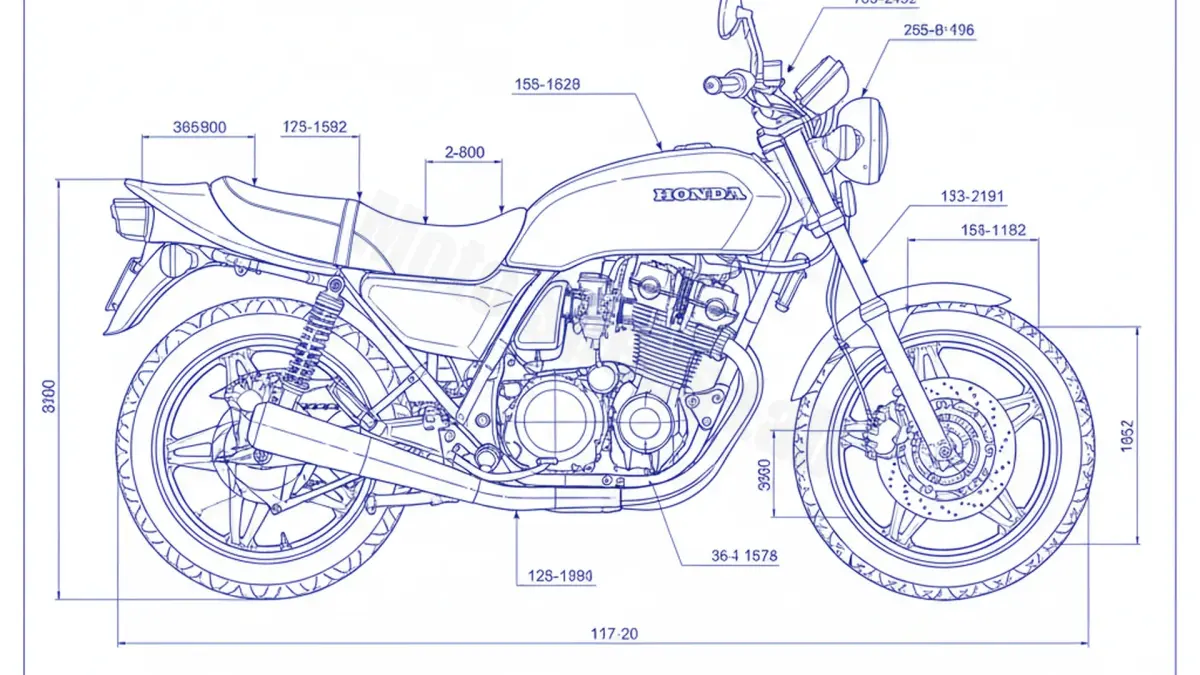
Historical Engineering Highlight: The Honda CBX 550 F is most famously recognized for its revolutionary “Inboard Ventilated Disc Brakes.” While they appeared to be drum brakes from a distance, they were actually sophisticated disc units enclosed in a ventilated housing to prevent brake fade in wet conditions and provide a clean, uncluttered aesthetic to the ComStar wheels.
| Parameter | Specification |
|---|---|
| Production Years | 1982 – 1984 |
| Engine Type | Inline-4, DOHC, 16-valve |
| Engine Oil | SAE 10W-40 API SE/SF (JASO MA) (2.5 L) |
| Tires (Front/Rear) | F: 100/90-18 56H / R: 115/90-18 65H |
| Tire Pressure | F: 2.25 bar / R: 2.25 – 2.80 bar |
| Battery | YB12A-A |
| Spark Plug | NGK DR8ES-L (0.6–0.7 mm gap) |
Technical Review: The PC04 Platform
The Honda CBX 550 F (and its faired sibling, the F2) was Honda’s definitive answer to the burgeoning mid-sized performance market of the early 1980s. At its heart lies a high-revving 572cc, air-cooled, DOHC 16-valve inline-four engine. Unlike the larger CBX models, the 550 focused on agility and technical sophistication over raw displacement.
The PC04 chassis utilized a Pro-Link rear suspension system, which was cutting-edge at the time, offering rising-rate damping that improved both comfort and high-speed stability. The frame was a tubular steel cradle designed to handle the 60+ horsepower output, though the bike’s narrow 18-inch wheels remind the modern rider of its vintage handling characteristics.
Maintenance Guide & Essential Service Data
Maintaining a CBX 550 F requires attention to its unique components. The inboard brakes, while effective, are notoriously labor-intensive to service compared to standard external discs. Regular inspection of the ventilation ducts is required to prevent debris buildup.
Lubrication and Fluids
For the PC04 engine, use a high-quality SAE 10W-40 oil meeting JASO MA standards to ensure the wet clutch operates without slipping. A total oil change requires 2.5 liters. Given the air-cooled nature of this engine, frequent oil changes (every 3,000–5,000 km) are recommended to preserve the valve train.
Ignition and Electrical
The ignition system relies on NGK DR8ES-L spark plugs. For optimal combustion, the gap must be precisely set between 0.6 and 0.7 mm. The electrical system is powered by a standard YB12A-A lead-acid battery; owners should ensure the charging system is outputting correctly, as vintage Honda regulators can be a point of failure.
Tires and Handling
The CBX 550 F uses specific 18-inch fitments: 100/90-18 on the front and 115/90-18 on the rear. Maintaining correct pressure is vital for the bike’s tip-in characteristics. We recommend 2.25 bar (32 psi) for the front and 2.25 bar (32 psi) for the rear under normal conditions, increasing the rear to 2.80 bar (40 psi) when carrying a pillion or heavy luggage.
Editor’s Verdict
The Honda CBX 550 F/F2 remains a cult classic. Its combination of 16-valve power and unique styling makes it a standout piece of 1980s engineering. While the inboard brakes and complex valve adjustments require a dedicated mechanic, the reward is a smooth, high-revving experience that captures the essence of Honda’s golden era of innovation.