| Specification | Data |
|---|---|
| Production Years | 2004–2017 |
| Engine Oil | SAE 10W-30 (0.66-0.67 L) |
| Transmission Oil | SAE 10W-30 (0.60-0.68 L) |
| Tire Size (F/R) | 80/100-21 / 100/90-19 |
| Spark Plug | NGK IMR9C-9H / R0452A-10 |
| Starting System | Kickstart Only |
A milestone in motocross engineering, the Honda CRF 250 R (ME10A/D) was the machine that signaled the end of the two-stroke dominance in the 125cc class. Its most significant engineering highlight is the Unicam® valve train. By using a single overhead cam to actuate both intake and exhaust valves, Honda achieved the weight savings of a SOHC design with the high-RPM performance typically reserved for DOHC engines, allowing for a more compact cylinder head and a lower center of gravity.
Technical Engineering Overview
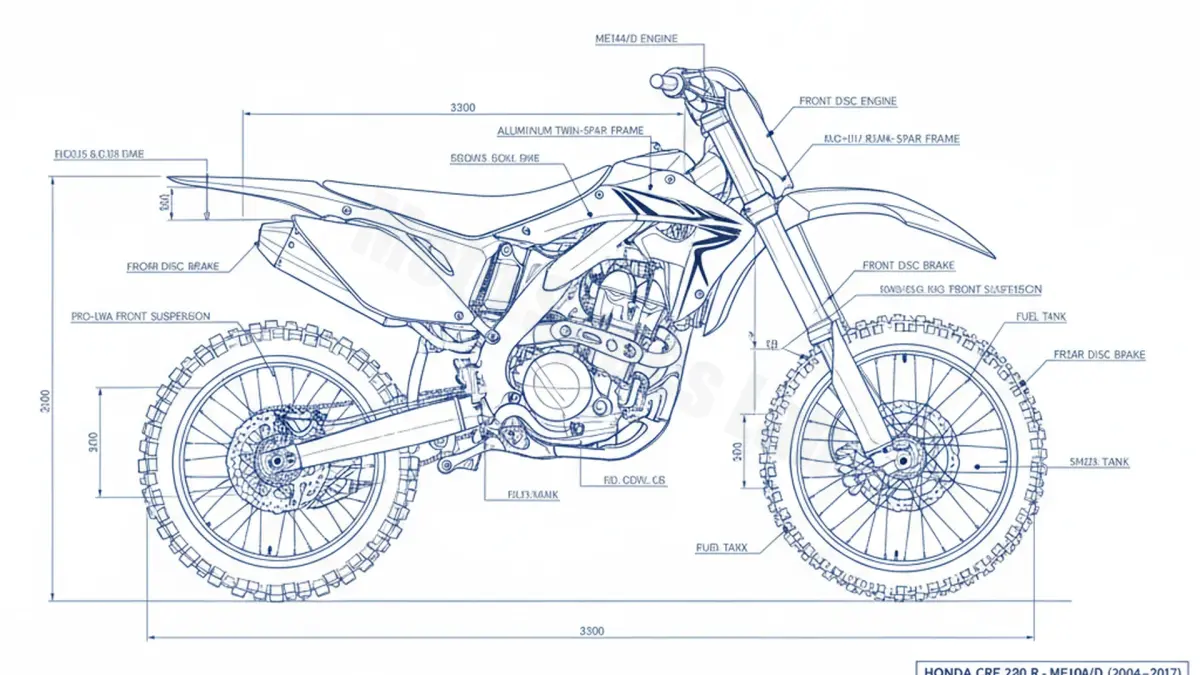
The ME10A/D chassis evolved through several generations, notably transitioning from the carbureted Keihin FCR era (2004-2009) to Programmed Fuel Injection (PGM-FI) in 2010. This transition refined the power delivery, making the CRF 250 R one of the most agile and predictable bikes in the quarter-liter class. The frame, a sixth-generation aluminum twin-spar design by the end of this production run, was specifically tuned for lateral flexibility to improve cornering feel.
Maintenance Guide: The Dual-Sump System
One of the most critical maintenance aspects of the CRF 250 R is its dual-sump lubrication system. Unlike many other four-strokes, Honda separates the engine oil from the transmission oil. This prevents clutch debris from contaminating the engine’s top end and crankshaft.
- Engine Oil: Use Pro Honda GN4 or HP4 SAE 10W-30. Capacity is approximately 0.66 to 0.67 liters.
- Transmission Oil: Use the same JASO T 903 MA spec oil. Capacity ranges from 0.60 to 0.68 liters depending on the specific year.
- Service Interval: For competitive use, oil should be changed every 15 hours of operation, with oil filters replaced every other oil change.
Chassis and Ignition
The CRF 250 R utilizes a high-performance ignition system that varies by generation. The 2004-2009 models require the NGK IMR9C-9H, a laser iridium plug designed to withstand the heat of high-compression racing. The 2010-2017 fuel-injected models moved to the NGK R0452A-10 to accommodate the different combustion characteristics of the PGM-FI system.
Tire pressure is standardized for track conditions at 1.0 bar (15 psi) for both the front 80/100-21 and rear 100/90-19 tires, though riders may drop to 12-13 psi for increased traction in soft loam or sand.
Final Verdict
The Honda CRF 250 R (ME10A/D) remains a benchmark for handling and ergonomic design. While it requires a disciplined maintenance schedule—particularly regarding valve clearances and separate oil reservoirs—it rewards the rider with surgical precision and a broad, usable powerband that is accessible to both intermediates and pro-level racers.