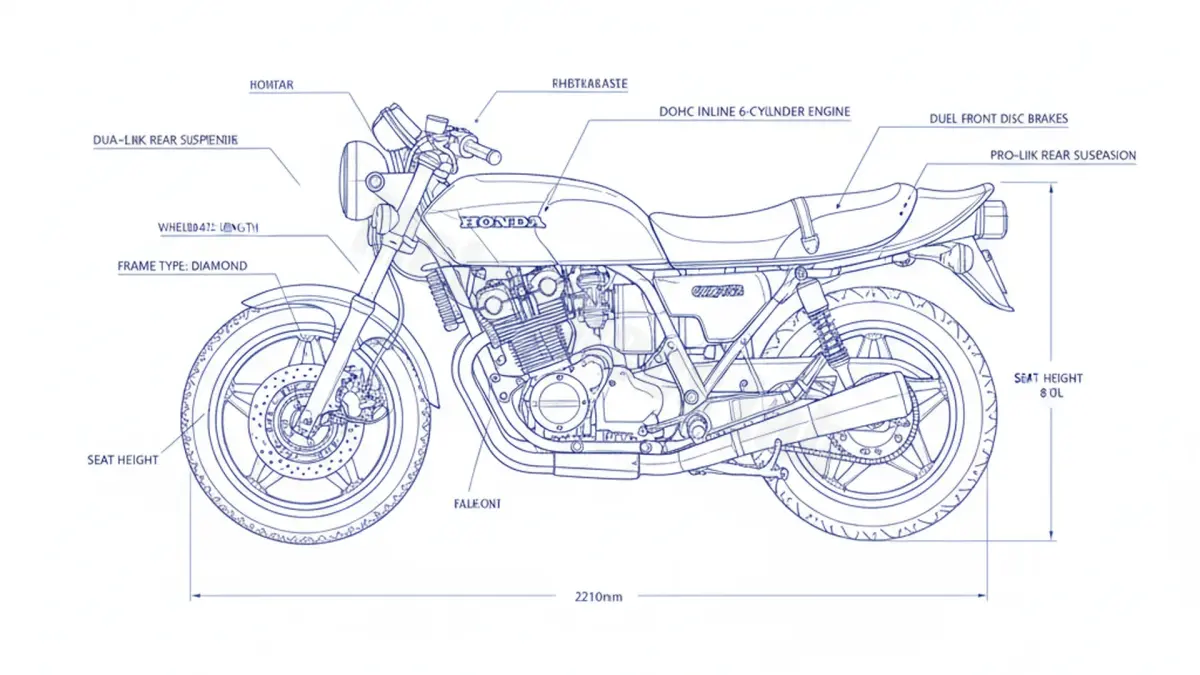
| Component | Specification |
|---|---|
| Production Years | 1978 – 1979 (CB1) |
| Engine Type | 1047cc Inline-6, DOHC, 24-Valve |
| Engine Oil | SAE 10W-40 API SE (4.0 L) |
| Tire Size (Front/Rear) | F: 3.50-V19 / R: 4.25-V18 |
| Tire Pressure (F/R) | 2.0 bar (28 psi) / 2.2 bar (32 psi) |
| Spark Plug | NGK DR8ES-L |
| Battery | Y50-N18L-A |
Historical Engineering Highlight: Designed by Shoichiro Irimajiri, who previously engineered Honda’s legendary multi-cylinder Grand Prix racing engines, the CBX 1000 was a technological tour de force. A unique engineering detail of the CB1 is the “vee” orientation of its intake tract; to keep the engine’s width manageable for the rider, the six 28mm Keihin CV carburetors are canted inward, allowing for a narrower profile at the knees despite the massive transverse engine block.
Technical Deep Dive: The Inline-Six Powerhouse
The CBX 1000 CB1 remains one of the most iconic motorcycles ever produced, primarily due to its 1,047cc DOHC 24-valve engine. Producing 105 bhp at 9,000 rpm, it was the fastest production motorcycle of its era. The engine serves as a stressed member of the frame, utilizing a diamond-configuration steel chassis that leaves the spectacular six-cylinder bank fully exposed to the eye.
Maintenance Protocol & Technical Guidelines
1. Lubrication System
The CBX is an air-cooled machine with a high thermal load due to the proximity of the central cylinders. We recommend using a high-quality SAE 10W-40 API SE oil. The total capacity is 4.0 liters. Given the complexity of the internal oil galleries, frequent changes are essential to prevent sludge buildup in the primary chain tensioner area.
2. Ignition & Electrical
For optimal combustion across all six cylinders, the NGK DR8ES-L spark plug is the factory standard. Ensuring the gap is precise is critical for a smooth idle. The electrical system is supported by a substantial Y50-N18L-A battery, which is necessary to provide the cranking amps required to turn over the heavy six-cylinder rotating assembly.
3. Chassis & Tires
The CB1 utilizes a 19-inch front and 18-inch rear wheel setup. For modern riding while maintaining period-correct handling characteristics, stick to the 3.50-V19 front and 4.25-V18 rear sizing. Maintain pressures at 2.0 bar (28 psi) in the front and 2.2 bar (32 psi) in the rear to mitigate the “hinge-in-the-middle” sensation often reported under heavy cornering on vintage bias-ply tires.
MotoSpecsLab Editorial Verdict
The Honda CBX 1000 (CB1) is not merely a motorcycle; it is a symphony of mechanical engineering. While maintenance on six carburetors and 24 valves requires patience and precision, the reward is an exhaust note that remains unparalleled in the motorcycling world. It is the ultimate collector’s machine for those who value mechanical complexity and historical significance.
Frequently Asked Questions
Q: Is it difficult to sync the carburetors?
A: Yes, syncing the six Keihin carburetors requires a high-quality vacuum gauge set and significant experience, as the linkage is complex.
Q: Can I use modern synthetic oil?
A: While modern oils offer better protection, ensure they are compatible with wet clutches and meet the API SE or higher (but JASO MA) standards to prevent clutch slippage.