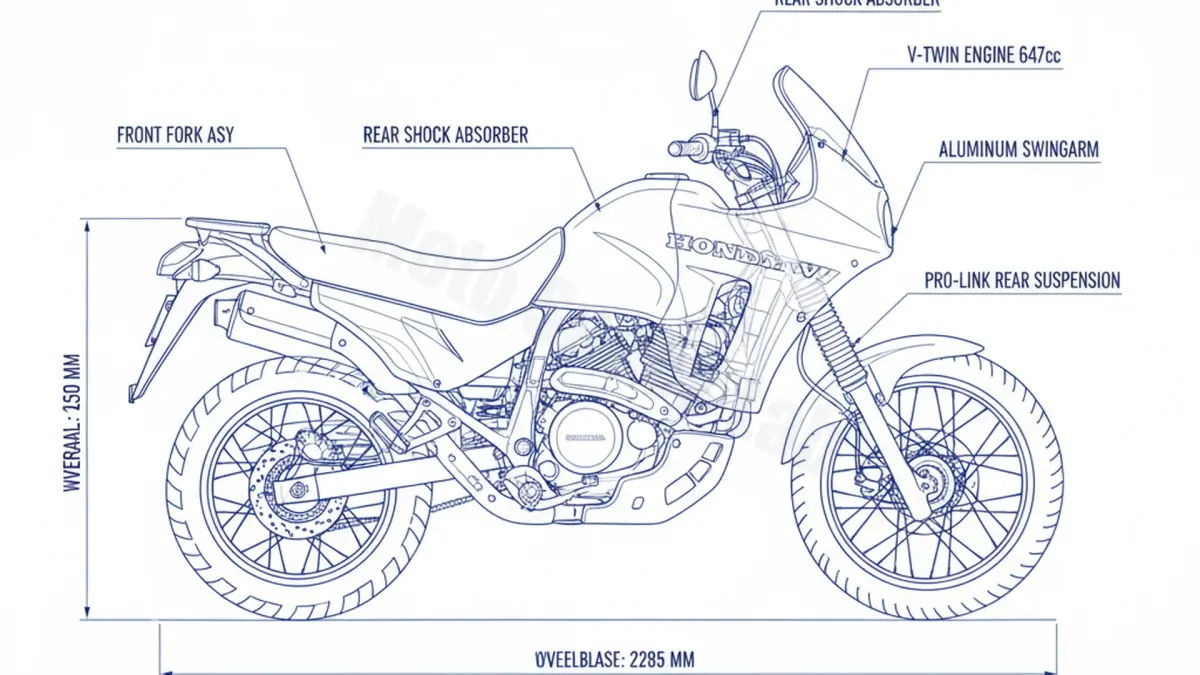
| Feature | Specification |
|---|---|
| Production Years | 2000 – 2007 |
| Engine Type | 52° V-Twin, 647cc, Liquid-cooled |
| Oil Capacity | 2.9 L (SAE 10W-40) |
| Spark Plugs | NGK DPR8EA-9 / Denso X24EPR-U9 |
| Battery | YTZ12S (Maintenance Free) |
| Tire Sizes | F: 90/90-21 | R: 120/90-17 |
The Honda XL 650 V Transalp, spanning the RD10 and RD11 designations, represents a pivotal moment in dual-sport engineering. While many adventure bikes of the era moved toward higher complexity, the Transalp 650 refined the 52-degree V-twin architecture—a design lineage tracing back to the VT500 of 1982. This specific engine configuration is unique because it uses an offset dual-pin crankshaft to achieve perfect primary balance, eliminating the need for heavy balancer shafts while maintaining a compact footprint.
Engineering Overview: RD10 vs. RD11
The RD10 (2000–2001) was initially produced in Japan (Hamamatsu), while production for the RD11 (2002–2007) moved to Italy (Atessa). Technically, the machines are nearly identical, though the RD11 introduced minor updates to the anti-pollution systems and slight suspension tuning. The heart of the machine remains the 647cc SOHC engine featuring three valves per cylinder (two intake, one exhaust), providing a torque-rich power delivery ideal for both unpaved trails and highway cruising.
Maintenance Specifications & Fluid Capacities
To maintain the legendary reliability of the Transalp, strict adherence to fluid specifications is mandatory. The 650cc engine requires 2.9 liters of SAE 10W-40 oil meeting JASO MA standards to ensure the wet clutch operates without slippage. For ignition, the dual-spark system utilizes two NGK DPR8EA-9 plugs, which should be inspected every 12,000 km for electrode wear.
Tires and Chassis
The 21-inch front wheel (90/90-21) provides excellent roll-over capability on off-road terrain, while the 17-inch rear (120/90-17) ensures a wide selection of adventure-touring rubber. Recommended tire pressures are 2.0 bar (29 psi) for the front and 2.0 bar (29 psi) for the rear when riding solo, increasing to 2.3 bar (33 psi) on the rear for loaded touring.
Common Technical Issues to Monitor
- Regulator/Rectifier: Like many Hondas of this era, the charging system can be a weak point. Ensure the battery terminals are clean and monitor the voltage output of the YTZ12S battery.
- Spoke Corrosion: The original DID rims are robust, but the spokes are prone to surface oxidation if not treated with protective coatings after wet rides.
- Secondary Air Supply (PAIR) System: On higher mileage RD11 models, the vacuum hoses for the air injection system can perish, leading to popping on deceleration.
The MotoSpecsLab Verdict
The Honda XL 650 V Transalp RD10/RD11 remains a gold standard for ‘overland’ reliability. It lacks the electronic complexity of modern ADVs, which is precisely its greatest technical asset. For the home mechanic, it offers accessible valve clearances and a robust carbureted fuel system that can be serviced in the field with basic tools.