| Feature | Specification |
|---|---|
| Model Year | 1994 (ZX400L4) |
| Engine Type | Liquid-cooled, Inline-4, DOHC |
| Oil Type | SAE 10W-40 (API SE, SF, SG) |
| Oil Capacity | 2.6 Liters |
| Tires (F/R) | 120/60 ZR 17 / 160/60 ZR 17 |
| Spark Plugs | NGK CR9EK |
| Battery | YTX9-BS |
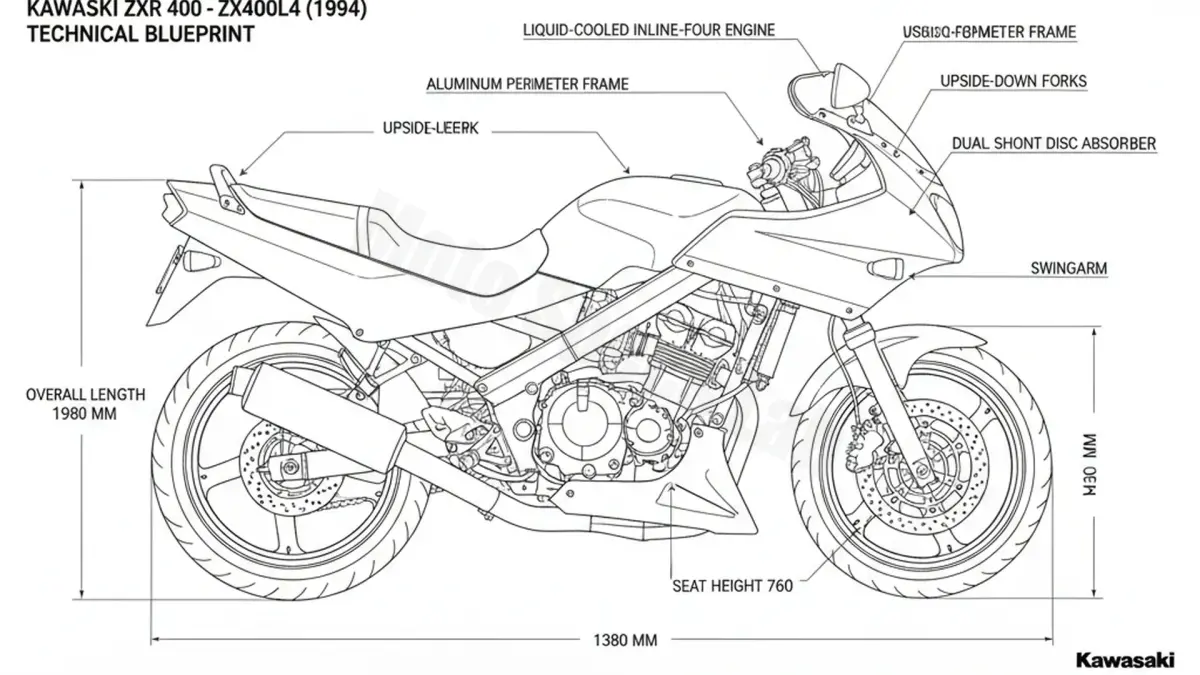
Engineering Highlight: The Kawasaki ZXR 400 was a pioneer in the 400cc class, being one of the first production motorcycles to feature the Kawasaki Brake Air System (K-BAS). These distinctive hoses running from the fairing to the fuel tank were not ram-air intakes for the engine, but rather cooling ducts designed to direct airflow over the cylinder head and spark plugs, a direct trickle-down from Kawasaki’s factory endurance racing efforts.
Technical Review: The ZX400L4 Platform
By 1994, the ZX400L series had matured into one of the most formidable supersport platforms in the sub-500cc category. The L4 variant benefited from the significant frame and engine revisions introduced in 1991, featuring a stiff aluminum e-box frame and 41mm inverted forks. This setup provided front-end stability that rivaled its larger 750cc siblings, making it a favorite for club racers and enthusiasts who valued corner speed over raw straight-line power.
The 398cc engine is a high-revving masterpiece, reaching its peak power near 12,500 RPM. Maintenance of the valvetrain is critical on these units, as the high-frequency vibrations and heat cycles can lead to shim wear over extended periods.
Maintenance Guide & Specifications
1. Lubrication System
For the 1994 ZX400L4, Kawasaki specifies a SAE 10W-40 viscosity. To maintain the integrity of the wet clutch and high-revving journals, ensure the oil meets API SE, SF, or SG standards. A total volume of 2.6 liters is required for a standard change with filter replacement. Using a high-quality synthetic or semi-synthetic blend is highly recommended given the 14,000+ RPM redline.
2. Tires and Handling
The L4 utilizes a radial tire setup that was cutting-edge for its time. The front 120/60 ZR 17 and rear 160/60 ZR 17 combination provides a sharp turn-in characteristic. For optimal handling and tire longevity, maintain pressures at 2.25 bar (32 psi) in the front and 2.50 bar (36 psi) in the rear. Deviating from these pressures can significantly affect the bike’s tendency to ‘stand up’ mid-corner.
3. Ignition and Electrical
The 1994 model utilizes NGK CR9EK spark plugs. These are dual-ground electrode plugs designed to provide a consistent spark under high compression and high RPM. The electrical system is powered by a YTX9-BS battery; given the age of these machines, ensuring the charging system (regulator/rectifier) is outputting between 14.0V and 14.5V at 5,000 RPM is a vital preventative maintenance step.
Expert Verdict
The Kawasaki ZXR 400 ZX400L4 remains a benchmark for engineering density. It offers a pure, mechanical connection that modern rider aids have largely sanitized. For the collector or the track enthusiast, adherence to the specific 10W-40 lubrication and NGK ignition standards is the key to preserving this 1990s screamer for the next generation.