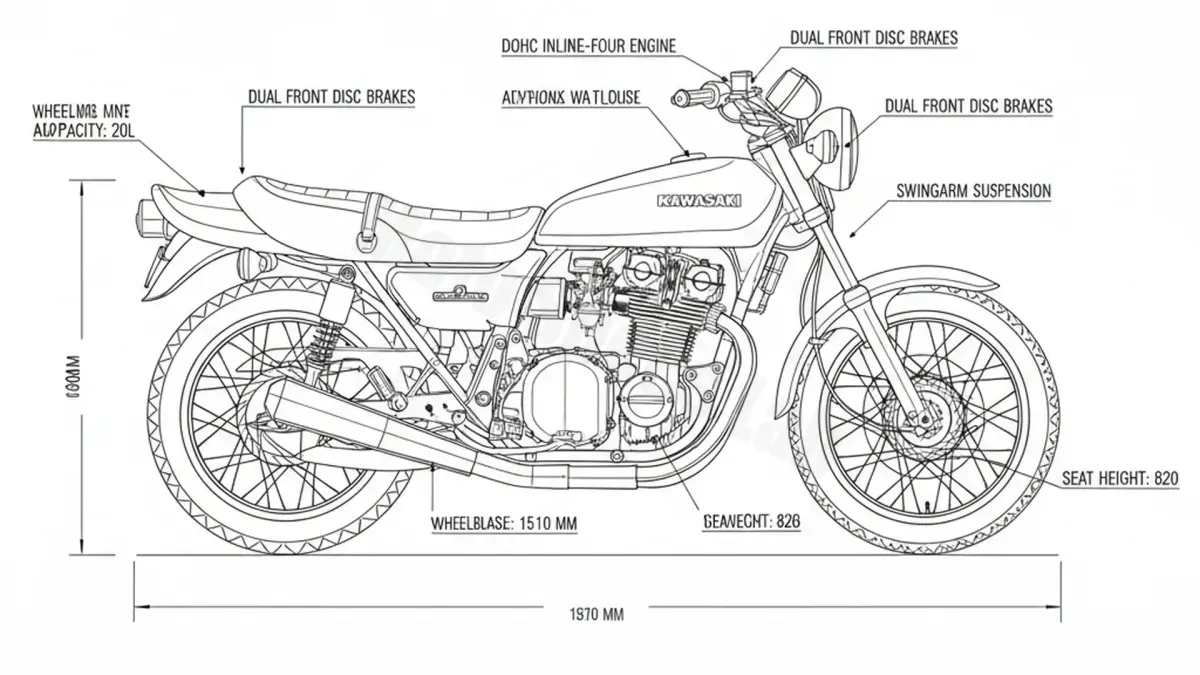
| Component | Specification |
|---|---|
| Production Years | 1979 – 1980 |
| Engine Type | Air-cooled, 4-cylinder, DOHC |
| Engine Oil | 3.0 L (SAE 10W-40 to 20W-50 API SE/SF) |
| Tire Size (Front/Rear) | 3.25 H 19 4PR / 4.00 H 18 4PR |
| Spark Plug | NGK B8ES (0.7 – 0.8 mm gap) |
| Battery | YB14L-A2 |
Engineering Heritage & Historical Context
The Kawasaki Z 1000 MK II (KZT00A/A) represents a pivotal moment in Japanese motorcycle history. While its predecessors defined the ‘Superbike’ era with curved aesthetics, the MK II introduced the iconic ‘Square Tank’ design language. Notably, the MK II was the first in the Z-series to transition from traditional contact breaker points to a transistorized ignition system, significantly improving reliability and timing accuracy for the high-revving inline-four.
Technical Review: Power and Performance
The KZT00A/A engine is a masterclass in late-70s engineering. Displacing 1015cc, the engine was refined with larger crankpins and a more robust crankshaft to handle the 93 horsepower output. The DOHC configuration, paired with Mikuni VM28SS carburetors, offers a linear power delivery that remains a benchmark for classic enthusiasts. The frame received additional gusseting over the earlier Z1000 models to improve high-speed stability, addressing the ‘wobble’ issues associated with earlier chassis designs.
Maintenance Guide & Fluid Specifications
Maintaining a KZT00A/A requires adherence to vintage-specific tolerances to ensure longevity. At MotoSpecsLab, we recommend the following service parameters:
Lubrication System
The MK II requires 3.0 liters of high-quality mineral or semi-synthetic oil. Depending on your operating climate, use SAE 10W-40 or 10W-50 for temperate zones, or 20W-40/20W-50 for warmer environments. Ensure the oil meets API SE or SF standards to protect the flat-tappet cam followers.
Ignition and Electrical
The transistorized ignition system utilizes NGK B8ES spark plugs. For optimal combustion, the gap must be set strictly between 0.7 and 0.8 mm. The electrical system is supported by a YB14L-A2 lead-acid battery; given the age of these machines, checking the charging system output (stator and regulator/rectifier) is a critical seasonal task.
Chassis and Tires
The MK II retains the classic 19-inch front and 18-inch rear wheel configuration. For modern safety, ensure tires meet the H-speed rating. Recommended pressures are:
- Front: 2.0 bar (28 psi)
- Rear (Solo): 2.25 bar (32 psi)
- Rear (With Pillion): 2.5 bar (36 psi)
Professional Summary
The Kawasaki Z 1000 MK II is more than a vintage motorcycle; it is a refined mechanical instrument. By following these technical specifications and maintenance intervals, owners can preserve the legendary performance of the KZT00A/A for decades to come.