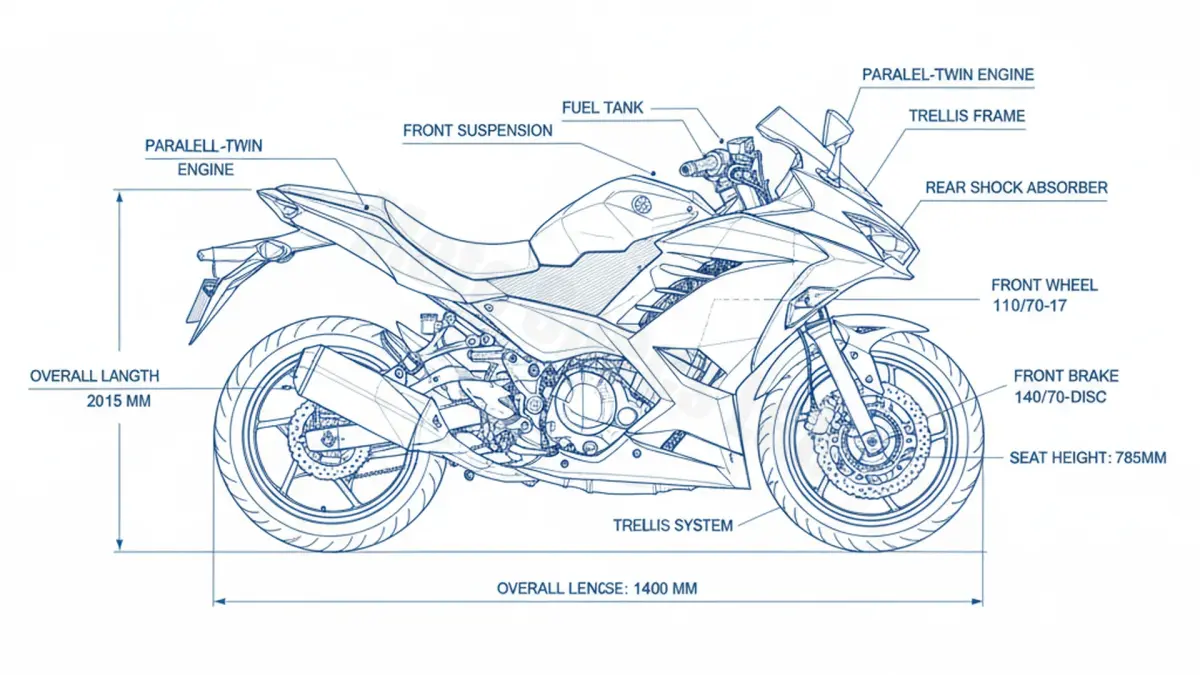
| Component | Specification |
|---|---|
| Engine Displacement | 296cc Parallel-Twin |
| Oil Type | SAE 10W-40 (JASO MA/MA2) |
| Oil Capacity | 2.2 Liters |
| Tire Size | F: 110/70-17 / R: 140/70-17 |
| Tire Pressure | F: 28 psi / R: 32 psi |
| Spark Plug | NGK CR8E (0.7–0.8 mm gap) |
| Battery | FTX9-BS |
The Kawasaki Ninja 300 (EX300) holds a significant place in motorcycling history as the machine that successfully bridged the gap between entry-level accessibility and true supersport performance. Engineering Highlight: Upon its release in 2013, the EX300 was the first motorcycle in the sub-400cc category to feature a race-derived Assist & Slipper Clutch as standard equipment, a mechanism that significantly reduces back-torque during aggressive downshifting to prevent rear-wheel hop.
Technical Engineering Overview
At the heart of the Ninja 300 is a liquid-cooled, 296cc parallel-twin engine. Unlike its predecessor (the Ninja 250R), the EX300 utilized a longer stroke and digital fuel injection (DFI) to provide a broader powerband. The use of sleeveless, die-cast aluminum cylinders and hard-coated pistons allowed for superior heat dissipation and reduced weight, ensuring the engine could reliably sustain high-RPM operation near its 13,000 RPM redline.
Maintenance Essentials
Lubrication System
For optimal engine longevity and clutch performance, the EX300 requires 2.2 liters of high-quality motorcycle oil. We recommend a SAE 10W-40 grade. It is critical to use oil that meets JASO MA/MA2 standards to ensure the wet clutch system does not slip. Always replace the oil filter during every oil change to prevent contaminant buildup.
Chassis and Tires
The Ninja 300’s handling characteristics are highly dependent on tire condition and pressure. The factory-specified sizes are 110/70-17 for the front and 140/70-17 for the rear. For standard street riding, maintain 2.0 bar (28 psi) in the front and 2.25 bar (32 psi) in the rear. Lower pressures may result in sluggish steering, while over-inflation can reduce the contact patch and grip.
Electrical & Ignition
The ignition system relies on NGK CR8E spark plugs. For peak combustion efficiency, ensure the electrode gap is precisely set between 0.7 and 0.8 mm. If the bike struggles to start or the digital display dims, check the FTX9-BS battery. This AGM (Absorbed Glass Mat) battery is designed to handle the vibrations inherent in high-revving twins.
MotoSpecsLab Verdict
The Kawasaki Ninja 300 remains a benchmark for lightweight sportbikes. Its mechanical simplicity combined with sophisticated features like the slipper clutch makes it an ideal candidate for DIY maintenance. Following the prescribed service intervals will ensure this machine remains a reliable companion for both commuting and spirited weekend rides.
Frequently Asked Questions (FAQ)
What is the recommended spark plug gap?
The NGK CR8E spark plugs should be gapped to 0.7–0.8 mm.
How much oil does the EX300 take during a change?
A standard oil and filter change requires 2.2 liters of oil.
What battery model is required?
The Ninja 300 uses an FTX9-BS battery.