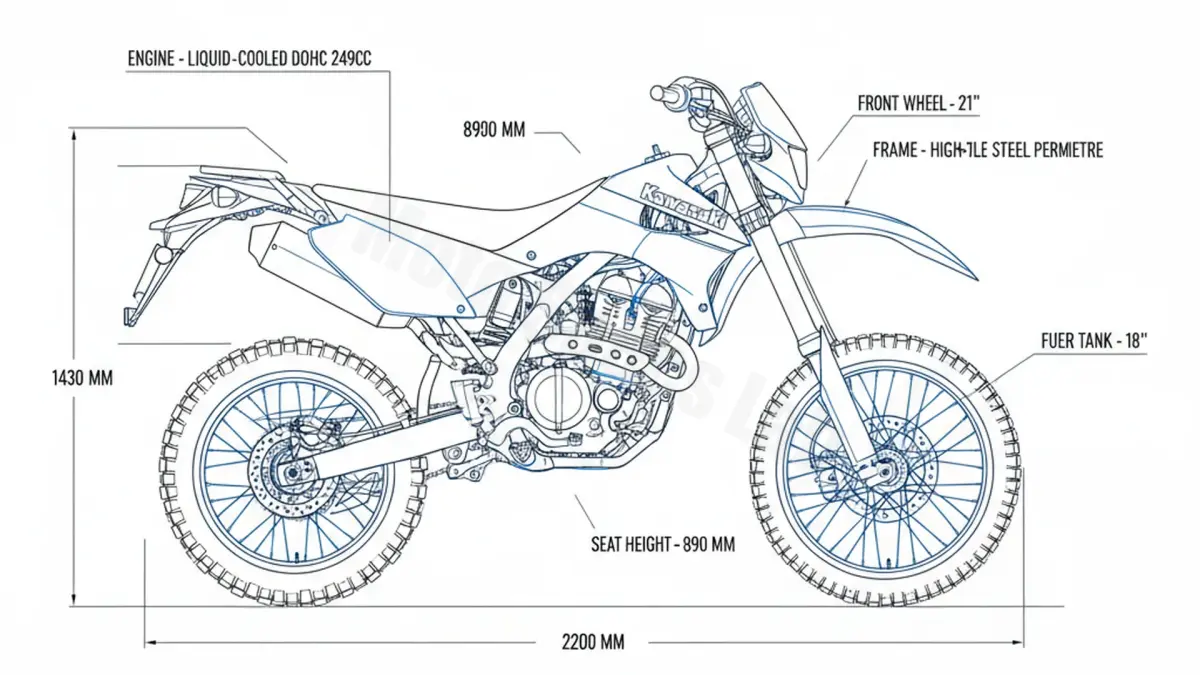
An engineering highlight often overlooked in the Kawasaki KLX 250 (LX250S) is its use of an electrofusion cylinder. This process deposits a thin, porous layer of iron and molybdenum onto the cylinder bore to provide superior oil retention and heat dissipation compared to traditional iron liners, a technology directly inherited from Kawasaki’s high-performance KX motocross lineage.
| Component | Specification |
|---|---|
| Production Years | 2009–2020 |
| Engine Oil | SAE 10W-40 JASO MA2 (1.3 L) |
| Spark Plug | NGK CR8E |
| Battery | YTX7L-BS |
| Front Tire | 3.00-21 51P (1.5 bar / 22 psi) |
| Rear Tire | 4.60-18 63P (1.5 bar / 22 psi) |
Technical Overview & Engineering Excellence
The LX250S platform represents a significant evolution in the 250cc dual-sport category. Unlike many of its competitors that utilize budget-oriented steel frames, the KLX 250 features a high-tensile steel perimeter frame. This design offers a level of torsional rigidity usually reserved for dedicated off-road competition bikes, providing stable handling during aggressive trail riding while maintaining composure on paved surfaces.
Maintenance Guide: Sustaining Peak Performance
1. Lubrication System
To maintain the integrity of the DOHC valvetrain, MotoSpecsLab recommends using 1.3 liters of SAE 10W-40 JASO MA2 compliant oil. The JASO MA2 rating is critical to prevent clutch slippage in the wet-sump system. Always replace the oil filter during every oil change to prevent debris from clogging the narrow oil passages leading to the cylinder head.
2. Ignition & Electrical
The LX250S utilizes a DC-CDI (or EFI on later models) ignition system paired with an NGK CR8E spark plug. Gapping should be checked every 6,000 miles. For the electrical system, the YTX7L-BS battery provides the necessary cold-cranking amps to start the high-compression single-cylinder engine even in cold weather conditions.
3. Chassis & Wheels
Tire maintenance is paramount for dual-sport versatility. The factory-recommended pressures are 1.5 bar (22 psi) for both the front (3.00-21) and rear (4.60-18) tires. While off-road enthusiasts may drop pressures for increased traction, 22 psi remains the engineering standard for balanced heat management and rim protection during street-to-trail transitions.
MotoSpecsLab Verdict
The Kawasaki KLX 250 (LX250S) remains a top-tier choice for riders seeking a mechanical balance between durability and performance. Its liquid-cooled engine and sophisticated suspension components make it a more capable technical tool than the air-cooled alternatives in the same displacement bracket. Regular adherence to the 1.3L oil capacity and valve clearance checks will ensure this machine exceeds the 50,000-mile mark with ease.
Frequently Asked Questions
A: Use a high-quality SAE 10W-40 meeting JASO MA2 standards. 1.3 liters are required for a standard change.
A: The standard gap for the NGK CR8E on the LX250S is 0.7–0.8 mm (0.028–0.031 in).