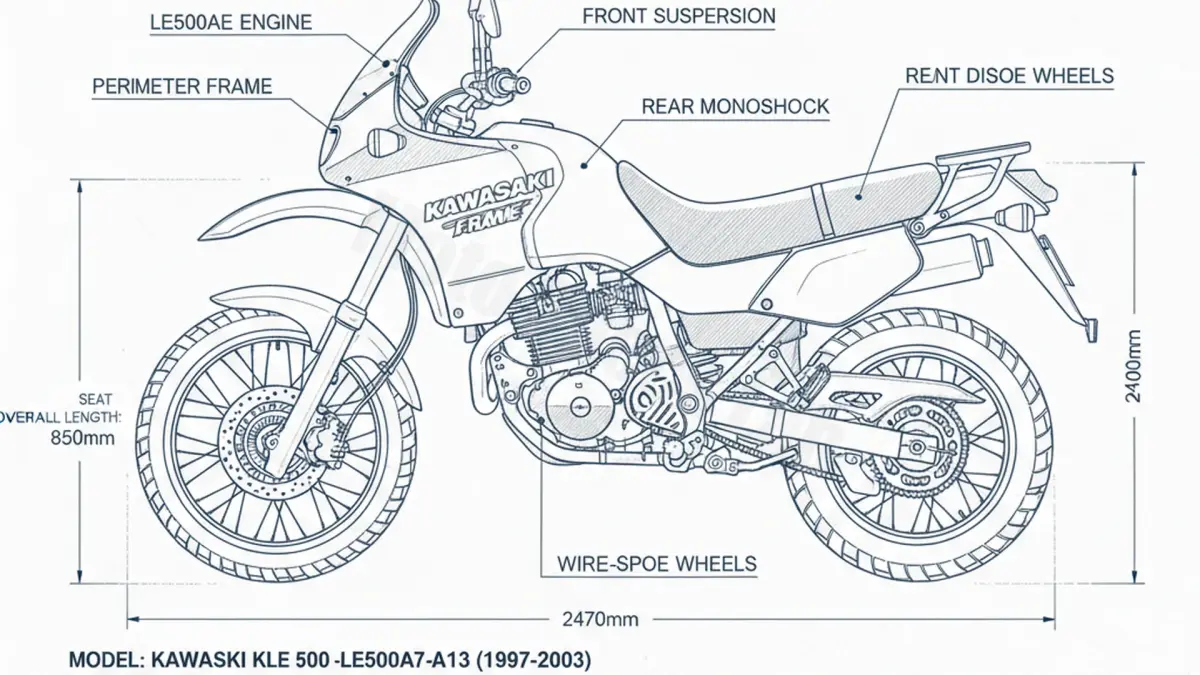
| Specification | Data |
|---|---|
| Production Years | 1997–2004 |
| Engine Type | 498cc Liquid-cooled Parallel-Twin |
| Oil Type | SAE 10W-40 (JASO MA2) |
| Spark Plug | NGK DR9EA (0.6–0.7 mm gap) |
| Battery | YTX12-BS |
| Tire Sizes | F: 90/90-21 | R: 130/80-17 |
While most manufacturers in the 1990s were focused on heavy single-cylinder thumpers for the dual-sport market, Kawasaki took a radical engineering detour. The Kawasaki KLE 500 features a high-revving parallel-twin engine directly inherited from the GPZ500S (EX500) sportbike. This unique mechanical DNA allowed the KLE 500 to offer a level of smoothness and top-end performance that its single-cylinder rivals simply could not match, making it an early pioneer of the modern ‘Adventure’ category.
Technical Engineering Overview
The LE500A7 through A13 variants represent the refined second-half of the first generation’s lifecycle. During this period, the engine was tuned for a more linear power delivery compared to its sport-bike cousin, utilizing different camshaft profiles and carburetor settings to improve low-to-mid-range torque. The 21-inch front wheel remains a testament to its genuine off-road aspirations, providing excellent stability over obstacles and loose terrain.
Maintenance Guide & Specifications
Lubrication System
To maintain the high-revving nature of the DOHC twin, oil quality is paramount. Use a high-quality SAE 10W-40 oil meeting JASO MA2 standards to ensure the wet clutch operates without slipping.
- Dry Fill: 3.4 Liters
- Oil Change with Filter: 3.0 Liters
- Oil Change without Filter: 2.8 Liters
Ignition & Electrical
The KLE 500 utilizes NGK DR9EA spark plugs. For optimal combustion efficiency, ensure the electrode gap is set precisely between 0.6 and 0.7 mm. Electrical reliability is anchored by the YTX12-BS battery, which provides the necessary cold-cranking amps for the high-compression twin.
Chassis & Tires
The LE500A7-A13 maintains a classic dual-sport wheel configuration. For street-biased riding, maintaining correct pressures is critical for handling stability. The front requires 1.50 bar (21 psi). The rear should be set at 1.50 bar (21 psi) for solo excursions, but must be increased to 2.25 bar (32 psi) when carrying a pillion or heavy luggage to prevent sidewall overheating.
Expert Verdict
The Kawasaki KLE 500 remains a cult favorite for its versatility. Its ability to cruise at highway speeds without the excessive vibration of a single, combined with its rugged chassis, makes it an excellent candidate for budget adventure touring. While the seat is notoriously slim for long-distance travel, the mechanical platform is exceptionally robust if the basic maintenance intervals are respected.