| Specification | Data |
|---|---|
| Model Code | KX250ZZA / ZDF (2013) |
| Engine Type | 249cc 4-stroke Single, DOHC |
| Oil Capacity | 0.8 L (10W-40 JASO MA) |
| Spark Plug | NGK CPR8EB-9 (0.8–0.9 mm gap) |
| Tire Size | F: 80/100-21 / R: 100/90-19 |
| Tire Pressure | 1.0 bar (15 psi) Front/Rear |
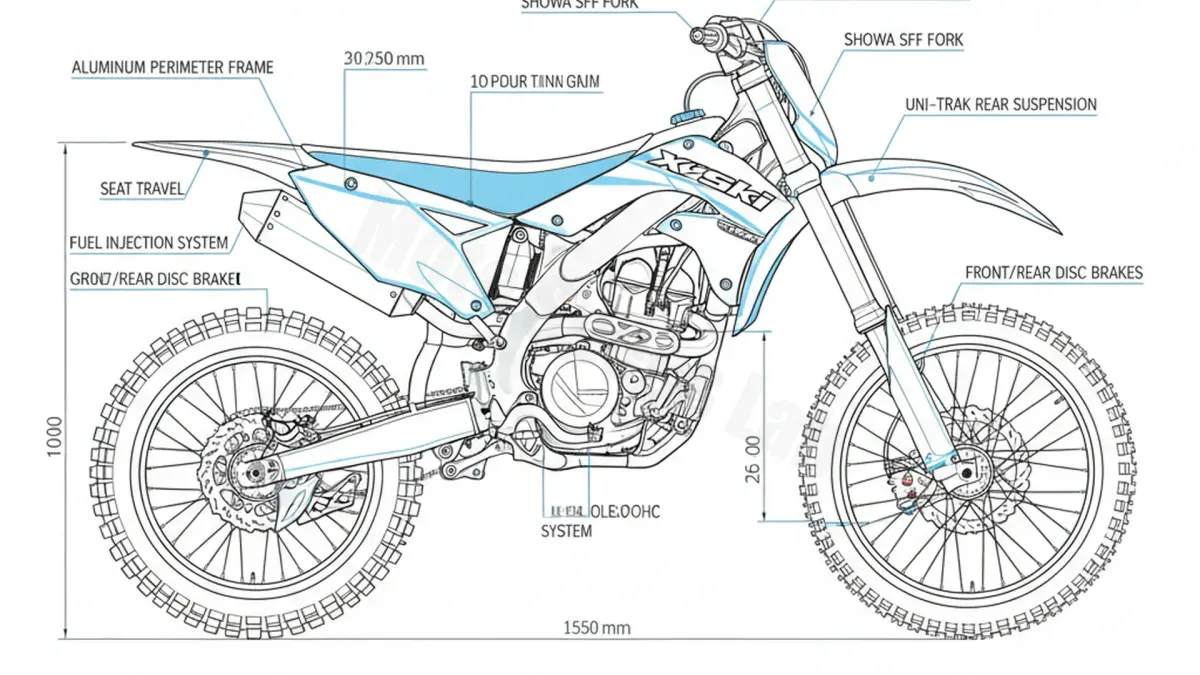
The 2013 Kawasaki KX 250 F stands as a milestone in motocross engineering, being the first production 250cc machine to successfully implement a Dual-Injector Digital Fuel Injection (DFI) system. This configuration utilizes one injector downstream of the throttle valve for immediate response and a second, upstream injector located near the airbox to maximize high-RPM power delivery—a technology derived directly from Kawasaki’s factory racing efforts.
Engineering Deep Dive: The ZZA/ZDF Platform
The KX250ZZA/ZDF iteration introduced significant chassis refinements, including a narrower frame and the second-generation Separate Function Fork (SFF Type 2). By isolating the damping assembly in the left tube and the spring in the right, Kawasaki reduced friction and weight while simplifying the tuning process for professional riders. The engine’s high-revving nature is supported by a bridged-box bottom piston, a design that balances extreme rigidity with minimal reciprocating mass.
Maintenance Guide & Technical Essentials
To maintain peak performance and ensure the longevity of the high-compression top end, strict adherence to the following service parameters is required:
1. Lubrication System
The KX 250 F utilizes a semi-dry sump system. For standard oil changes, the unit requires 0.8 Liters of SAE 10W-40. It is critical to use oil meeting JASO MA, MA1, or MA2 standards to prevent clutch slippage. Given the high-stress environment of the 249cc engine, MotoSpecsLab recommends oil changes every 6-10 hours of operation depending on track conditions.
2. Ignition & Electrical
Notably, the KX250ZZA is not equipped with a battery. Instead, it relies on a high-capacity ECU capacitor to provide the initial charge required for the fuel pump and DFI system during kick-starting. For ignition, the NGK CPR8EB-9 is the specified plug. Ensure the electrode gap is precisely set between 0.8–0.9 mm to avoid flame-out issues at high RPM.
3. Chassis & Tires
The factory-recommended tire setup involves an 80/100-21 51M front and a 100/90-19 57M rear. For optimal traction and rim protection, a baseline pressure of 1.0 bar (15 psi) should be maintained. Adjustments may be made (-2 psi for soft mud, +2 psi for hard-pack) based on circuit topology.
MotoSpecsLab Verdict
The 2013 Kawasaki KX 250 F remains a formidable choice for competitive motocross due to its aggressive powerband and innovative suspension. Its reliance on high-precision components like the dual injectors means that fuel quality and air filter maintenance are paramount. For the technician, the lack of a battery simplifies the electrical loom, though it places higher importance on the health of the stator and capacitor circuit.
Frequently Asked Questions
Q: What is the recommended spark plug gap?
A: The NGK CPR8EB-9 should be gapped to 0.8–0.9 mm.
Q: Does the 2013 KX250F require a special battery?
A: No, the model uses an ECU capacitor system and does not have a traditional battery.
Q: How much oil is needed for a standard change?
A: 0.8 liters of 10W-40 JASO MA compliant oil.