| Parameter | Specification |
|---|---|
| Model Years | 1989-1990 (H1/H2) |
| Engine Oil | SAE 10W-40 (API SE, SF, SG) | 3.2 L |
| Tire Sizes | F: 120/70 ZR 17 / R: 170/60 ZR 17 |
| Tire Pressure | F: 2.25 bar (32 psi) / R: 2.5 bar (36 psi) |
| Battery Type | YB12AL-A2 |
| Spark Plug | NGK CR9E (Gap: 0.7–0.8 mm) |
Historical Engineering Highlight: The ‘Hoover’ Pipes
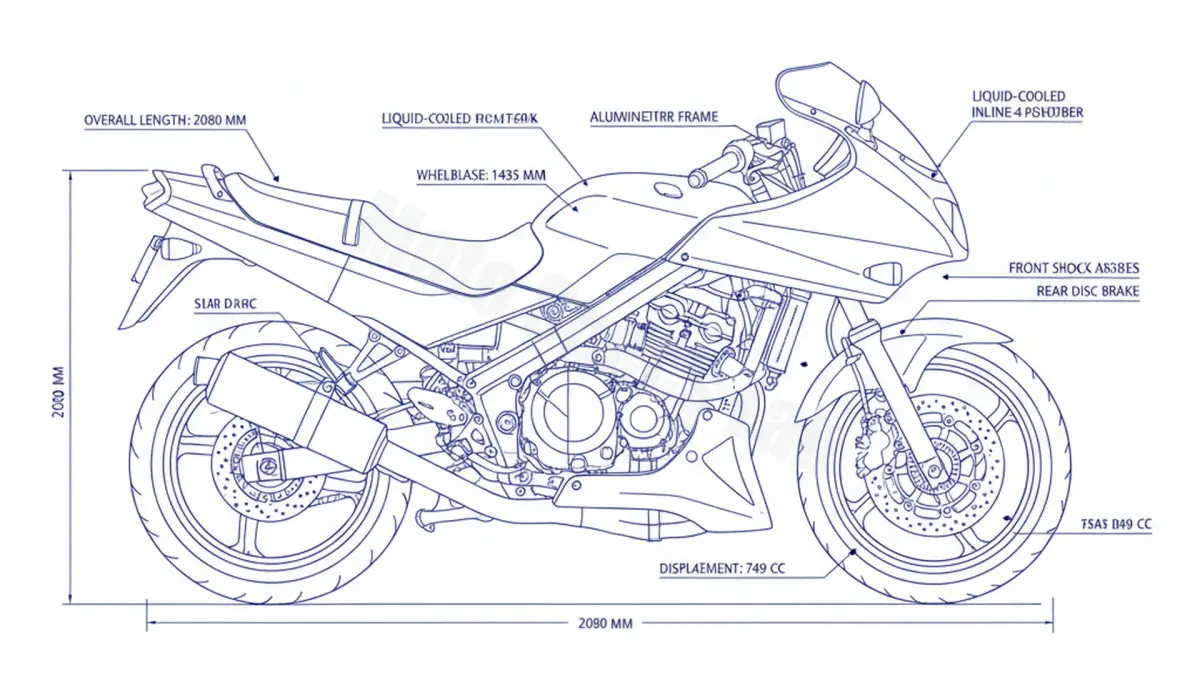
The Kawasaki ZXR 750 ZX750H, introduced in 1989, secured its place in motorcycle history not just through its performance, but through a unique engineering visual: the ‘Stinger’ pipes. While often mistaken for a true Ram-Air system (which appeared on later models), these iconic hoses routed through the fuel tank were actually designed to direct cool air directly onto the top of the cylinder head. This helped manage thermal loads during high-stress racing conditions, a direct transfer of technology from Kawasaki’s endurance racing efforts.
Technical Overview: The E-Box Frame and Inline-Four Power
The H1 and H2 models were built around a massive aluminum ‘E-Box’ perimeter frame, providing a level of rigidity that was revolutionary for the late 80s. Powering this beast was a 748cc DOHC inline-four engine. In its 1989 (H1) and 1990 (H2) iterations, the bike utilized large 38mm Keihin CVKD carburetors, delivering a raw, mechanical throttle response that modern fuel-injected bikes struggle to replicate.
The H2 model (1990) featured significant internal refinements over the H1, including improved cooling and revised engine internals to increase reliability under racing stress. The suspension was notoriously stiff, reflecting its uncompromising track-focused DNA.
Maintenance Guide for the ZX750H
Lubrication and Fluids
For optimal engine longevity, MotoSpecsLab recommends high-quality mineral or semi-synthetic 10W-40 oil. The total capacity is 3.2 liters. Given the age of these engines, staying within the API SE, SF, or SG rating is critical to ensure compatibility with original seal materials.
Ignition System
The ZXR 750 utilizes NGK CR9E spark plugs. Precision is required here; a gap of 0.7–0.8 mm is essential for consistent combustion across the high-revving powerband. Check the plugs every 6,000 miles for signs of carbon fouling or electrode wear.
Chassis and Tires
Handling is highly sensitive to tire pressure. Maintain 32 psi in the front and 36 psi in the rear. The 170/60-17 rear tire was a standard for the era, offering a balance between flickability and a sufficient contact patch for the 100+ horsepower output.
Editor’s Verdict
The ZXR 750 H-series is a visceral reminder of the golden age of 750cc superbikes. It is heavy by modern standards, but the front-end feedback and the induction roar from those ‘Stinger’ pipes provide an analog experience that is highly sought after by collectors today. At MotoSpecsLab, we rate the ZX750H as a 4.5/5 for historical significance and mechanical soul.