| Attribute | Specification |
|---|---|
| Production Years | 1983–1985 |
| Engine Type | In-line 4, 4-stroke, DOHC, 8-valve |
| Oil Capacity | 3.2 Liters |
| Recommended Oil | SAE 10W-40, 10W-50, 20W-40, 20W-50 (API SE, SF, SG) |
| Front Tire | 110/90-18 61V |
| Rear Tire | 130/90-17 68V |
| Battery | YB14L-A2 |
| Spark Plugs | NGK BR8ES |
Historical Engineering Highlight: The GPZ 1100 (KZT10B-A) holds a prestigious place in motorcycling history as the pinnacle of Kawasaki’s air-cooled evolution, being the first mass-production motorcycle to successfully integrate a sophisticated Digital Fuel Injection (DFI) system. This was a significant technological leap over the earlier analog Bosch-derived systems, offering micro-processor-controlled fuel delivery that set the stage for the modern superbike era.
Technical Analysis: The Uni-Trak Revolution
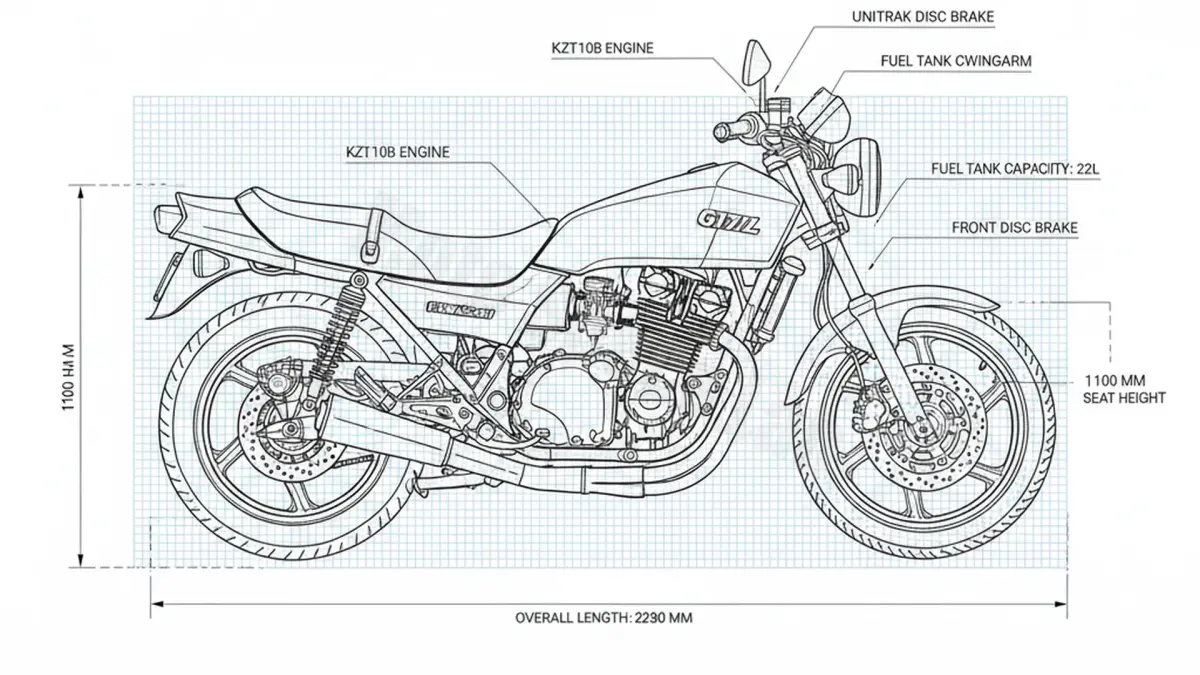
The KZT10B-A series represented more than just a displacement increase. The ‘Uni-Trak’ moniker refers to Kawasaki’s progressive rising-rate rear suspension system. Unlike traditional twin-shock setups, the Uni-Trak utilized a single shock absorber connected to a system of linkages, allowing the suspension to be supple over small bumps while becoming progressively firmer under heavy compression. This provided the GPZ 1100 with stability that was previously unheard of in the 1100cc class.
The DFI System and Power Delivery
The heart of the GPZ 1100 is its 1089cc engine, producing approximately 120 horsepower. The Digital Fuel Injection system was revolutionary for 1983, using sensors for engine speed, intake air pressure, and temperature to calculate the precise fuel requirement. While early DFI systems can be sensitive to voltage fluctuations, a well-maintained KZT10B-A provides a linear power band and throttle response that remains impressive even by contemporary standards.
Maintenance Guide: Preserving a Legend
Lubrication System
For the GPZ 1100, oil is not just a lubricant; it is a vital cooling component. We recommend a high-quality mineral or semi-synthetic oil meeting API SE, SF, or SG standards. The total capacity is 3.2 Liters. In temperate climates, 10W-40 is ideal, while 20W-50 is preferred for high-temperature environments to maintain oil film integrity at high RPMs.
Ignition and Electrical
The electrical system relies on a YB14L-A2 lead-acid battery. Given the sensitivity of the DFI computer, maintaining a steady voltage is critical. We recommend the use of NGK BR8ES spark plugs, gapped to manufacturer specifications, to ensure complete combustion and prevent fouling in the DFI injectors.
Chassis and Tires
Correct tire pressure is essential for the GPZ’s handling characteristics. The factory-specified pressures are 2.25 bar (32 psi) for the front and 2.50 bar (36 psi) for the rear. Using the correct 18-inch front and 17-inch rear tire sizes is vital to maintain the intended geometry of the Uni-Trak chassis.
Editorial Review: MotoSpecsLab Verdict
The Kawasaki GPZ 1100 (KZT10B-A) is the definitive “Muscle Bike” of the early 80s. It offers a unique blend of raw air-cooled power and burgeoning digital technology. While the DFI system requires a specialized understanding for troubleshooting, the mechanical robustness of the KZT10 engine is legendary. For the collector or the enthusiast, it remains one of the most rewarding vintage superbikes to own and ride.
Frequently Asked Questions (FAQ)
What are the common signs of DFI failure?
Common symptoms include erratic idling, surging at constant throttle, or difficulty starting when warm. Often, these are caused by corroded electrical connectors rather than the ECU itself.
Can I use synthetic oil in my GPZ 1100?
While modern synthetics offer superior protection, ensure they do not contain friction modifiers (Energy Conserving) which can cause the wet clutch to slip. A dedicated motorcycle 4T oil is recommended.