| Component | Specification |
|---|---|
| Model Years | 2019–2020 |
| Engine Oil | SAE 10W-40 API SG-SM/SN (2.0 L) |
| Tire Size | F: 110/70R17 / R: 150/60R17 |
| Tire Pressure | F: 2.0 bar (28 psi) / R: 2.25 bar (32 psi) |
| Battery | FTX9-BS |
| Spark Plug | NGK LMAR9G (Gap: 0.7–0.8 mm) |
Engineering Insight: The Sugomi Evolution
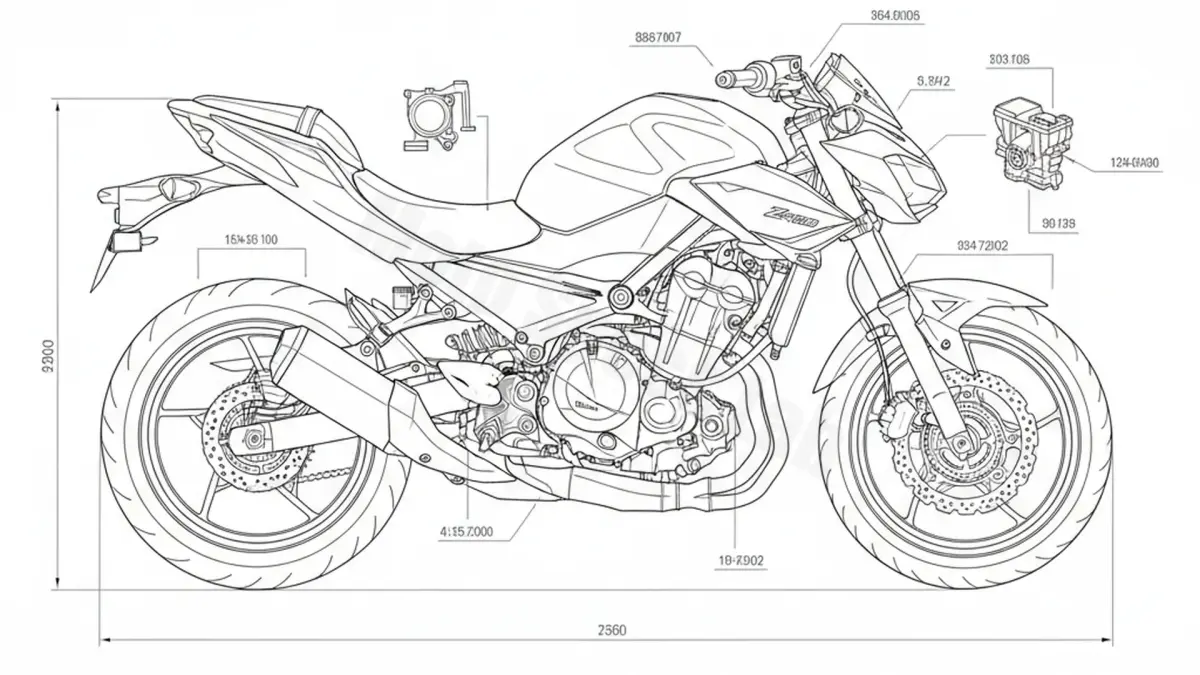
The Kawasaki Z 400 (ER400D) represents a pivotal moment in Kawasaki’s small-displacement history. Unlike its predecessor, the Z300, which was essentially a sleeved-down engine in a heavy frame, the ER400D was engineered from the ground up alongside the Ninja 400. This resulted in a weight reduction of approximately 3kg, despite a significant increase in displacement and torque. The bike utilizes a trellis frame design inspired by the H2, optimized for a shorter wheelbase and a steeper caster angle to deliver razor-sharp handling in urban environments.
Technical Review: Performance and Handling
The 399cc parallel-twin engine is the heart of the Z 400, delivering a linear power delivery that is particularly friendly to A2 license holders while remaining engaging for experienced riders. The Euro 4 compliance was achieved through refined fuel injection mapping and a high-volume airbox that improves intake efficiency. The Assist & Slipper clutch is a standout feature, reducing lever pull effort by 20% and preventing rear-wheel hop during aggressive downshifts.
Maintenance Roadmap
Lubrication System
For the ER400D, oil quality is paramount. It requires 2.0 liters of SAE 10W-40. Ensure the oil meets JASO MA2 standards to protect the wet clutch system. Kawasaki recommends checking the oil level via the sight glass while the bike is vertical, not on its side stand.
Ignition and Electrical
The 2019-2020 models utilize the NGK LMAR9G spark plug. It is critical to maintain the gap between 0.7 and 0.8 mm to ensure consistent combustion and prevent misfires under high-load conditions. The electrical system is powered by an FTX9-BS battery; given the bike’s high-compression nature, maintaining a healthy CCA (Cold Cranking Amps) is essential for reliable starting.
Chassis and Contact Patch
The Z 400 runs on radial tires, which are sensitive to pressure fluctuations. For optimal handling and tire longevity, maintain 2.0 bar (28 psi) in the front and 2.25 bar (32 psi) in the rear. These pressures are calibrated for a balance between heat dissipation and grip.
Frequently Asked Questions
Q: How often should I change the spark plugs?
A: Kawasaki generally recommends inspection every 12,000 km, but for optimal performance in the ER400D, replacement is advised if the electrode shows rounding or significant carbon buildup.
Q: Can I use 10W-50 oil?
A: While 10W-40 is the factory standard, 10W-50 may be used in consistently hot climates, provided it meets the JASO MA2 specification.