| Specification | Detail |
|---|---|
| Model Designation | ZX750G (GPZ 750 R) |
| Production Years | 1984 – 1986 |
| Engine | Liquid-cooled, 4-stroke, In-line 4, DOHC |
| Oil Capacity | 3.0 Liters |
| Tire Dimensions | F: 120/80-16 | R: 130/80-18 |
| Spark Plug | NGK DR8ES (0.6 – 0.7 mm gap) |
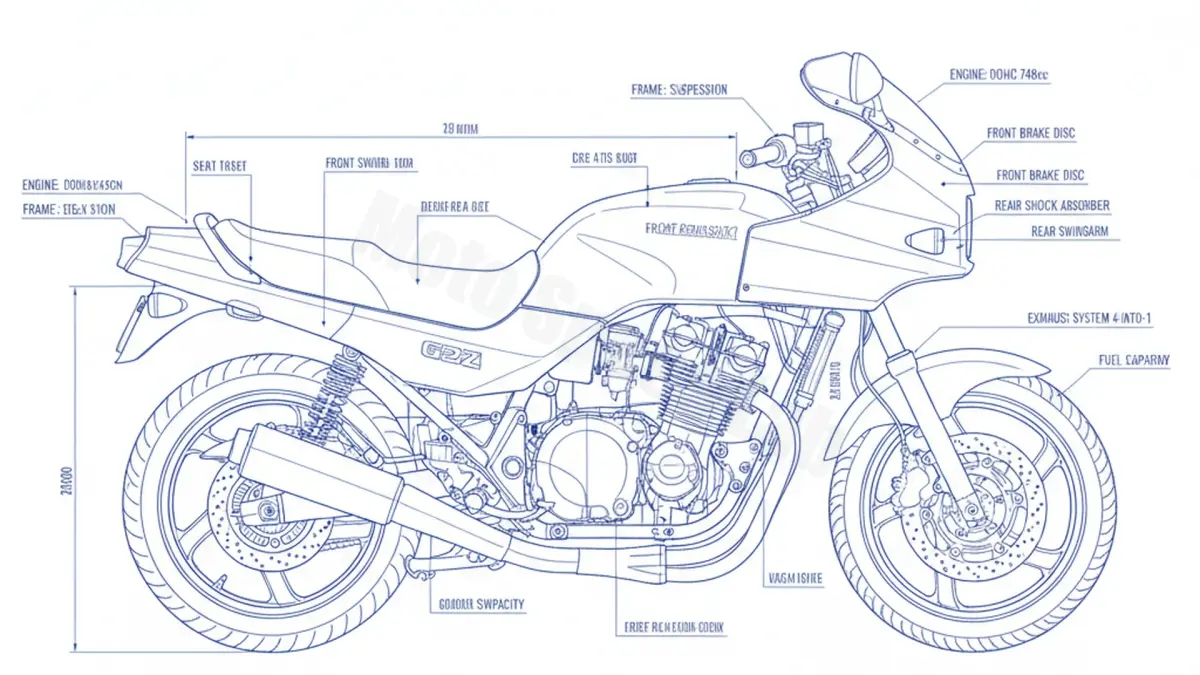
While the GPZ 900 R achieved immortality as the first ‘Ninja,’ the Kawasaki GPZ 750 R (ZX750G) holds a unique place in engineering history as the machine that proved Kawasaki’s liquid-cooled, 16-valve architecture could be scaled for high-revving 750cc performance. Sharing the majority of its chassis and engine components with its larger sibling, the ZX750G offered a more balanced power-to-weight ratio for riders who demanded precision over raw straight-line speed.
Technical Engineering Overview
The heart of the ZX750G is its liquid-cooled, transverse four-cylinder engine. By utilizing a side-driven cam chain, Kawasaki engineers were able to keep the cylinder head narrow, improving aerodynamics and reducing the overall width of the machine. This era marked a transition from the air-cooled ‘Z’ series to the high-thermal-efficiency era of modern sportbikes. The 16-valve DOHC head allowed for optimized gas flow at high RPMs, a necessity for the competitive 750cc class of the mid-80s.
Maintenance Guide & Fluid Requirements
To maintain the performance and longevity of this vintage powerhouse, strict adherence to fluid specifications is mandatory. The GPZ 750 R engine is sensitive to oil shear and thermal breakdown.
- Engine Oil: The system requires 3.0 liters. Owners should use SAE 10W-40 or 10W-50 for temperate climates, or 20W-40/20W-50 for higher ambient temperatures. Ensure the oil meets API SE, SF, or SG standards to protect the integrated gearbox.
- Ignition System: The precise combustion required by the high-compression head is facilitated by NGK DR8ES spark plugs. The gap must be set between 0.6 mm and 0.7 mm to prevent misfires under load.
- Electrical: A standard YB12AL-A battery provides the necessary cold cranking amps to move the high-compression pistons.
Chassis & Wheel Dynamics
The ZX750G features a 16-inch front wheel—a hallmark of mid-80s handling philosophy designed to provide rapid turn-in response. Modern owners must ensure tire pressures are maintained at 2.25 bar (32 psi) in the front and 2.50 bar (36 psi) in the rear to preserve the intended geometry. The staggered 16/18-inch wheel combination requires specific tire profiles: 120/80-16 for the front and 130/80-18 for the rear.
Editorial Conclusion
The Kawasaki GPZ 750 R (ZX750G) is more than a ‘sleeper’ Ninja; it is a sophisticated piece of 1980s engineering that rewards the meticulous mechanic. Its shared DNA with the 900R makes it a robust platform, but its specific 750cc tuning requires careful attention to valve clearances and cooling system integrity. For the collector or enthusiast, it remains a quintessential example of Kawasaki’s ‘Heavy Industries’ approach to performance.
Frequently Asked Questions
Q: Can I use modern synthetic oil?
A: Yes, provided it meets the API SG rating and does not contain friction modifiers that could cause the wet clutch to slip.
Q: Why the 16-inch front wheel?
A: It was designed to reduce gyroscopic effect, allowing for faster steering, though it requires specific tire choices today to maintain stability.