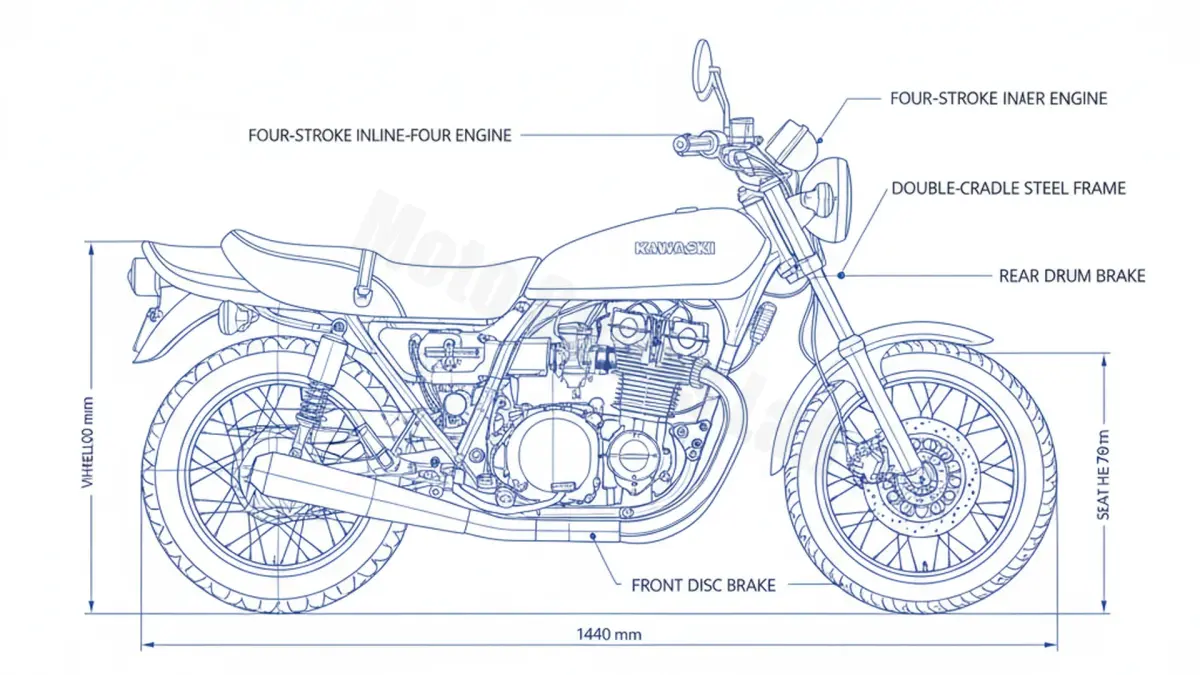
| Component | Specification |
|---|---|
| Production Years | 1977–1979 |
| Engine Oil (API SE/SF) | SAE 10W-40, 10W-50, 20W-40, or 20W-50 |
| Oil Capacity | 3.0 L (with filter change) |
| Tires (Front/Rear) | F: 3.25-19 4PR / R: 4.00-18 4PR |
| Tire Pressure (Front/Rear) | F: 1.75 bar (25 psi) / R: 2.0 bar (28 psi) |
| Spark Plug / Gap | NGK B7ES / 0.7–0.8 mm |
| Battery Type | YB10L-A2 |
Historical Engineering Highlight: While often overshadowed by its larger sibling, the Z1, the Kawasaki Z 650 (KZ650B) was a landmark machine for Kawasaki Heavy Industries. It was the first of their multi-cylinder engines to move away from the traditional roller-bearing crankshaft in favor of a plain-bearing (automotive style) crankshaft. This engineering shift, led by legendary designer Ben Inamura, allowed for a more compact engine casing and paved the way for the high-revving performance of modern inline-fours.
Technical Review: The ‘Son of Z1’
The KZ650B arrived in late 1976 as a 1977 model, bridging the gap between the lightweight 400s and the heavy 900s. Its 652cc DOHC engine was praised for its balance of power and agility. Unlike many of its contemporaries, the Z 650 offered handling characteristics that were considered superior to the larger Z1, thanks to a stiffer frame and a weight-to-power ratio that rewarded spirited riding.
The engine architecture utilized a chain-driven double overhead camshaft layout. By utilizing plain bearings, Kawasaki achieved a smoother, quieter operation that could withstand higher oil pressures, a design philosophy that remains the standard for performance motorcycles today.
Maintenance Guide: Preserving a Classic
Lubrication System
For the KZ650B, oil quality is paramount due to the plain-bearing design. Kawasaki recommended API SE or SF grades. In modern contexts, ensure you use a motorcycle-specific oil to protect the wet clutch. The system requires 3.0 liters when the filter is replaced. Regular intervals are suggested every 3,000 miles (5,000 km) to prevent sludge buildup in the narrow oil galleries.
Ignition & Electrical
The 1977–1979 models utilize a points-and-condenser ignition system. For optimal combustion, the NGK B7ES plugs must be gapped strictly between 0.7 and 0.8 mm. The electrical system is supported by a YB10L-A2 battery; given the age of these machines, checking the charging system output (rectifier/regulator) is a recommended annual task.
Chassis & Tires
The Z 650 maintains its vintage geometry with a 19-inch front and 18-inch rear wheel. For period-correct handling and safety, maintain tire pressures at 25 psi (front) and 28 psi (rear). Over-inflating can lead to a harsh ride and reduced contact patch, which is critical on the narrower tire profiles of the 1970s.
Expert Verdict
The Kawasaki Z 650 KZ650B remains one of the most usable vintage motorcycles. Its over-engineered bottom end and accessible power delivery make it a favorite for restorers and daily riders alike. At MotoSpecsLab, we rate this machine as a 4.8/5 for its historical significance and mechanical robustness.
Frequently Asked Questions (FAQ)
What is the recommended tire pressure for the Z 650?
The factory recommended pressure is 1.75 bar (25 psi) for the front and 2.0 bar (28 psi) for the rear.
Can I use modern synthetic oil in my KZ650B?
While modern synthetics offer superior protection, ensure they are JASO MA rated to prevent clutch slippage. Most owners prefer high-quality mineral or semi-synthetic 10W-40 or 20W-50 API SE/SF equivalent oils.
What is the spark plug gap for the NGK B7ES?
The gap should be set to 0.7–0.8 mm for consistent ignition timing and performance.