| Specification | Data |
|---|---|
| Production Years | 1982-1984 |
| Engine Oil | SAE 10W-40 / 20W-50 (JASO MA2) |
| Oil Capacity | 2.1 L (2.5 L with filter) |
| Tires (Front/Rear) | 100/90-19 57H / 130/90-16 67H |
| Tire Pressure (F/R) | 2.0 bar / 2.25-2.5 bar |
| Battery | YB14L-A2 |
| Spark Plug | NGK BR7ES (0.7-0.8 mm gap) |
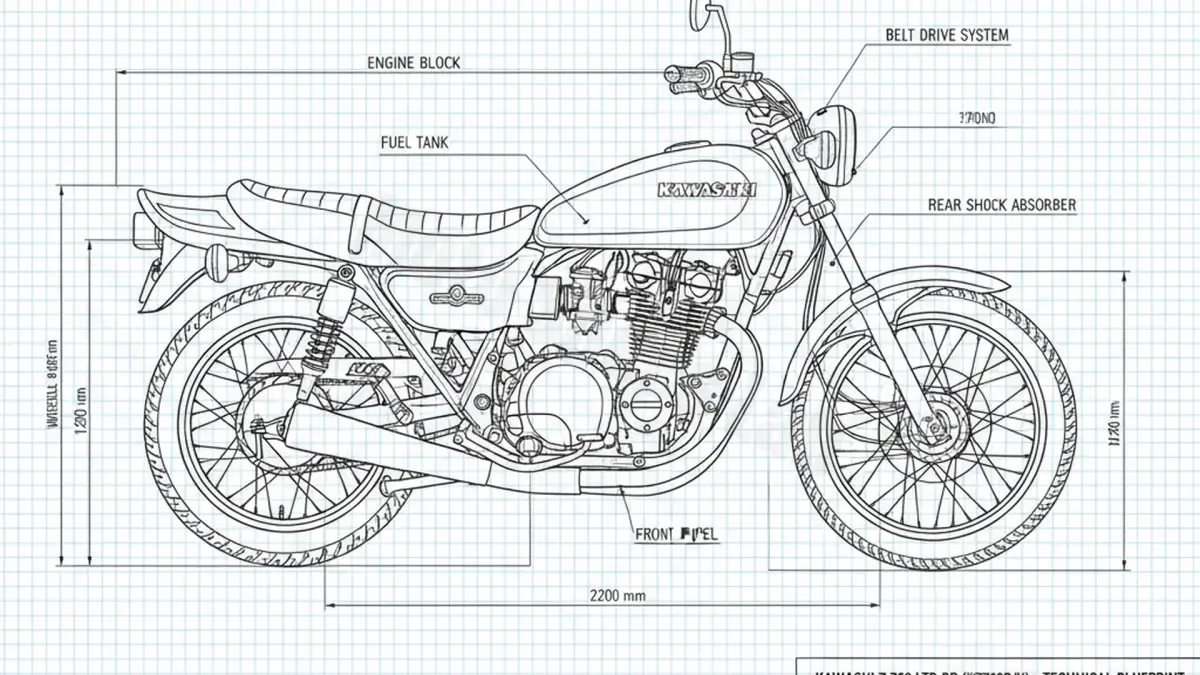
Engineering Highlight: The Kawasaki Z 750 LTD BD (KZ750B/K) represents a pivotal moment in early 80s cruiser evolution, specifically distinguished by its ‘Zahnriemen’ (Belt Drive) system. While most Japanese manufacturers were committed to chain or shaft drives, the BD variant utilized a Kevlar-reinforced belt drive to provide the smooth, quiet operation of a shaft drive without the significant weight penalty or ‘shaft-jacking’ effect, making it one of the most refined parallel-twins of its era.
Technical Deep Dive
At the heart of the KZ750B/K is a robust 745cc parallel-twin engine. Unlike the more common four-cylinder Z750 models, the twin-cylinder LTD was designed for torque-rich, relaxed cruising. The ‘BD’ designation signifies the belt drive system, which significantly reduces maintenance intervals compared to traditional O-ring chains. However, owners should inspect the belt for cracking or debris penetration, as replacements for this specific vintage system can be difficult to source.
Maintenance Essentials
For optimal engine longevity, MotoSpecsLab recommends high-quality mineral or semi-synthetic oils. Given the air-cooled nature of this twin, SAE 20W-50 is often preferred in warmer climates to maintain viscosity under high thermal loads. The oiling system requires 2.5 liters when performing a full service including the filter.
The ignition system relies on NGK BR7ES plugs. Ensuring the precise gap of 0.7-0.8 mm is critical for preventing low-end hesitation, a common trait in large-displacement twins if the spark is weak. The electrical system is supported by a standard YB14L-A2 lead-acid battery; however, many modern owners opt for AGM equivalents to prevent acid overflow near the belt drive components.
MotoSpecsLab Editorial Review
Pros: The belt drive remains the standout feature, offering a remarkably clean and quiet final drive. The 16-inch rear wheel and 19-inch front provide the classic ‘LTD’ stance that defined the early Japanese cruiser aesthetic. It is a mechanically honest machine that is relatively easy to service for the home mechanic.
Cons: As a parallel twin, vibration can be noticeable at higher RPMs despite the counterbalancers. Parts for the belt drive system (specifically the sprockets and the belt itself) are becoming increasingly rare, necessitating careful preservation of existing components.
Frequently Asked Questions (FAQ)
What is the recommended tire pressure?
For the KZ750B/K, the front should be set to 2.0 bar (28 psi). The rear should be 2.25 bar (32 psi) for solo riding, increasing to 2.5 bar (36 psi) when carrying a passenger or heavy luggage.
Can I use synthetic oil?
While synthetic oil can be used, ensure it is JASO MA2 certified to prevent clutch slippage. Due to the tolerances of 1980s seals, many specialists prefer high-quality mineral-based oils.