| Specification | Data |
|---|---|
| Production Years | 1987 – 1990 |
| Engine Oil | SAE 10W-40 (API SE, SF or SG) (3.2 L) |
| Tires (F/R) | 110/80-16 55V / 140/70-18 67V |
| Tire Pressure (F/R) | 2.25 bar (32 psi) / 2.5–2.9 bar (36–42 psi) |
| Battery | YB14L-A2 |
| Spark Plug | NGK DR8ES (0.6–0.7 mm gap) |
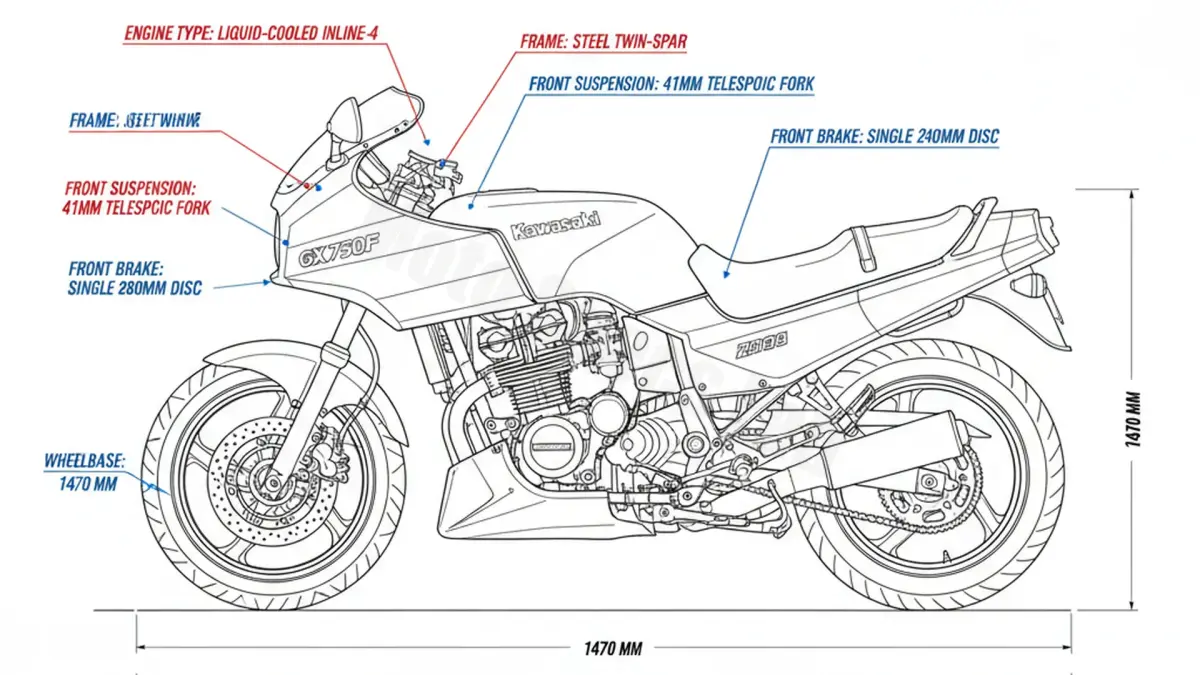
The Kawasaki GPX 750 R (ZX750F) stands as a pivotal milestone in sportbike evolution. Notably, it was the first Kawasaki 750 to utilize a steel perimeter frame, an engineering shift that significantly increased torsional rigidity compared to the cradle frames of the preceding GPZ series. This architectural choice paved the way for the legendary ZXR series, making the GPX a sophisticated bridge between 80s aesthetics and 90s performance engineering.
Engineering Overview
At the heart of the ZX750F is a liquid-cooled, 16-valve, inline-four engine producing approximately 106 horsepower. While the 16-inch front wheel was a hallmark of late-80s handling philosophy—intended to provide rapid turn-in—the GPX 750 R balanced this with a longer wheelbase to maintain stability at high speeds. Despite its “sport-touring” label in some markets, its lightweight engine internals and high-revving nature made it a formidable competitor on the track during its tenure.
Maintenance Guide & Technical Requirements
Lubrication System
For optimal engine longevity and gearbox performance, MotoSpecsLab recommends SAE 10W-40 engine oil. Ensure the oil meets API SE, SF, or SG classifications. The total capacity for an oil and filter change is 3.2 Liters. Given the age of these machines, high-zinc mineral or semi-synthetic oils are often preferred to protect the overhead cam surfaces.
Ignition & Electrical
The ignition system relies on NGK DR8ES spark plugs. For smooth idling and efficient combustion, the electrode gap must be precisely set between 0.6 and 0.7 mm. Electrical reliability is anchored by the YB14L-A2 lead-acid battery; however, modern AGM equivalents are often used by restorers for better vibration resistance.
Tires and Handling
The GPX 750 R features a unique staggered wheel setup: a 16-inch front and an 18-inch rear. Maintaining correct pressures is critical for handling safety:
- Front (110/80-16 55V): 2.25 bar (32 psi)
- Rear (140/70-18 67V): 2.5 bar (36 psi) for standard use, increasing to 2.9 bar (42 psi) for high-speed or pillion riding.
Expert Verdict
The Kawasaki GPX 750 R remains a highly underrated classic. While it was eventually overshadowed by the ZXR750, its engine was renowned for being smoother and more flexible for street riding. From a technical perspective, it represents the pinnacle of Kawasaki’s transition into the modern era of chassis design. For the collector or enthusiast, maintaining the ZX750F requires attention to the cooling system and specific tire sizing, but the reward is a machine that captures the raw essence of 1980s superbike culture.
Frequently Asked Questions (FAQ)
Q: Can I use modern synthetic oil in the GPX 750 R?
A: Yes, provided it is a 10W-40 motorcycle-specific oil (JASO MA) to ensure the wet clutch does not slip. However, older seals may perform better with semi-synthetic blends.
Q: Why does the GPX 750 R have a 16-inch front wheel?
A: During the late 80s, 16-inch wheels were popular in GP racing to reduce the gyroscopic effect, allowing for faster steering. While it makes tire selection more limited today, it provides the bike’s signature quick handling.