| Component | Specification |
|---|---|
| Production Years | 1987 – 1995 |
| Engine Oil | SAE 10W-40 (API SE, SF, or SG) – 3.1 L |
| Tires (F/R) | F: 100/90-19 57H / R: 150/90-15 74H |
| Tire Pressure | F: 2.0 bar / R: 2.25-2.50 bar |
| Battery | YB16B-A |
| Spark Plug | NGK DPR7EA-9 |
When the Kawasaki VN 15 (marketed as the Vulcan 88 in North America) debuted in 1987, it earned a permanent place in history by becoming the first mass-produced V-twin motorcycle to exceed 1,400cc displacement. This engineering milestone effectively ignited the “displacement wars” among metric cruisers, proving that Japanese manufacturers could compete with and exceed the traditional heavyweights in the heavyweight cruiser segment.
Engineering Overview: The VNT50A/C Platform
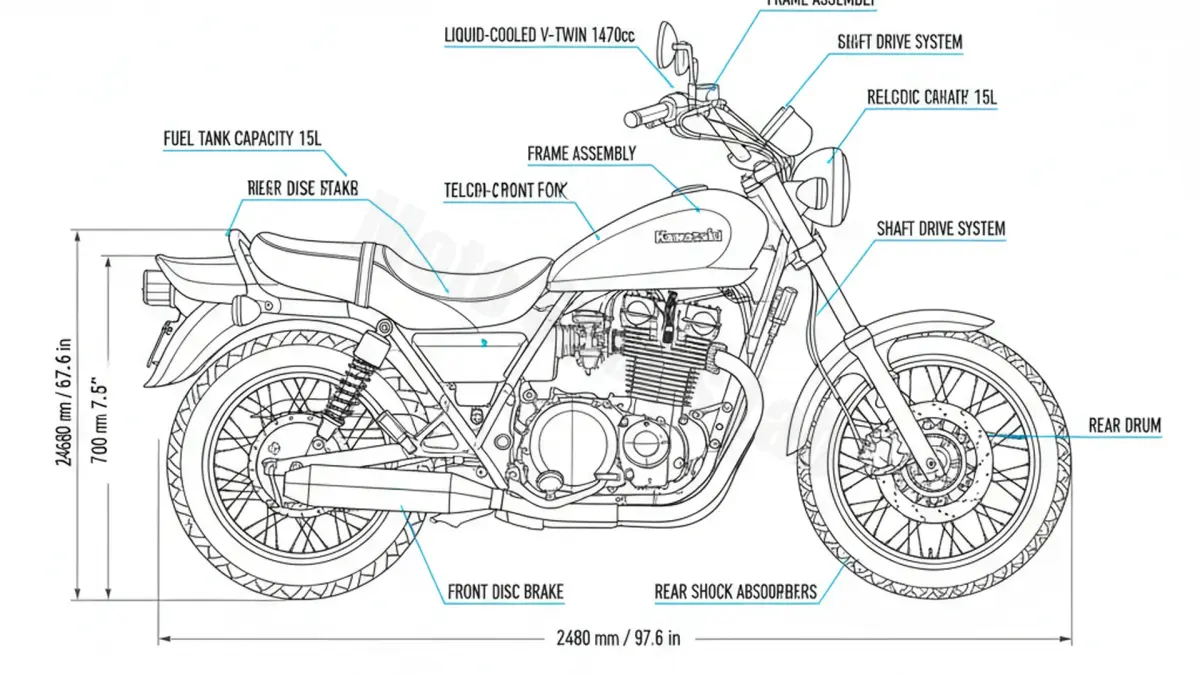
The heart of the VN 15 is a liquid-cooled, 50-degree V-twin engine. Unlike many of its contemporaries that utilized air-cooling for aesthetic reasons, Kawasaki prioritized thermal stability and long-term reliability. The engine features SOHC (Single Over Head Cam) architecture with four valves per cylinder and dual spark plugs (utilizing the NGK DPR7EA-9), ensuring efficient combustion for such a large bore.
The power is delivered via a low-maintenance shaft drive, a hallmark of the VNT50 series, which minimizes the owner’s workload compared to chain-driven rivals. The 4-speed (early models) or 5-speed transmission was designed to handle the significant torque output of the 1470cc power plant.
Maintenance Guide & Technical Specs
Lubrication System
For optimal performance and protection of the internal components, MotoSpecsLab recommends SAE 10W-40 oil. It is critical to use oils meeting API SE, SF, or SG standards to ensure compatibility with the wet clutch system. The total capacity is 3.1 liters.
Tires and Chassis
The VN 15 utilizes a staggered wheel setup to provide that classic cruiser stance. The front 19-inch wheel requires a 100/90-19 57H tire, while the rear 15-inch wheel uses a beefy 150/90-15 74H. Maintaining correct pressure is vital for handling: 2.0 bar (28 psi) at the front, and 2.25 bar (32 psi) at the rear for solo riding, increasing to 2.50 bar (36 psi) when fully loaded.
Electrical System
The electrical heart of the VNT50A/C is the YB16B-A lead-acid battery. Given the high compression of the large V-twin, ensuring a healthy battery with high cold-cranking amps is essential for reliable starting, especially in cooler climates.
Editor’s Verdict
The Kawasaki VN 15 remains a testament to late-80s over-engineering. While it lacks the modern electronic suites of today’s cruisers, its mechanical purity and historical significance make it a highly desirable machine for collectors and long-distance tourers alike. Its maintenance requirements are straightforward, provided the owner adheres to the specified fluid capacities and tire pressures.