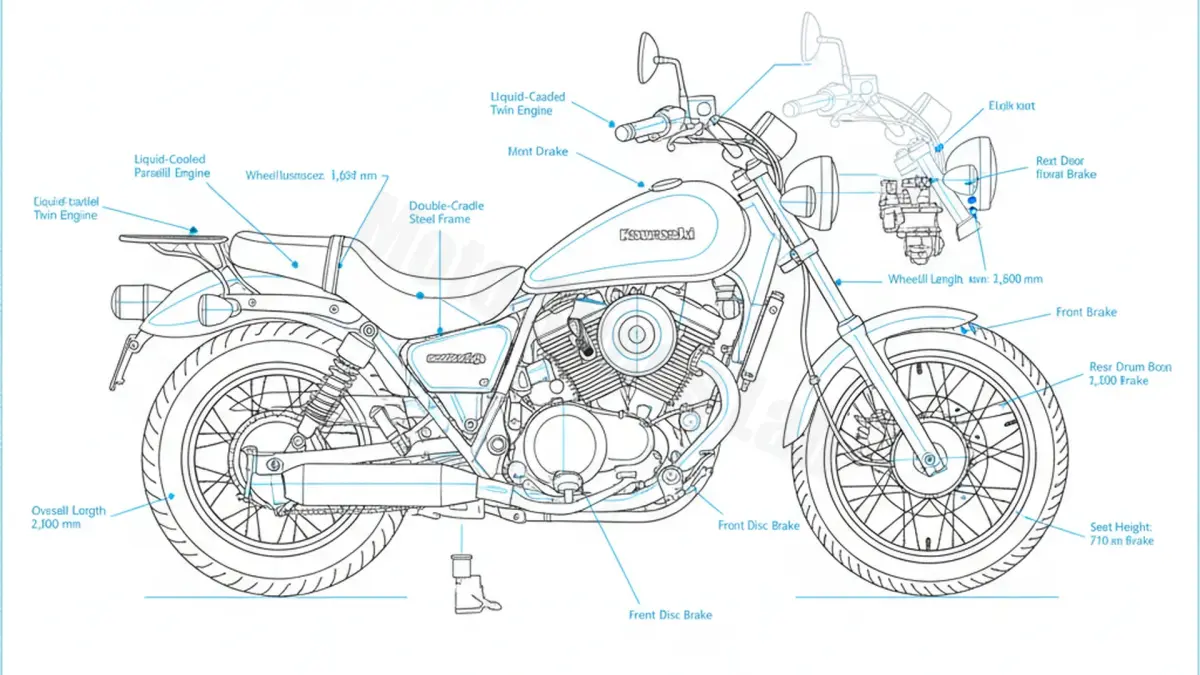
| Specification | Value |
|---|---|
| Production Years | 1996-2009 |
| Engine Type | 498cc Parallel-Twin, Liquid-Cooled |
| Oil Type/Capacity | SAE 10W-40 (3.0 L) JASO MA |
| Tire Size Front | 100/90-19 57H |
| Tire Size Rear | 140/90-15 70H |
| Battery | YB12A-A |
| Spark Plug | NGK DR9EA (0.6-0.7 mm gap) |
The Kawasaki Vulcan 500 LTD (EN500LTD) holds a unique position in motorcycling history as the cruiser that refused to behave like one. While its competitors relied on low-revving, torque-heavy V-twins, the Vulcan 500 LTD was engineered with the high-revving 498cc parallel-twin heart of the legendary Ninja 500R (EX500). This engineering choice gave the LTD a distinct power band and a top-end rush that remains unparalleled in the mid-size cruiser segment.
Technical Review: Performance and Engineering
From a technical perspective, the EN500LTD is a masterclass in platform sharing. By utilizing the EX500 engine, Kawasaki delivered a motorcycle with double overhead cams (DOHC) and four valves per cylinder—features often reserved for sportbikes during its production run. The result is a cruiser that is exceptionally smooth at highway speeds and possesses a surprising degree of mechanical reliability.
The chassis is a traditional steel cradle, providing a low seat height of 28 inches, making it an ideal candidate for both entry-level riders and those seeking a manageable daily commuter. Unlike its predecessor (the belt-driven EN500A), the LTD version utilizes a final chain drive, simplifying maintenance for the home mechanic while offering slightly more efficient power transfer.
Maintenance Guide & Essential Specifications
Lubrication System
The EN500LTD requires 3.0 liters of engine oil. For optimal clutch performance and engine longevity, use SAE 10W-40 oil. It is critical to ensure the oil meets JASO MA, MA1, or MA2 standards to prevent clutch slippage, given the shared sump design. API classifications SE through SL are acceptable.
Tires and Chassis
Maintaining correct tire pressure is vital for the Vulcan’s handling characteristics. The front 100/90-19 should be set to 2.0 bar (28 psi), while the rear 140/90-15 requires 2.25-2.5 bar (32-36 psi) depending on load. Proper inflation ensures the bike tracks straight and absorbs road imperfections without compromising the carcass integrity of the high-profile rear tire.
Ignition and Electrical
The ignition system relies on two NGK DR9EA spark plugs. For peak combustion efficiency, the gap must be precisely set between 0.6-0.7 mm. The electrical system is powered by a standard YB12A-A lead-acid battery; however, many modern owners opt for AGM equivalents to reduce maintenance requirements.
Editor’s Verdict
The Kawasaki Vulcan 500 LTD remains a “sleeper” in the used market. Its combination of a sport-derived engine and classic cruiser ergonomics creates a riding experience that is both comfortable and engaging. For the technician, it is a straightforward machine to service, provided the cooling system and chain tension are monitored regularly.