| Component | Specification |
|---|---|
| Production Years | 1995–1998 |
| Engine Type | 1089cc, Inline-4, Liquid-cooled |
| Oil Grade | SAE 10W-40 API SE, SF, or SG (JASO MA2) |
| Oil Capacity | 3.2 L (Filter Change) / 3.7 L (Dry) |
| Tire Size (Front) | 120/70 ZR 17 |
| Tire Size (Rear) | 170/60 ZR 17 |
| Tire Pressure (F/R) | 2.5 bar (36 psi) / 2.9 bar (42 psi) |
| Spark Plug | NGK CR9EK (0.7–0.8 mm gap) |
| Battery | YTX14-BS |
Engineering Heritage: The ‘Gentleman’s Express’
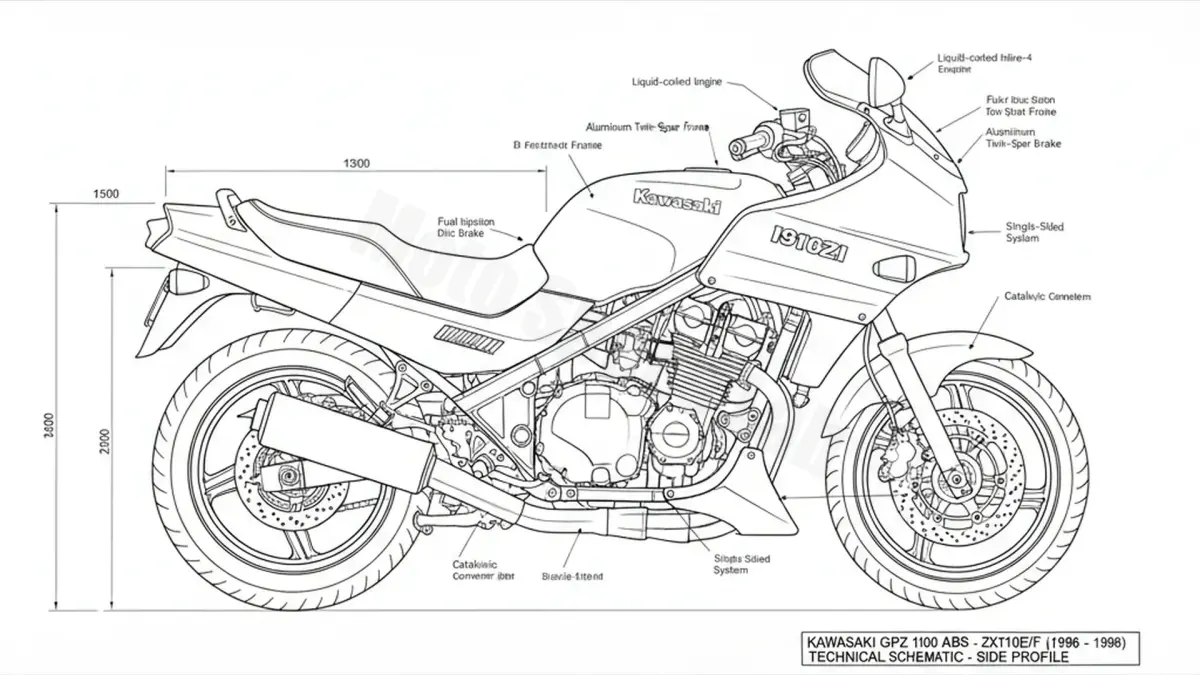
A unique engineering highlight of the Kawasaki GPZ 1100 (ZXT10E/F) is its heart: a strategically detuned version of the legendary ZZ-R1100 (ZX-11) engine. While the ZZ-R was focused on absolute top-speed dominance, the GPZ 1100 was engineered for the ‘sport-touring’ enthusiast. Kawasaki engineers utilized smaller 36mm carburetors and revised cam profiles to shift the powerband, resulting in a machine that offered significantly more usable mid-range torque—ideal for high-speed continental crossings rather than just track-day sprints.
Technical Performance & Handling
The ZXT10E chassis was a steel perimeter design, a departure from the aluminum frames of the more aggressive sportbikes of the era, providing a more compliant and stable ride for long-distance touring. The ‘F’ designation specifically denotes the inclusion of a first-generation ABS system, which was a sophisticated addition for the mid-90s, aimed at increasing safety during wet-weather touring.
Maintenance Guide
Lubrication System
For optimal engine longevity and clutch performance, MotoSpecsLab recommends a high-quality SAE 10W-40 oil meeting JASO MA2 standards. The GPZ is sensitive to oil levels; ensure you account for the 3.2-liter requirement when replacing the filter. A dry fill after an engine rebuild requires 3.7 liters.
Ignition & Electrical
The use of NGK CR9EK plugs is critical. These dual-ground electrode plugs are designed to provide consistent ignition under the high-thermal loads of the 1089cc engine. The gap should be precisely set between 0.7 and 0.8 mm. The YTX14-BS battery provides the necessary cold-cranking amps to turn over the large-displacement four-cylinder engine reliably.
Tires and Safety
Maintaining the specified 36 psi front and 42 psi rear pressure is vital for the GPZ 1100’s handling characteristics. Given the bike’s significant wet weight (approx. 242kg dry), under-inflation can lead to sluggish turn-in and accelerated tire cupping. The 120/70 and 170/60 ZR 17 combination offers a wide range of modern sport-touring rubber options.
MotoSpecsLab Verdict
The GPZ 1100 ABS (ZXT10E/F) remains a masterclass in balanced engineering. It successfully combined the raw power of the Ninja lineage with the ergonomics and reliability required for serious touring. For the modern collector or rider, it represents a durable, high-speed platform that is remarkably easy to maintain with basic mechanical knowledge.
Frequently Asked Questions
Q: What is the recommended tire pressure for the GPZ 1100?
A: For standard operation, the front should be set to 2.5 bar (36 psi) and the rear to 2.9 bar (42 psi).
Q: Can I use synthetic oil in the ZXT10E?
A: Yes, provided it meets the JASO MA2 specification to ensure the wet clutch does not slip.