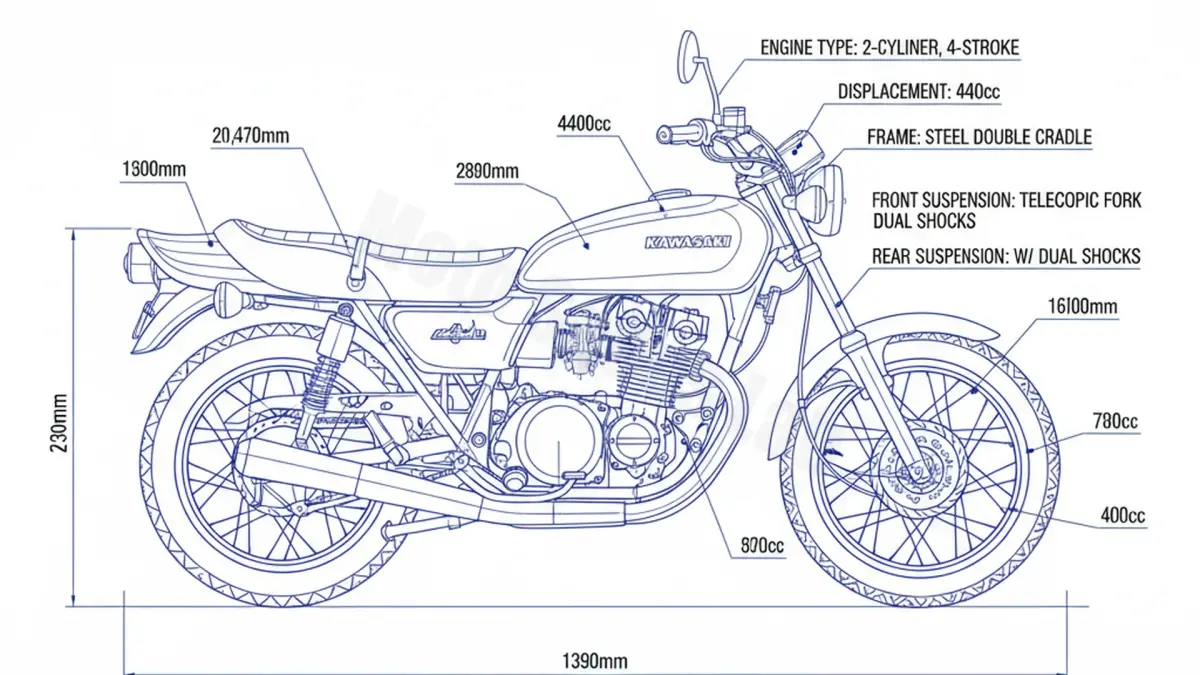
The Kawasaki Z 440 (KZ440) holds a unique place in motorcycling history as the platform that helped pioneer the mass-market application of the Kevlar belt drive. While most mid-sized twins of the early 1980s relied on messy chain drives, the KZ440 LTD variants showcased Kawasaki’s commitment to low-maintenance engineering, offering a cleaner, quieter alternative that set the stage for modern cruiser technology.
| Quick Specs: Kawasaki Z 440 (1980–1984) | |
|---|---|
| Engine Type | Parallel Twin, 4-Stroke |
| Oil Specification | SAE 10W-40 (2.1 Liters) |
| Spark Plugs | NGK B7ES / BR7ES |
| Battery | YB12A-A (12V) |
| Front Tire | 100/90-19 |
| Rear Tire | 130/90-16 (LTD) / 110/90-18 (Std) |
| Tire Pressure (F/R) | 2.0 bar / 2.25-2.5 bar |
Engineering Overview
The KZ440 was an evolution of the earlier Z400, bored out to 443cc to provide a broader torque curve and improved highway manners. The air-cooled, SOHC parallel-twin engine is renowned for its mechanical simplicity and robust bottom end. Utilizing a 180-degree crankshaft, the Z 440 produces a distinct rhythmic exhaust note and manageable vibration levels, making it an ideal candidate for both urban commuting and light touring.
Maintenance & Service Guidelines
Lubrication System
For optimal engine longevity and clutch performance, MotoSpecsLab recommends SAE 10W-40 mineral or semi-synthetic motorcycle-specific oil. The total capacity is 2.1 liters. Regular oil changes every 3,000 miles (5,000 km) are critical for protecting the overhead cam from oil starvation.
Ignition & Electrical
The Z 440 utilizes NGK B7ES or the resistor-type BR7ES spark plugs. Maintaining a clean gap is essential for cold-start reliability. The electrical system is powered by a standard YB12A-A lead-acid battery; however, many modern owners opt for AGM equivalents to minimize the risk of acid overflow damaging the frame finish.
Chassis & Tires
Handling characteristics vary significantly between the LTD (cruiser) and Standard (commuter) models due to rear wheel sizing. The LTD uses a 16-inch rear for a low-slung look, while the Standard uses an 18-inch wheel for more neutral cornering. Ensure tire pressures are maintained at 2.0 bar (Front) and 2.25-2.5 bar (Rear) to prevent uneven wear and heavy steering.
Editorial Verdict
The Kawasaki Z 440 remains a benchmark of early 80s reliability. Its over-engineered top end and the availability of both chain and belt drive variants make it a versatile classic. While it lacks the raw power of the larger Z-series fours, its balance of economy and ‘bulletproof’ mechanicals earns it a high recommendation for vintage enthusiasts and custom builders alike.