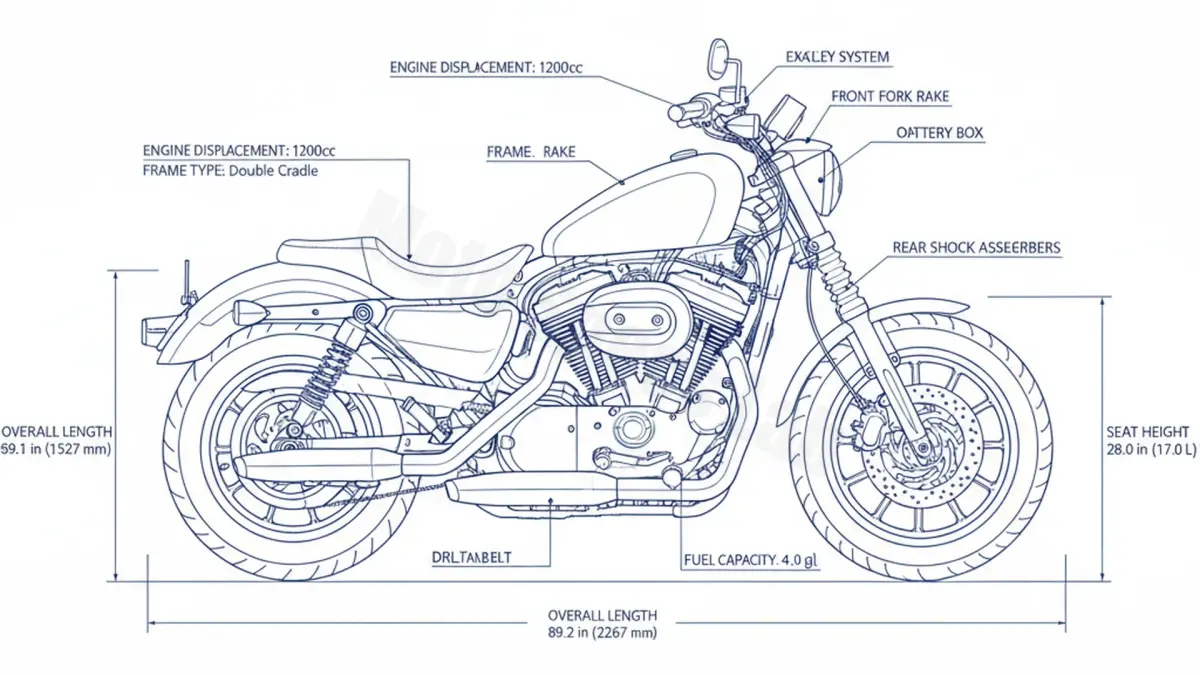
| Engine Type | Evolution® V-Twin, Air-Cooled |
|---|---|
| Oil Specification | 20W50 HD 360 / SYN3 (2.1 L) |
| Front Tire | 130/90B16 67H |
| Rear Tire | 150/80B16 77H |
| Tire Pressure | F: 36 psi / R: 40 psi |
| Battery Type | YTX14L-BS |
| Spark Plug | HD-6R12 |
A pivotal moment in the Evolution-era Sportster lineage occurred in 2011. While the XL1200C nameplate had existed for years, the “11” redesign introduced a radical engineering departure: the “Fat Front End.” By adopting a 130mm front tire on a 16-inch rim—traditionally reserved for heavy cruisers like the Heritage Softail—Harley-Davidson fundamentally altered the Sportster’s center of gravity and gyroscopic stability, bridging the gap between agile urban brawler and stable highway cruiser.
Technical Engineering Analysis
At the heart of the XL1200C is the 1202cc Evolution engine, a mill celebrated for its “tractor-like” torque curve and mechanical simplicity. Unlike the earlier rigid-mount frames, this generation utilizes a rubber-mounted powertrain system. This isolation reduces high-frequency vibrations at cruising speeds (2,500 – 3,500 RPM), though it maintains the characteristic Harley-Davidson idle pulse that enthusiasts demand.
The suspension geometry was specifically recalibrated in 2011 to accommodate the wider Michelin Scorcher tires. The wider triple trees not only provide the necessary clearance for the 130mm front rubber but also increase the bike’s visual mass, giving it a “bulldog” stance that differentiates it from the narrow-front XL1200V or XL883N models.
Maintenance & Service Guidelines
To maintain peak performance and longevity of the Evolution engine, strict adherence to fluid and electrical intervals is mandatory. As Editor-in-Chief of MotoSpecsLab, I recommend the following technical protocols:
1. Lubrication System
The XL1200C utilizes a dry-sump lubrication system. The total capacity is 2.1 Liters (approx. 2.2 US Quarts). We recommend 20W50 (HD 360 or SYN3). Note that checking the oil level must be done when the engine is at operating temperature, with the bike resting on its side stand, to ensure an accurate reading from the oil tank dipstick.
2. Tires and Contact Patch
The 16-inch wheel configuration is sensitive to pressure fluctuations. Maintaining 36 psi (2.5 bar) in the front and 40 psi (2.8 bar) in the rear is critical for preventing “cupping” on the wide front tire and ensuring predictable turn-in response. The 130/90B16 front tire offers a significant contact patch, providing superior braking stability compared to the 19 or 21-inch variants.
3. Electrical and Ignition
The YTX14L-BS battery provides the high cold-cranking amps (CCA) required to turn over the high-compression V-twin. For ignition, the HD-6R12 spark plugs should be inspected every 5,000 miles for carbon fouling or electrode erosion. Proper gapping is essential to prevent hesitation under heavy load.
MotoSpecsLab Verdict
The XL1200C (2011-2019) represents the zenith of the air-cooled Sportster’s evolution as a versatile cruiser. Its unique wheel configuration offers a plush ride quality that belies its Sportster heritage, making it an ideal candidate for riders who want Big Twin aesthetics with the manageable weight of the XL chassis.
Frequently Asked Questions (FAQ)
Q: How often should I change the primary chaincase lubricant?
A: In addition to the 2.1L engine oil, the primary chaincase requires approximately 0.95L of Formula+ lubricant, typically changed every 10,000 miles or annually.
Q: Can I use 10W40 oil?
A: Only in extremely cold climates. For standard operating temperatures, 20W50 is the required viscosity to protect the air-cooled top end from thermal breakdown.